

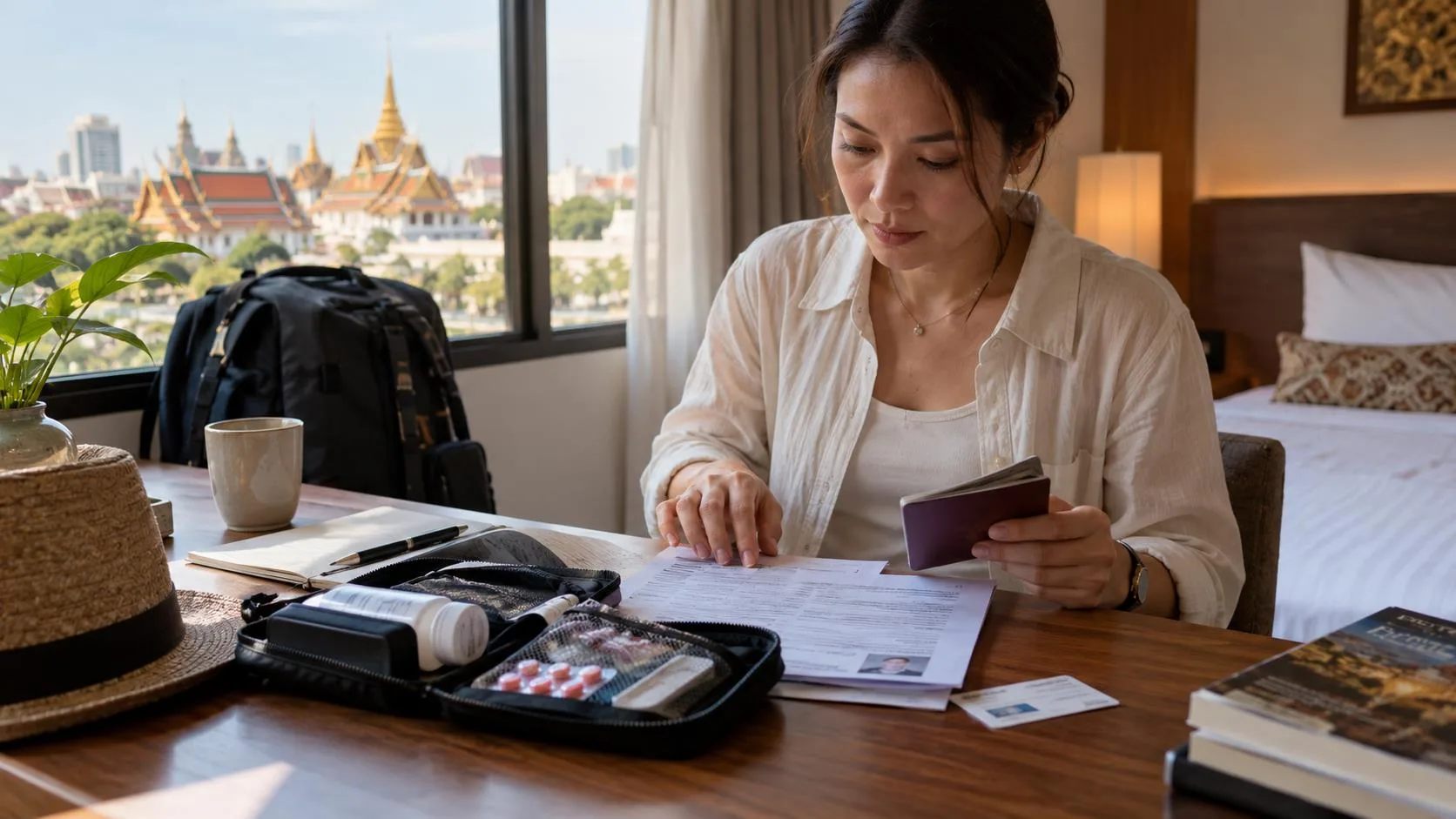
Thailand is welcoming to visitors, but that does not mean every rule is informal or every familiar holiday habit is appropriate. Customs procedures, controlled medicines, drone operation, road use and conduct at religious or royal sites can have legal consequences. Other points are matters of courtesy rather than law, yet they still affect how comfortably a visitor moves through the country.
This guide explains what not to do in Thailand and why. It distinguishes official requirements from cultural advice and avoids treating rumours or isolated anecdotes as law. Rules can change, particularly for border controls, aviation, medicines and regulated products. Check the linked Thai authorities again shortly before travel and ask the relevant authority when your circumstances are unusual.
The article provides general travel information, not legal or medical advice. It cannot determine whether a particular medicine, device, product or activity is permitted in an individual case. Keep prescriptions, permits, insurance documents and booking confirmations available in their original form. If an official instruction at an airport, temple, park or other site differs from an older article, follow the current instruction.
Preparation should be specific to the route. A city break in Bangkok, a diving course on an island and a self-drive journey through several provinces do not create the same obligations. List the planned activities before departure, then check the documents, insurance and permits for each one. Recheck any time-sensitive approval after changing the route. A permit for one activity or place should never be treated as general permission for something else.
Key takeaways
- Do not insult, damage or use royal or religious images as props. Follow current local law and site rules.
- Dress modestly at temples and royal sites, remove footwear where instructed and ask before photographing ceremonies or people.
- Do not carry narcotics, electronic cigarettes or unknown packages across the border. Declare restricted goods and ask Customs when unsure.
- Check every prescription medicine in the Thai FDA traveller system. Some controlled medicines require a permit before arrival.
- Do not fly a camera drone without completing the applicable CAAT and NBTC requirements and checking local site restrictions.
- Do not rent a scooter unless the rider has the correct licence, appropriate insurance, a helmet and genuine experience.
- Do not assume that a wildlife venue is responsible because it uses words such as sanctuary, rescue or ethical.
- For tourist assistance, translation support or an urgent visitor problem, the official Tourist Police hotline is 1155.
Rules of conduct in Thailand

Respect for local traditions
Respect begins with observing the place rather than performing a list of gestures. At a temple, palace, home or community event, look for signs, watch how access is organised and follow staff instructions. Some areas remain active places of worship even when they are also major attractions. A ticket does not give a visitor permission to interrupt prayer, enter a closed room, climb a structure or arrange people and sacred objects for a photograph.
Images of the Buddha, spirit houses, shrines, royal portraits, flags and banknotes should be treated carefully. Do not sit on a statue, climb a monument, place feet against a sacred object or use a religious image as comic scenery. Do not write insulting comments about the monarchy or religion online on the assumption that behaviour outside Thailand is irrelevant. Thai law applies in Thailand, and the safest advice is simple: discuss sensitive subjects respectfully and do not turn them into a provocation.
Some widely repeated etiquette points are cultural guidance, not a licence to stereotype every Thai person. Avoid touching another person’s head, pointing at people with a foot, stepping over someone, or resting feet on a table. When sitting near a shrine or monk, keep feet directed away from people and sacred images where practical. If a mistake occurs, stop, apologise calmly and follow the correction. A sincere, quiet response is more useful than arguing about what another travel blog claimed.
Monks follow religious rules that may shape how objects are passed and how physical contact is handled. Women should avoid touching a monk or handing an item directly when a temple provides another method. Men should also respect personal space and local instructions. Customs differ by setting, so observe the arrangement instead of forcing a theatrical wai or an unnecessary physical greeting.
Staying safe in public places
Thailand is not one uniform risk environment. A crowded station, nightlife district, remote trail and quiet hotel each require different precautions. Keep passports, phones and money secure in crowded places. Use a hotel safe or another secure arrangement for documents not needed during the day, while carrying the identification required for the activity. Save copies of essential documents separately, but remember that a photograph may not replace the original when an authority requires it.
Do not accept drinks, food, transport or packages from strangers when the terms are unclear. Never carry someone else’s luggage through an airport or border, even as a favour. Confirm taxi, boat and activity prices before departure and keep the booking record. When using an app, compare the vehicle and driver with the booking before entering. A polite refusal is enough. There is no need to debate with a persistent seller or follow a stranger to a second location.
Avoid political demonstrations and areas where police have restricted access. Travellers cannot reliably judge whether a gathering will remain peaceful or how quickly transport routes will close. Check current local notices and your government’s travel advice when an event is developing. Do not claim press status, film security operations or enter a cordoned area without authority.
If a visitor needs immediate tourist assistance, translation help or support after a suspected scam or theft, contact the Thailand Tourist Police on 1155. For a medical emergency, ask hotel staff, the tour operator, police or a nearby responsible person to contact the appropriate emergency service and give the exact location. Do not delay urgent care while searching for the perfect English-language hospital review.
Keep the accommodation name and address in Thai, the group’s emergency contact and the insurance assistance number on each phone and on paper. A mobile signal, battery or roaming service can fail at the worst moment. Agree where the group will meet if separated. Children should know which adult to contact and should not display their name, hotel room or full itinerary publicly.
Dressing appropriately for Thai culture
Beach clothing belongs at the beach or pool. At temples, royal sites, government buildings and formal community settings, choose clothing that covers shoulders and knees. Some locations apply a stricter dress code and may reject scarves used as an improvised cover. Check the site’s current visitor information before arriving. Carrying a light shirt and long trousers or a long skirt prevents many problems without requiring heavy clothing in the heat.
Remove shoes where signs or local practice require it, particularly before entering some temple buildings, homes and small businesses. Place footwear without blocking the entrance. Socks may not solve a rule that requires bare feet, and disposable shoe covers are not automatically accepted. If protective footwear is required for mobility or medical reasons, contact the venue in advance rather than assuming an exception.
Clothing advice should remain practical and non-judgemental. Visitors do not need to imitate ceremonial dress or buy an outfit marketed as traditional. Avoid clothing with offensive religious, political or sexual imagery. In rural communities and family settings, modest clothing often makes interaction easier. In nightlife areas, more relaxed dress does not remove the need to respect staff, performers and other guests.
Heat and sun protection still matter. Choose breathable fabric, a hat for outdoor areas and footwear suitable for wet or uneven ground. Do not reduce sun exposure by ignoring a temple dress rule, and do not meet the rule with clothing that creates a heat risk. Plan shade and water breaks, particularly for children, older travellers and anyone taking medication that affects heat tolerance.
Culture and customs
The role of religion in Thailand
Buddhist temples are prominent across Thailand, while Muslim, Christian, Hindu, Sikh and other communities are also part of the country. Avoid reducing Thai culture to a single belief or assuming that every resident follows the same custom. At any religious site, treat worship as the primary activity and tourism as secondary. Speak quietly, silence calls and do not walk between a worshipper and the object of worship for a photograph.
Photography rules differ. Exterior photographs may be allowed while a chapel, museum room, ceremony or artwork is restricted. A lack of a visible prohibition does not always mean that flash, tripods, drones or commercial filming are permitted. Ask staff before photographing monks, worshippers, children or a ceremony. Do not publish a recognisable person’s image in a humiliating or misleading context.
Buddha images and some cultural objects can be subject to export controls, especially antiques, fragments and objects represented as historic. A shop receipt does not necessarily replace an export permit. Before buying an old or unusually valuable object, check the current requirements with the relevant Thai authority and Customs. Do not remove objects, stones, tiles or plant material from a religious or archaeological site.
Festivals can temporarily change access, alcohol sales, traffic and acceptable behaviour. Songkran is associated with water, but not every person, device, vehicle or religious setting is an invitation to be soaked. Loy Krathong and local lantern events may have environmental and fire-safety restrictions. Follow municipal and venue instructions rather than copying an activity seen in an old video.
Respect also applies to commerce and creative work. Ask before recording a craft demonstration, performer or market trader at close range. Do not represent a private workshop, religious ritual or community visit as a free photo set. Buy only when the terms are clear, keep receipts for significant purchases and avoid claims that a souvenir is authentic, antique or locally made unless the seller can substantiate them.
Interpersonal etiquette
The wai is a Thai greeting and sign of respect, but visitors do not need to calculate a perfect hand height for every encounter. A smile, slight nod and polite greeting are usually sufficient when unsure. Do not initiate a wai to very young children or service staff merely as a performance. Respond naturally when greeted and follow the tone of the situation.
Calm communication is effective, especially when a booking, bill or route is disputed. Raising a voice, pointing aggressively or humiliating a worker in front of other people can make resolution harder. State the problem clearly, show the written booking or receipt and ask for a supervisor or Tourist Police assistance if needed. Politeness does not require accepting fraud, unsafe service or a charge that was never agreed.
Personal space and physical contact vary between individuals. Do not touch a stranger’s head, hug people without invitation or treat staff as part of the entertainment. Ask before photographing, particularly in markets, homes, workshops and minority communities. A payment for a tour does not purchase unlimited access to private life.
English ability varies. Use short, respectful sentences, written addresses and maps rather than interpreting a misunderstanding as dishonesty. Avoid jokes that depend on sarcasm or sexual language in a formal setting. Learn a few courteous Thai phrases if possible, but do not mock pronunciation or imitate an accent.
Common mistakes made by tourists
One common mistake is treating every rule as negotiable because a vendor, driver or other traveller says enforcement is relaxed. An informal assurance cannot authorise a prohibited import, unlicensed vehicle, closed park trail or drone flight. When the consequence matters, use the responsible government agency or the site’s written rule.
Another mistake is assuming that a famous attraction is always open and that anyone announcing a closure must be correct. Check the official entrance, website or verified operator. Some scams begin with a claim that a temple is closed and an invitation to an alternative shop or ride. Genuine temporary closures also occur, so the answer is verification, not automatically dismissing every warning.
Do not photograph people in distress, accident victims, police operations or religious ceremonies for social media attention. Do not climb onto roofs, railway tracks, cliff edges or closed structures for a better angle. A popular location in an image may be private, restricted or unsafe under current conditions.
Visitors also create problems by planning every day to the minute. Heat, storms, traffic, queues and changed boat operations require flexibility. Leave time for meals, hydration and transfers. A private itinerary can be adjusted to a closed group, but it cannot override weather, park, aviation or safety decisions. AsiaTrip’s English service is for one private closed group of 4 to 20 guests, with an individual quote in THB, and does not combine unrelated customers.
Online arguments are another avoidable risk. Do not publish a passport, boarding pass, hotel key, licence plate or another person’s private details while trying to report a problem. Save the evidence privately and use the booking platform, insurer, police or relevant authority. Reviews should describe verifiable experience without threats, invented criminal allegations or identifying a staff member who was not involved.
Law and regulations
Alcohol regulations
Alcohol sales and consumption are regulated by age, place, licence, date and time. Restrictions can also apply on election days and certain religious dates. Because the details and exemptions can change, do not build a travel plan around an old list of sales hours. Ask the licensed venue or retailer what can legally be sold at that time and respect a refusal.
Do not drink in a temple, government building, school, petrol station or other place where alcohol is prohibited. Public drinking can also be inappropriate or restricted at particular beaches, parks and events. A sealed bottle bought legally does not create a right to open it everywhere. Hotels and event venues can impose their own rules in addition to national or local law.
Never drive, ride a scooter, operate a boat or join a risky water activity after drinking. A person who feels capable can still have impaired judgement and may invalidate insurance or face legal consequences. Plan the return journey before the first drink and use a sober licensed driver or recognised transport option.
Keep the group together without pressuring anyone to drink. Watch a drink being prepared, do not leave it unattended and seek help if someone becomes unusually confused, unresponsive or ill. Do not diagnose the cause yourself. Ask venue staff for assistance and arrange urgent medical care when symptoms are serious.
Drug laws
Do not possess, purchase, transport or use illegal drugs in Thailand. Never accept a package or substance from a stranger, and do not assume that a small quantity will be treated casually. The legal classification and consequences depend on the substance and circumstances, so a simplified claim about a universal penalty is unreliable. The practical rule is to avoid unknown and illicit substances completely.
Cannabis rules have changed repeatedly and remain a poor subject for assumptions based on a shop sign or an old article. Do not carry cannabis, cannabis food, extracts or related products across Thailand’s border without current written authority. Public use, sale, medical use and possession can be subject to different rules. Check the current Thai authority guidance immediately before travel rather than relying on a social-media summary.
Prescription medication can also be controlled. The Thai FDA traveller permit system allows visitors to check medicines and permit requirements. Thai FDA guidance distinguishes ordinary medicine from narcotic and psychotropic substances and applies different quantity and documentation rules. Start the check well before departure because some controlled medicines require a permit application in advance.
Keep medicine in its original labelled packaging and carry the prescription or medical certificate requested by the authority. The document should identify the patient, medicine, dose and medical need. Do not combine tablets in an unlabelled container for the flight. If the medicine or active ingredient cannot be found in the checker, contact Thai FDA rather than guessing from the brand name.
Do not share prescription medicine with another traveller or buy controlled medicine from an unverified online seller. A medicine available without difficulty elsewhere can have a different status in Thailand, while the same brand can contain a different formulation. Carry enough legitimately prescribed medicine for the permitted period, allow for travel disruption within the authority’s rules and keep it in hand luggage when temperature and airline rules permit.
Environmental protection and animal welfare
Do not remove coral, shells, plants, rocks or wildlife products from beaches, reefs, caves, parks or protected areas. An object that appears abandoned can still be protected, important to the ecosystem or restricted by Customs. Do not buy products made from protected species. If the origin of an object is unclear, leave it and ask the responsible authority.
Marine rules protect visitors and habitats. Do not stand on coral, chase animals, feed fish or anchor in a prohibited area. Follow park officers and boat crew when they restrict a site because of currents, weather or conservation measures. A tour price does not include permission to ignore a national park closure.
Assess wildlife attractions carefully. Avoid elephant riding, forced bathing, performances, close handling of wild animals and photo props that depend on restraint or sedation. Words such as ethical, rescue and sanctuary are not, by themselves, proof of welfare standards. Ask how contact is managed, where animals came from, whether breeding occurs and what an independent welfare policy actually prohibits.
Do not feed monkeys or other wildlife, even when other visitors are doing it. Feeding changes behaviour and can lead to bites, scratches, theft of food and conflict with residents. Keep distance, secure loose objects and follow local warnings. Seek medical advice promptly after an animal bite or scratch because the need for treatment is time-sensitive and cannot be assessed from the animal’s appearance.
Prohibitions and restrictions
What is prohibited at sacred sites
Do not enter a closed room, pass a barrier or climb a chedi, altar, statue or archaeological structure. Do not sit with feet pointed towards a principal Buddha image where the site asks visitors to kneel or sit differently. Keep food, alcohol and smoking away from worship areas. Turn off loud audio and do not use a drone over the site without all required permissions.
Some temples prohibit photographs in particular interiors, while others restrict flash, tripods or commercial filming. Follow the current sign and staff instruction. Do not touch murals or objects, move offerings for a composition, or place a bag on an altar. Parents should supervise children without treating the site as a playground.
Dress codes can be enforced at the entrance. Clothing that is accepted at one temple may be refused at another, especially at a royal site. Prepare suitable clothing rather than arguing that another visitor was admitted. Accessibility needs should be discussed with staff, as ramps, lifts and permitted routes vary considerably.
Religious souvenirs require judgement. A newly made decorative item sold openly is different from an antique, archaeological object or fragment. The Thai Customs list of prohibited and restricted goods identifies Buddha images, artefacts and antiques as examples of goods that may require permission from the Fine Arts Department.
Restrictions on bringing items into the country
Use Thailand’s red or green Customs channel correctly. The green channel is for travellers who have nothing to declare and no prohibited or restricted goods. When an item needs a permit, exceeds the applicable allowance or is intended for commercial use, use the declaration process. If unsure, declare it or ask Customs before passing the control point.
Thai Customs lists narcotics, pornographic materials, counterfeit currency, intellectual-property infringing goods and certain protected wildlife as prohibited examples. Restricted categories can include medicine, food supplements, plants, animals, cosmetics, firearms, communications equipment and cultural objects. A permit from the responsible agency may be required before arrival. The list is not a substitute for checking the exact item.
Electronic cigarettes, vaping devices and related liquids are prohibited imports. Do not pack them because they are common or legal in the country of departure. Thai Customs publishes an official electronic-cigarette import notice. Hookahs and barakus are also identified as prohibited in inbound passenger guidance.
Customs allowances for alcohol and tobacco are quantity-specific and can change. The current official inbound guidance should be checked immediately before travel. Do not divide goods among passengers who do not genuinely own or carry them to disguise an excess. Keep purchase evidence when relevant and use the declaration channel when over the permitted amount.
Food, seeds, fruit, plants, animal products and supplements can also be controlled even when they look harmless or are intended as gifts. Packaging from a supermarket is not an import permit. Check the responsible Thai agriculture, livestock or food authority before travel. On departure, the destination country can impose a second set of restrictions, so a product legally bought in Thailand is not automatically legal to take home.
Drone restrictions
Do not assume that a small consumer drone or a brief holiday flight is exempt. Current Civil Aviation Authority of Thailand guidance states that camera-equipped drones require registration, as do heavier drones without cameras. It explains that both CAAT and NBTC requirements can apply.
CAAT registration for the aircraft and pilot certificate is handled through the official UAS Portal. NBTC permission concerns radio-frequency use. Complete the relevant steps and receive approval before flying. Do not rely on a retailer, hotel or tour seller saying that registration is unnecessary.
Registration does not authorise every flight. Airports, military areas, royal locations, national parks, temples, private property, events and densely populated areas can have separate restrictions or permission requirements. Temporary airspace controls can also apply. Check the flight location and date with the competent authority and obtain landowner or site permission where required.
Maintain visual control, respect privacy and follow the operating conditions attached to the registration and location. Do not fly over crowds, emergency operations or wildlife for a dramatic shot. If the conditions, insurance or authority are unclear, keep the drone grounded. A missed video is less serious than an unsafe or unauthorised flight.
Transporting a drone also requires planning. Check airline battery rules, protect terminals and pack equipment according to the carrier’s instructions. Registration records, pilot credentials, insurance and site permission should be available during the flight. Do not borrow or rent an aircraft and assume that the owner’s paperwork automatically covers a different pilot.
Safety and health
Personal safety while travelling
Road traffic is one of the most significant practical risks for visitors. Do not learn to ride a scooter during a holiday. A rider needs the correct licence for the vehicle category, any required international documentation, valid insurance and a properly fastened helmet. A rental shop handing over keys does not confirm legal eligibility or insurance cover.
Inspect a rental vehicle before use and photograph existing damage. Read the deposit, repair and fuel terms. Do not leave a passport as security if a safer documented deposit arrangement is available. After any collision, prioritise safety and medical help, document the scene when safe, contact the insurer and obtain Tourist Police support if communication is difficult.
On boats, use a life jacket that fits and follow the captain’s safety briefing. Do not board an obviously overloaded vessel or pressure a captain to sail against a weather decision. Protect medicines and documents from water and tell the crew about mobility limitations. Sea conditions can change even on a route that appeared calm in the morning.
Protect valuables without becoming isolated. Tell someone where a remote hike, dive or boat trip is going and when the group expects to return. Use a reputable operator and keep emergency contact details offline. Do not enter caves, waterfalls, cliff routes or forest trails after closure or against ranger advice.
Vaccinations and health precautions
Health preparation depends on the traveller’s medical history, itinerary, season, activities and previous vaccinations. Consult a qualified travel-health professional early enough for any recommended course to take effect. Use current official public-health and entry information rather than a generic list copied from another traveller.
Prevent mosquito bites with suitable repellent, clothing and accommodation measures, particularly around dawn, dusk and vegetated areas. No single measure removes all risk. Seek medical advice for fever or significant illness during or after travel and explain the itinerary. Do not self-diagnose from symptoms described in a blog.
Food safety is about handling and turnover, not whether a meal is sold on the street or in a hotel. Choose food cooked thoroughly and served hot, wash or sanitise hands and use safe drinking water. People with severe allergies should carry translated information and emergency medication prescribed for them. Cross-contact cannot be ruled out merely because staff understand the ingredient list.
Travel insurance should match the activities. Check exclusions for scooters, diving, alcohol, pre-existing conditions, remote evacuation and unlicensed operation. A policy card alone is not proof that every planned activity is covered. Keep the assistance number and policy details accessible to another member of the group.
Sun exposure, air quality and marine hazards deserve the same preparation as infectious disease. Check current air-quality information before prolonged outdoor exercise, particularly during smoke episodes in the north. At sea, protect against sun and dehydration even in cloudy weather. Do not touch jellyfish or unknown marine life, and follow local first-aid guidance rather than applying a popular remedy without knowing the species or injury.
What to do after an accident or sudden illness
Move away from immediate danger if it is safe to do so and request professional help. Give the exact location, visible landmarks, number of people affected and the nature of the incident. Use a map pin when language makes the address difficult. Do not move a seriously injured person unless remaining in place creates a greater danger.
For visitor assistance and translation support, call Tourist Police on 1155. Hotel staff, attraction staff, a licensed guide or local police can help contact the appropriate ambulance or emergency service. In remote areas, the operator should have a specific emergency plan. Ask about it before joining a demanding trail, dive or boat trip.
Contact the travel insurer as soon as practical, but do not postpone urgent treatment while waiting for an insurer to answer. Keep medical reports, prescriptions, invoices and payment receipts. If a hospital requests a deposit or guarantee, ask the insurer how direct billing works while continuing medically necessary care.
After theft or an accident involving another party, obtain an official report when required by the insurer or embassy. Do not sign a Thai-language statement you do not understand without translation or advice. Photograph relevant documents and damage when safe, preserve messages and booking records, and avoid publishing accusations before the facts are established.
Embassies and consulates can assist with lost passports and explain available consular support, but they do not replace local police, courts, hospitals or insurers. Save the contact for the embassy responsible for the traveller’s nationality before departure. When a passport is lost, report it promptly and confirm both the replacement-document process and any immigration steps needed to leave Thailand legally.
Adapting to the climate and local conditions
How to cope with the heat
High heat and humidity can affect healthy travellers as well as people with known conditions. Start outdoor days earlier, reduce the number of stops and schedule shade or air-conditioned breaks. Drink regularly and eat normally enough to replace energy and salts. Alcohol is not hydration and can make judgement about heat symptoms worse.
Wear breathable clothing, a hat and suitable sunscreen, and reapply it after swimming or heavy sweating. Children, older adults, pregnant travellers and people taking certain medicines may need more conservative plans. Ask a clinician about individual risk rather than changing prescribed medication independently.
Confusion, fainting, severe weakness, vomiting or altered behaviour can indicate a serious heat illness. Stop the activity, move the person to a cooler place and seek urgent medical help. Do not continue a tour because a ticket was expensive or because the group is close to the final viewpoint.
Air-conditioning creates another practical issue. Moving repeatedly between intense heat and very cold interiors can be uncomfortable, and dehydration remains possible indoors. Carry a light layer for long vehicle journeys and keep water available. Build acclimatisation into the first days instead of scheduling the hardest activity immediately after a long flight.
Preparing for the monsoon season
Thailand does not have one identical rainy season across every coast and province. Weather patterns differ between the Andaman coast, Gulf islands, Bangkok, the north and mountain areas. Historical averages are useful for planning but cannot predict the exact travel day. Review current forecasts and official warnings close to departure and throughout the trip.
Heavy rain can close caves, waterfalls, park trails, piers and roads with little notice. Do not bypass a closure or pressure an operator to continue. Flash flooding and strong currents may develop away from the place where rain is visible. A blue sky at the hotel does not prove that a mountain or offshore route is safe.
Use waterproof protection for documents, phones and essential medicines. Choose footwear with grip and keep luggage manageable for wet boat landings. Leave a buffer before important flights when the itinerary depends on ferries or remote roads. A missed connection caused by weather is easier to manage when the schedule is not built to the last minute.
Travel insurance terms for weather disruption vary. Read the conditions for delay, cancellation and abandoned travel before the event occurs. Keep operator notices and receipts if a claim becomes necessary. A forecast alone may not trigger cover, while an official cancellation might.
Driving conditions can deteriorate quickly during intense rain. Visibility falls, standing water hides damaged road surfaces and mountain routes can be affected by runoff or landslides. Do not continue because the hotel is already paid for. Stop in a safe place, follow road closures and ask the accommodation or operator to help revise the arrival plan.
Rules for rest and relaxation
A holiday does not need continuous activities. Fatigue increases the risk of falls, poor transport decisions, dehydration and conflict. Alternate demanding days with lighter ones and allow sleep after overnight travel. Children and older relatives may need a different pace from the person who planned the itinerary.
At beaches and pools, follow flags, lifeguards and opening rules. Do not swim alone in rough conditions, after drinking or outside a safe depth for the swimmer. Inflatable toys are not safety devices. Supervise children directly rather than assuming that a resort or boat crew has taken over that responsibility.
Massage and wellness venues should explain services, prices and boundaries clearly. Choose a reputable establishment and communicate health conditions or injuries that affect treatment. A traditional or natural label does not prove that a treatment is appropriate for every person. Do not replace medical care with a spa treatment for an injury or illness.
Respect hotel quiet hours, smoking rules, occupancy limits and property boundaries. Do not fly a drone, host a party or invite unregistered visitors against the accommodation rules. Check what the booking includes and report problems promptly so the property has a chance to resolve them.
Water activities need recovery time as well. Follow recognised diving guidance about fitness, alcohol and the interval before flying or travelling to altitude. Only a qualified instructor or medical professional can assess an individual concern. Do not add a dive on departure day merely because a gap appeared in the schedule.
Conclusion: prepare carefully without travelling in fear
Most problems are avoided by a small number of habits: use official sources for regulated matters, keep documents organised, ask before entering or photographing, choose licensed transport and operators, and accept a safety decision even when it changes the plan. Courtesy and caution are not signs that Thailand is unusually difficult. They are normal responsibilities in a country with its own law, religion, communities and environment.
Do not memorise penalties from sensational articles. Rules change, facts depend on circumstances and only the competent authority can decide a particular case. Check Customs for goods, Thai FDA for medicine, CAAT and NBTC for drones, park authorities for protected areas and the site’s own instructions for access and dress.
For route planning, AsiaTrip serves private closed groups of 4 to 20 guests. Unrelated customers are not combined. The programme and inclusions are agreed individually and the quote is prepared in THB. This does not change public law, park rules, weather decisions or the responsibilities of the traveller.
Use the English trip-planning form to describe the group’s dates, route and practical needs, or browse the private tour catalogue. For entry documentation, read the separately maintained Thailand entry and visa guide and verify the official requirements for the passport used.
Official information to recheck before travel
- Thailand Tourist Police for visitor assistance information and the official 1155 contact.
- Thai FDA traveller permit system for current medicine classifications, documents and permit instructions.
- Thai Customs passenger guidance for prohibited, restricted and declarable goods.
- Civil Aviation Authority of Thailand drone guidance and the official UAS Portal for current registration information.
Open these official pages again shortly before departure. A working link and the article’s publication date do not guarantee that a rule, permit process or temporary restriction has remained unchanged.
FAQ
Can I bring my prescription medicine to Thailand?
It depends on the active ingredient, schedule, quantity and documents. Check the medicine in the Thai FDA traveller permit system. Some ordinary medicine may be carried for personal use with appropriate packaging and prescription, while controlled narcotic or psychotropic medicine can require a permit before arrival. Do not rely only on the brand name.
Can I bring a vape or electronic cigarette?
Thai Customs identifies electronic cigarettes, devices and related liquids as prohibited imports. Do not pack them for entry into Thailand, even if they are legal at home.
Can I fly a drone on holiday?
Not simply because the drone is small. Camera drones and other specified aircraft require CAAT registration, and NBTC requirements can apply. The pilot, aircraft, flight location and site permissions must all comply. Complete approval before flying and check temporary restrictions.
What should I wear at a temple?
Use modest clothing that covers shoulders and knees, and remove footwear where instructed. Royal sites and individual temples can apply stricter rules, so check the official visitor information. Avoid clothing with offensive religious or political imagery.
Is it safe to rent a scooter?
A scooter is not an appropriate choice for an inexperienced rider. The rider needs the correct vehicle-category licence, required international documentation, a helmet, suitable insurance and genuine experience in local traffic. A rental shop’s willingness to hand over a scooter does not prove legal or insurance compliance.
Can I take shells, coral or Buddha images home?
Do not remove natural material from beaches, reefs, parks or protected sites. Buddha images, antiques and cultural objects can require permission. Check the exact item with Thai Customs and the responsible authority before purchase or export.
How should I respond if I make an etiquette mistake?
Stop the behaviour, apologise calmly and follow the instruction. Do not argue from an old guide or copy another visitor. Most accidental courtesy mistakes are best handled with respect and a willingness to correct them.
Who can help a tourist in an urgent problem?
The official Tourist Police hotline is 1155 and offers tourist assistance and translation support. For immediate medical danger, ask a responsible local person or authority to contact the appropriate emergency service and provide the exact location.

No comments