

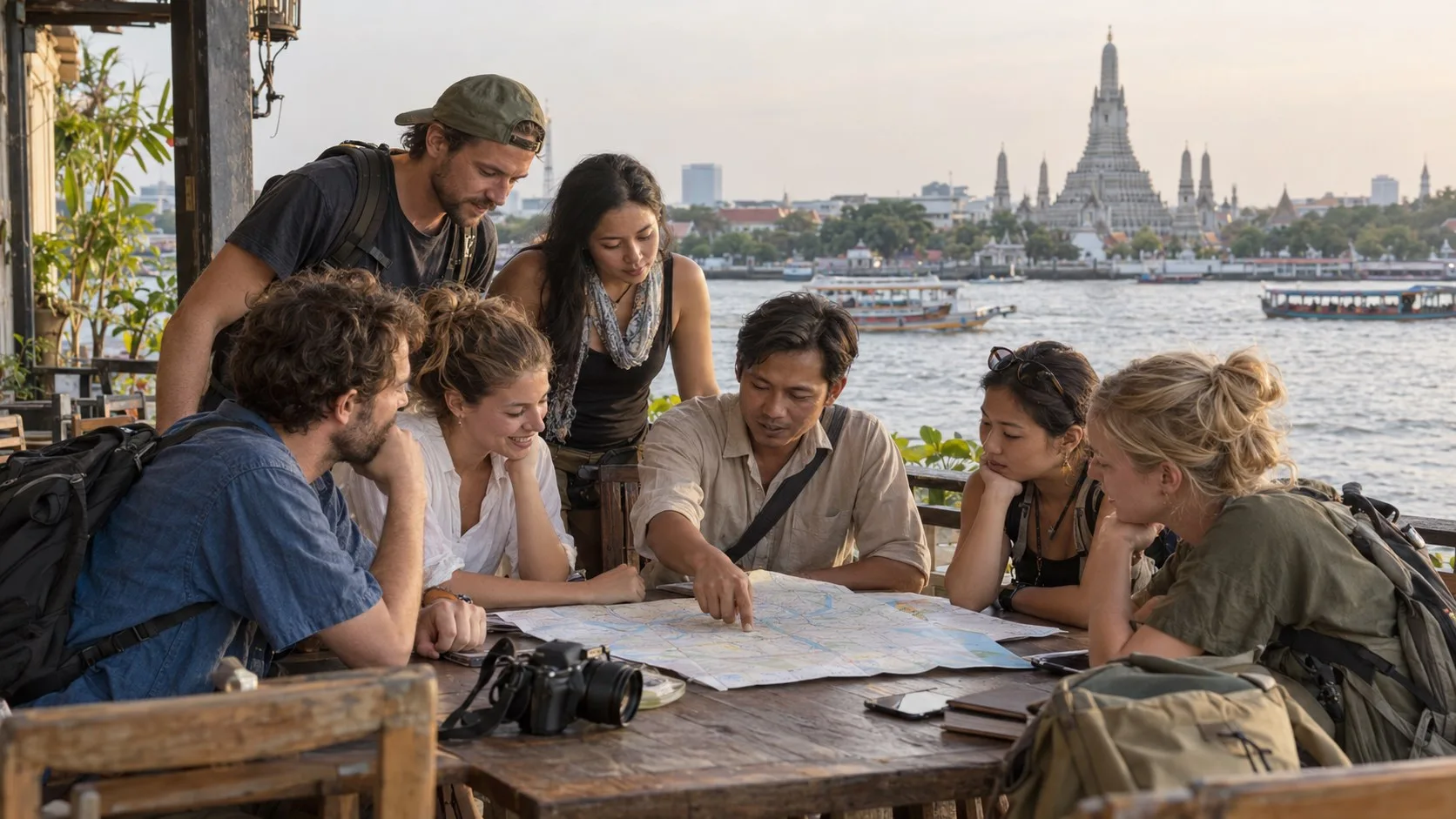
Thailand rewards careful planning because the country offers several very different journeys within one trip. Bangkok, the former capitals, northern cities, national parks and southern islands do not share one climate, one transport system or one natural pace. A route that looks compact on a map can involve a domestic flight, a long road transfer, a ferry and an early hotel departure. The best plan is therefore not the one with the longest list of attractions. It is the one that gives each region enough time and makes every transfer, inclusion and responsibility clear before the group travels.
This guide explains how to compare routes, transport and private services without relying on exaggerated promises. It is written for travellers considering an independent holiday, a privately coordinated itinerary or selected days with a licensed guide. It covers Bangkok, Ayutthaya, Kanchanaburi, Chiang Mai, Phuket, Krabi, Koh Samui and nearby islands, while recognising that weather, timetables and supplier conditions can change.
AsiaTrip EN prepares itineraries for one existing closed group of 4 to 20 guests. Unrelated customers are not combined. Every proposal is quoted individually in THB, and there is no public package price. A private format describes who travels together; it does not automatically mean that every vehicle, guide, admission, meal, flight or boat is included. Those services must appear in the written proposal.
What makes Thailand so varied?
Thailand can feel like several destinations joined by one national transport network. Bangkok is a dense river city with historic temples, modern rail lines, markets and neighbourhoods that change character within a few stations. Ayutthaya presents the remains of an earlier capital in an open archaeological landscape. Kanchanaburi combines difficult twentieth-century history with rivers, forest and waterfalls. Chiang Mai brings the old city, northern food, craft traditions and mountain routes into the same programme.
The southern coasts add another contrast. Phuket is a large island with an international airport, busy resort areas and road journeys that can take longer than expected. Krabi combines mainland beaches, limestone scenery and boat connections. Koh Samui sits in the Gulf of Thailand and has its own airport and ferry links. Phi Phi, Hong Islands and Ang Thong are reached by boat, which means that wind, sea conditions and operator decisions matter as much as the itinerary printed before departure.
This variety is the main reason not to describe Thailand as a single resort holiday. A traveller can spend the morning beside Bangkok’s Chao Phraya River, continue through a busy market district and later fly south to an island. The experiences are connected, but they require different clothing, timing, safety decisions and expectations. The route should show these changes rather than hide them behind a phrase such as “see everything”.
Entry formalities also belong in the planning stage. Thailand’s Immigration Bureau currently requires non-Thai nationals to submit the Thailand Digital Arrival Card before entry, generally within the three days preceding arrival. The rules, exemptions and form can change, so travellers should use the official Thailand Digital Arrival Card service shortly before travel rather than copying instructions from an old article. Passport validity, visa status, insurance and health requirements remain the traveller’s responsibility unless a written service explicitly states otherwise.
Season is equally important. The Tourism Authority of Thailand explains that the country’s weather is shaped by monsoons, but the practical pattern differs between central Thailand, the north, the Andaman coast and the Gulf coast. “Rainy season” does not mean constant rain every day, and “dry season” does not guarantee clear seas or uninterrupted transport. Check the official Tourism Authority of Thailand weather information and a current forecast for every region in the route.

Which places belong in a first Thailand itinerary?
There is no mandatory list, but a first journey usually works better when it combines two or three types of place rather than trying to cross the whole country. Bangkok is a practical arrival point and deserves more than a transfer night. Ayutthaya can be visited from Bangkok or included on a route north. Kanchanaburi requires more time because the historic sites, Erawan Falls and the River Kwai area are spread across the province. Chiang Mai becomes worthwhile when the itinerary allows several days rather than a rushed flight and one evening.
A southern stay should be chosen by coast, season and the group’s preferred pace. Phuket offers the widest range of flights, accommodation and services, but it also has busy roads and highly developed resort zones. Krabi suits travellers interested in limestone scenery and boat excursions, although different beaches and piers create different logistics. Koh Samui can be convenient for Gulf islands, while Koh Phangan and Koh Tao add ferry transfers and their own seasonal considerations.
Bangkok, Ayutthaya, Kanchanaburi and one beach region can form a balanced route. Another sensible option combines Bangkok, Chiang Mai and an island. A longer journey may include all four regions, but domestic travel days must remain visible. Moving from Kanchanaburi to Chiang Mai, for example, is not the same as taking a short city transfer. The group may need to return towards Bangkok, use a train or fly after a road connection.
Market visits need the same discipline. Damnoen Saduak Floating Market, Amphawa Floating Market and Maeklong Railway Market are different places with different operating patterns. Maeklong depends on an active railway timetable, while Amphawa is associated with particular days and later hours. A combined market plan must use current information. The detailed Damnoen Saduak and Maeklong route guide explains how to build the day around a verified train movement and a clearly defined boat service.
Animal attractions should never be added simply because a route passes nearby. “Sanctuary”, “ethical” and “rescue” are not protected guarantees of welfare. Ask whether animals perform, carry visitors, are restrained for photographs or have the ability to move away from contact. If reliable current evidence is not available, leave the activity out. A route can be complete without an animal encounter.
Food also deserves realistic language. A local restaurant may be excellent, but popularity or a recommendation does not prove hygiene, allergen control or suitability for every traveller. A guide can explain a dish and help communicate preferences when that service is included. The customer still makes the final food choice and should seek medical advice before travel when allergies or health conditions require a specific plan.
Bangkok: how to enjoy the city without fighting it
Bangkok works best when the itinerary is organised by neighbourhood and transport corridor. The Grand Palace, Wat Pho and riverside sites fit together more naturally than a day that repeatedly crosses the city. Wat Arun can be reached from the river, while Chinatown, Talat Noi and the historic district can form another route. Modern shopping areas, Jim Thompson House and parks belong to different transport patterns. Grouping places reduces time spent in traffic without pretending that delays can be eliminated.
The first day after a long flight should remain flexible. Immigration, baggage, airport transfers and hotel check-in can take longer than a schedule suggests. A short neighbourhood walk or an optional evening meal is safer than a prepaid attraction that becomes impossible after a delayed arrival. The same principle applies before departure. Leave a proper margin for the airport rather than treating the fastest journey shown by a map as a promise.
Heat changes how much a group can comfortably cover. Temples and outdoor markets can feel demanding even when the distance is short. Carry water from a trusted source, use sun protection and include shaded or air-conditioned breaks. A midday pause does not waste the day. It can make the afternoon more enjoyable and reduce the temptation to rush through religious sites or busy crossings.
Bangkok’s river is both an attraction and a transport route. Public boats, private charters and dinner cruises are separate products. Confirm the pier, vessel, route, duration, meal conditions and return point before boarding. River traffic, water levels and weather can affect operations. “Private” should refer to the actual vessel or reserved service, not merely to a private booking enquiry.
A market excursion outside Bangkok may require an early departure. The value lies in seeing a working place and understanding its context, not in turning vendors into scenery. Ask before taking close portraits, do not block a stall and follow staff instructions beside active roads or railway tracks. The train at Maeklong is operating transport infrastructure. No photograph justifies standing outside the designated safe area.
For emergencies or serious problems, the coordinator is not a substitute for the authorities. Thailand’s Tourist Police publish the hotline `1155` and offer assistance to visitors. Save the official Tourist Police information, the hotel address and travel-insurance contact details. For immediate danger, follow local emergency instructions.
Island time still needs a practical plan
Island photographs hide the transport behind the view. A boat day can begin with a road transfer to a pier, check-in, a waiting period, a sea crossing and another transfer at the destination. Return conditions may change with weather or port instructions. A realistic itinerary shows that chain instead of describing the whole day as a short cruise.
Phuket, Krabi, Koh Samui and Koh Phangan are not interchangeable. Phuket has extensive infrastructure and many direct flights, but travelling between the airport, west-coast beaches and southern piers can consume a large part of the day. Krabi’s airport serves mainland areas such as Ao Nang and connections to islands, but the correct pier depends on the route. Koh Samui has air and ferry access, while onward travel to Koh Phangan or Koh Tao adds another marine segment.
Boat type matters. A speedboat, long-tail boat, ferry and larger excursion vessel respond differently to sea conditions and offer different levels of shade, boarding ease, seating and toilet access. Families, older travellers and people with mobility concerns should ask about the exact vessel rather than accepting a generic promise that the trip is suitable for everyone.
Life jackets should fit the passenger and be used according to crew instructions. Parents remain responsible for children, even on a private excursion. Swimming ability, currents, coral, heat and sun exposure should be considered separately. A quiet-looking cove is not automatically safe, and private access does not guarantee an empty beach or calm water.
Marine parks and island routes may have seasonal closures, visitor rules and admission conditions. The operator should confirm the current route and alternatives, but travellers should also check official notices close to departure. An old timetable or social-media post cannot establish that a pier, trail or island is open on the intended day.
A two-week itinerary often feels better when the island stay comes after the busiest sightseeing days. That order is not compulsory, but it reduces the pressure to catch several long transfers immediately after an international arrival. Keep at least one unstructured period for rest. A holiday should not become a sequence of alarms, vehicle check-ins and boat departures.
Moving through Thai cities without losing the day
Urban transport decisions should start with the route, not with a favourite vehicle. Bangkok offers rail, river boats, taxis, buses and app-based services. Chiang Mai relies more heavily on road transport. Phuket and Pattaya have their own patterns, distances and congestion points. A solution that works for a hotel near a Bangkok rail station may be unsuitable for a family staying far from the line or carrying luggage.
In Bangkok, BTS and MRT can bypass road congestion for many journeys. The systems are connected at selected interchange areas but are operated through different networks and ticket arrangements. Check the current BTS route and fare information and the MRTA route information rather than assuming that every coloured line uses the same ticket. Station lifts, entrances and walking distances also matter when the group has luggage, a pushchair or reduced mobility.
Bangkok taxis can be useful when the pickup and destination are away from rail. Save the hotel address in Thai and confirm how the fare will be calculated before the ride. Traffic can make a short distance slow, particularly at peak times or during heavy rain. A taxi journey that worked well one morning does not establish a reliable duration for another day.
Tuk-tuks are best treated as a short local transport option, not as a universal solution. Agree on the destination and fare before boarding. Do not accept an unexpected detour to a shop or ticket office simply because it is presented as part of the ride. If the arrangement becomes unclear, decline calmly and choose another service.
River and canal boats can be efficient when the route matches their stops. Confirm the service, pier and direction before boarding. A public river boat is not the same as a private sightseeing boat. At busy piers, stand behind marked areas and follow crew instructions. Boarding can involve a moving vessel and a height difference between the pier and deck, so travellers with mobility concerns should ask about access in advance.
A written private itinerary should identify each agreed transfer. Useful details include the pickup address, approximate time, vehicle capacity, luggage allowance, driver contact procedure, child-seat requirement and destination. The driver and licensed guide may be different people. If English-language guiding or another working language is important, it must be confirmed explicitly rather than inferred from the English website.
Road planning also needs rest. Long drives to Kanchanaburi, between northern regions or towards a ferry pier should include sensible stops. A private vehicle gives a closed group more control over timing, but it does not remove road risk, traffic, weather or legal driving limits. The schedule must remain realistic for the driver as well as the passengers.
Choosing between taxis, trains, flights and private transfers
No single transport mode is best for an entire Thailand journey. Rail can be atmospheric and practical on selected routes, while domestic flights save time between distant regions. Private road transfers help connect hotels, smaller attractions and ferry piers. Ferries and speedboats are necessary for many islands. A good plan combines them based on distance, group needs and current schedules.
Train travel is worth considering for Ayutthaya, northern routes and some journeys west or south. Seat class, departure station, travel time and overnight comfort vary. The timetable can change, so use the official State Railway of Thailand service or confirm directly with the operator. A railway ticket does not include the transfer from the station to the hotel unless that service is listed separately.
Domestic flights can turn a full travel day into a shorter connection, but the flight time is only part of the journey. Add hotel checkout, road travel to the airport, check-in, security, baggage collection and the transfer at the destination. Low-cost fares may have separate baggage, seat and change conditions. Compare the complete travel chain, not only the price displayed first.
A private transfer is useful when public connections do not match the itinerary or when a closed group values door-to-door travel. Confirm whether tolls, parking, ferry charges, waiting time and additional stops are included. Ask what happens after a delayed flight or a changed ferry. “Private” means that the agreed vehicle is reserved for the group; it does not mean that roads, airports or piers become private.
For a ferry or speedboat, check the correct pier and the latest check-in time. Similar place names can refer to different terminals, and a transfer booked to the wrong pier can be difficult to recover. Ask whether the luggage travels on the same vessel, what weather policy applies and whether the ticket can be changed if the preceding flight is delayed.
Families should discuss child seats before confirming road transport. Availability and legal rules are not the same as a guarantee that a suitable seat will appear automatically. Share each child’s age and approximate size, then ask the supplier to state what equipment will be provided. For boats, ask separately about child-sized life jackets.
Travellers with limited mobility need more than a label saying “accessible”. Ask about steps, lift access, boarding gaps, vehicle height, toilet facilities and the surface at each attraction. A guide or coordinator can describe the planned route, but only the supplier or venue can confirm the current equipment and access conditions.
AsiaTrip EN prepares each proposal for one closed group of 4 to 20 guests. The document should name the transport services that are included and distinguish them from suggestions the customer may arrange independently. There is no public package price. The individual THB quote should make the comparison possible without hidden assumptions.
Street food: what to enjoy and what to check
Street food is part of daily life in Thailand, but it should not be treated as a compulsory test of courage. Markets and roadside stalls offer noodles, rice dishes, grilled meat, seafood, fruit, desserts and drinks. Availability varies by neighbourhood and time of day. A stall that appears in an old guide may move, close or change its menu.
Choose food using ordinary judgement. Look at turnover, handling, cooking temperature and storage. Hot food should be served hot, and cold food should be kept cold. Clean utensils and a busy stall can be reassuring signs, but they are not guarantees. The World Health Organization’s food-safety guide for travellers recommends attention to cooked food, safe water and personal hygiene, especially for children, pregnant travellers, older people and anyone with reduced immunity.
Ask about ingredients when allergies or dietary restrictions matter. Translation can help, but recipes and preparation surfaces may vary. A phrase card or written Thai explanation can support communication, although it cannot guarantee the absence of cross-contact. Travellers with serious allergies should discuss a medical plan with a qualified professional before departure and carry the medication prescribed for them.
Bangkok’s Chinatown, neighbourhood markets and food courts offer very different environments. Chiang Mai is known for northern dishes such as khao soi, while som tam, grilled skewers and noodle dishes appear in many regions with local variations. Southern food can be spicy and strongly flavoured. Instead of chasing a supposed definitive list, try dishes that suit the group’s preferences and ask before adding chilli or unfamiliar condiments.
Drinks deserve the same attention. Use sealed or otherwise trusted drinking water. Ice in established venues is commonly commercially produced, but a traveller still makes an individual decision based on the setting and health needs. Alcohol affects hydration and judgement, particularly in heat or before a boat trip. Keep the next morning’s transport in mind.
A licensed guide can explain dishes, help communicate preferences and suggest places when that service is included. The guide cannot inspect every kitchen or guarantee that food will be safe for every person. Avoid invented service names such as a “safe food tour” unless that is a verified product with clearly defined conditions.
Food stops also need time. A packed itinerary that allows twenty minutes for lunch may force the group into the nearest available venue. A private schedule can leave more room, but restaurants still have opening hours, waiting times and last-order policies. Confirm any essential reservation and keep alternatives nearby.
Restaurants that fit the route, not an imaginary ranking
A memorable restaurant does not need white tablecloths or a dramatic claim that it is the best in Thailand. The useful questions are simpler: Is it open? Can it seat the group? Does the menu suit dietary needs? Are the current prices acceptable? Is it close enough to the day’s route that lunch does not consume the afternoon?
In Bangkok, riverside dining can involve a long taxi journey from another district, while a neighbourhood restaurant near the day’s final stop may be a better choice. In Chiang Mai, the old city, Nimman area and riverside each create different evening plans. In Phuket or Krabi, a beachfront location can be attractive, but tide, weather, road access and a return vehicle still matter.
Fresh seafood should be ordered with a clear understanding of how the price is calculated. Ask whether the amount is per dish, per item or by weight. Confirm the preparation method and total before ordering an unfamiliar selection. A display without a visible price is a reason to ask, not proof of dishonesty.
Vegetarian language can also require clarification. A dish without visible meat may contain fish sauce, shrimp paste, oyster sauce or stock. The Thai concept of jay is more specific than a casual request for vegetables, but not every restaurant operates as a dedicated jay kitchen. Explain the actual restriction rather than relying on one English label.
Families may value early dining, simple rice or noodle choices and a venue where children can sit comfortably. Older travellers may prioritise quieter seating and easy access. A closed group does not need to choose one meal for everyone, but a large table can benefit from ordering in stages and confirming whether dishes are shared.
Recommendations should remain current and modest. Staff, menus, hygiene practices and ownership can change. A previous good experience is useful context, not a guarantee. AsiaTrip may suggest a venue when it fits the itinerary, but the customer chooses what to order and pays separately unless the written proposal states that a particular meal is included.
Customs and etiquette: simple ways to show respect
Respectful behaviour in Thailand begins with observation. A temple, family home, market and beach do not share the same expectations. Look for signs, notice what local visitors do and follow instructions from staff. When unsure, ask quietly rather than assuming that a place exists only for photographs.
At Buddhist temples, dress requirements vary, but shoulders and knees are commonly expected to be covered in important areas. Shoes are removed before entering certain buildings. Place them where directed and avoid leaving them in a doorway. Hats and sunglasses may also be inappropriate inside a shrine. A light layer carried in the day bag is more practical than arguing that a rule was not shown online.
Feet are treated as the lowest part of the body in Thai etiquette. Do not point the soles towards a Buddha image, monk or another person. Sit in a way that keeps the feet to the side where possible. The head is treated with particular respect, so avoid touching another person’s head, including a child’s, unless the context clearly makes it appropriate.
Buddha images are religious objects, not furniture or props. Do not climb onto a statue, lean against it or pose in a way that places the body above the image. Ruins at Ayutthaya remain sacred and historically important even when they are outdoors. Barriers and no-entry signs protect both visitors and fragile structures.
Photography rules differ. Some buildings allow photographs without flash; others prohibit cameras entirely. Monks, worshippers, vendors and children are people, not part of a set. Ask before taking a close portrait and accept a refusal. A long lens does not remove the need for respect.
Women should be aware that monks follow rules concerning physical contact. Do not assume that an item can be passed directly from a woman to a monk. Follow the method used at the location, which may involve placing the object on a cloth or handing it through another person. Visitors of any gender should avoid interrupting ceremonies or alms-giving for a photograph.
Public disagreement is usually easier to resolve through calm, specific communication. This does not mean ignoring a serious problem or surrendering legal rights. Keep written evidence of bookings and payments, ask for a manager when appropriate and contact the relevant authority or insurer if the matter cannot be resolved. Avoid stereotypes suggesting that every Thai person reacts in the same way.
The monarchy is treated with great seriousness in Thailand, and local law can apply to speech and conduct. Travellers do not need an improvised legal lesson from a tour article. The safe approach is to avoid insulting or provocative behaviour, follow local law and seek qualified legal advice if a real issue arises. Currency should also be handled respectfully because it bears royal imagery.
Spirit houses and offerings can appear outside hotels, shops and homes. They are not public tables or decorative installations. Do not move drinks, flowers or food placed there. Door thresholds may also have cultural significance. Step over rather than sitting on them when the household or venue follows that practice.
At markets, bargaining is context-dependent. A souvenir without a displayed price may allow polite negotiation, while food, transport tickets and ordinary retail items may have fixed prices. Ask first, remain friendly and walk away if the item is not worth the amount to you. Aggressive bargaining over a small difference is not a meaningful cultural experience.
Understanding religion and local traditions
Theravada Buddhism has a visible role in much of Thailand, but the country is religiously diverse. Muslim communities are important in several southern provinces, Chinese religious traditions shape shrines and festivals, and Christian, Hindu and other communities are also present. A traveller should not turn one statistic into a claim that every resident believes or behaves in the same way.
Morning alms-giving can be a meaningful practice for local communities. If visitors observe it, they should avoid crowding monks or positioning cameras in worshippers’ faces. Participation should follow local guidance. Buying a hurried “experience” without understanding the practice can turn a religious act into a performance for tourists.
Temple murals, architecture and Buddha images often refer to stories, patrons and periods that a casual visitor cannot identify. A licensed guide can add historical context when that service is included. The guide’s language and scope should be confirmed in advance. A driver or coordinator is not automatically authorised or prepared to provide cultural interpretation.
Ayutthaya illustrates why context matters. The city was a major centre of the former kingdom and contains temples from different periods and states of preservation. A day trip can show selected sites, but it cannot cover the entire historical park in depth. Choose a manageable group of temples and leave time to walk, rest and understand the setting.
Kanchanaburi requires a different tone. The Thailand-Burma Railway and related sites concern forced labour, prisoners of war and extensive loss of life. The landscape can be beautiful, but that beauty should not turn memorial places into a casual adventure theme. Follow museum and cemetery rules, use accurate names and allow time for reflection.
Chiang Mai’s old city contains active temples as well as major visitor attractions. Doi Suthep remains a religious site even when the viewpoint is busy. Dress and photography rules still apply. Mountain and minority communities should be described as living communities, not as exotic exhibits. A visit must have a clear, respectful purpose and should not invent access to private homes or ceremonies.
Festivals can change transport, opening hours and accommodation demand. Songkran involves water celebrations but also family and religious traditions. Loy Krathong and Yi Peng are related but not identical, and events are subject to local organisation and safety rules. Do not promise a lantern release or specific ceremony until the official programme and access conditions are confirmed.
Thailand’s regional identity is also expressed through food, language, crafts and everyday etiquette. Northern dishes are not simply milder versions of central Thai food, and southern cuisine is not one uniform menu. A well-paced route gives the group time to notice these differences instead of treating every province as another photo stop.
How to build an itinerary that actually works
Start with the international arrival and departure, then place the two or three most important regions between them. This prevents a list of attractions from becoming a route that is impossible to operate. Mark every night, every transfer and every check-in. If one date contains a flight, a ferry and several hours of road travel, it is a travel day even when the calendar still has empty space.
A ten-day trip can support Bangkok plus one northern or southern region. Twelve to fourteen days allow more variety, but adding a fourth region still creates pressure. The right duration depends on flight times, hotel changes, children, mobility, heat tolerance and the importance of rest. There is no universal number of days that proves a route is complete.
For a first fourteen-day route, a useful structure may be three nights in Bangkok, two or three nights in a historic or nature region, three nights in Chiang Mai and the remaining time on one coast. Another group may prefer Bangkok, Kanchanaburi and a longer beach stay. These are planning examples, not fixed packages or promises of availability.
Keep consecutive early starts to a minimum. A dawn departure for a market, an early flight the next morning and a sunrise boat on the following day can make a premium-looking itinerary exhausting. Choose which early experiences matter most and protect the rest of the week from unnecessary alarms.
Hotel changes have a cost beyond the room rate. Packing, checkout, storing luggage, waiting for transport and checking in again can consume hours. Two attractions added by changing hotels may provide less value than staying one extra night and taking a well-planned day trip.
Families need buffer time for meals, toilets, sleep and unexpected changes. Children do not experience a temple list as efficiently as adults reading a spreadsheet. A family route should identify swimming supervision, child-seat requests, boat equipment and any minimum age or height rule for activities. The detailed Thailand with children guide covers these decisions separately.
Older travellers and people with reduced mobility may prefer fewer bases and more private road transport, but assumptions are risky. Ask the group what distances, steps and boarding conditions are comfortable. A wheelchair-friendly hotel does not prove that a long-tail boat, temple staircase or island pier is accessible.
Build alternatives into weather-sensitive days. A boat trip should have a cancellation policy and a realistic fallback. An outdoor temple route can move earlier or later in extreme heat. Heavy rain may affect roads and airport travel. A backup is useful only when the group understands whether it changes the price or requires new tickets.
Keep free time genuinely free. Do not hide an optional sales visit or an unconfirmed attraction inside it. The group may want a massage, café, pool, market or simply rest. A private itinerary should create room for personal choice without suggesting that a coordinator remains permanently beside the group.
The final programme should distinguish fixed bookings from planning estimates. Flight numbers, ferry tickets and confirmed guide dates are fixed only after purchase and supplier confirmation. Pickup times may still depend on a hotel address or current traffic. Use clear labels so the customer knows which details are confirmed and which require a final check.
A practical fourteen-day framework
- Days 1 to 3: Bangkok. Allow arrival recovery, one focused historic or riverside day and one market, neighbourhood or modern-city day.
- Days 4 to 5: Ayutthaya or Kanchanaburi. Choose one region for a deeper visit instead of forcing both into a rushed transfer.
- Days 6 to 8: Chiang Mai or another northern base. Include the old city, one mountain or countryside route and unstructured evening time.
- Day 9: long transfer. Treat the flight and onward road journey as the main event, with no essential attraction after arrival.
- Days 10 to 13: one southern base. Keep one weather-sensitive boat day, one flexible local day and time for rest.
- Day 14: departure planning. Match the final hotel and transfer to the international flight with a suitable margin.
This framework can be reversed or simplified. It should not be sold as the only correct route. A group more interested in history may spend longer in central Thailand. A group travelling with young children may skip the north and use fewer hotels. The point is to show the rhythm of the journey, not to create another checklist.
What must appear in a private-tour proposal?
A useful proposal is specific enough to compare and flexible enough to reflect current availability. It should name the group size, dates, route, hotels or accommodation standard, transport, guide service, admissions, meals, activities and exclusions. It should also explain the payment, change and cancellation conditions that apply to that particular booking.
The word “private” must be defined. For AsiaTrip EN, the customer travels as one existing closed group of 4 to 20 guests, and unrelated customers are not combined. A shared public ferry, scheduled flight or ordinary attraction can still appear within the route. Those public services do not become exclusive merely because the itinerary itself is private.
The language of each service must be confirmed. An English website does not prove that every driver, boat crew member or local supplier provides English commentary. A licensed guide may be booked for selected days, while a coordinator handles agreed logistics. The proposal should identify the role and working language rather than using one vague language claim for the entire journey.
Every inclusion should be visible. “Transport included” is too broad when the route contains airports, islands and day trips. State which transfers are included and whether tolls, parking, ferry tickets or luggage are covered. “Meals included” should identify how many and on which days. “Admission included” should name the attraction or explain the allowance.
Exclusions deserve the same clarity. Personal meals, drinks, tips, optional activities, travel insurance, international flights or national-park fees may be outside the quote. The exact list depends on the proposal. A claim that all costs are visible is credible only when the document shows both inclusions and exclusions and the customer has a chance to ask questions.
AsiaTrip does not publish a fixed EN package price. The quote is prepared individually in THB because dates, route, vehicle, hotels, guide days, boat type and supplier availability affect the total. An individual quote should not contain invented discounts or imply that a saving is guaranteed by booking as a group.
Budgeting: what is realistic?
A realistic Thailand budget begins with categories rather than one attractive total. Separate international travel, the quoted itinerary, accommodation upgrades, personal meals, optional activities, insurance, tips, shopping and contingency. This makes it easier to compare proposals that include different services and prevents a low headline amount from hiding essential extras.
Private travel is not directly comparable with backpacking or a large coach tour. A closed group may use a reserved vehicle, selected guide days and a route designed around its own pickup points. The cost per person changes with group size, dates, room arrangement and the services included. That does not justify a generic “VIP” surcharge or an unsupported claim that private travel always saves money.
Accommodation prices vary by region and season. A Bangkok hotel near a rail station can reduce transport time, while a cheaper room far from the planned route may create extra taxi journeys. An island resort can involve mandatory transfers, gala meals or room policies that do not appear in the first search result. Compare the complete terms, including taxes, breakfast, cancellation and the number of guests permitted in each room.
Domestic flights should be compared with baggage and change conditions included. A fare without checked luggage may not suit a group travelling for two weeks. Seat selection, sports equipment and airport transfers can add to the total. A more expensive flight at the correct time may protect a ferry connection or avoid an unnecessary hotel night.
Day trips contain several possible components: vehicle, driver, licensed guide, boat, admission, meals and insurance provided by the operator. Ask which are included. A national-park fee can differ by visitor category and may change. Do not publish an old fee as a permanent package price or remove useful cost information from an independent travel guide merely because AsiaTrip’s own EN offer uses individual quotations.
Food can be inexpensive or expensive depending on the venue and destination. A market meal, shopping-centre food court, hotel restaurant and beachfront seafood dinner serve different purposes. Budget enough for the group’s actual preferences rather than repeating that Thailand is cheap. Families and travellers with dietary needs may choose more structured venues and should allow for that.
Cash remains useful at markets, small venues and some local services, while cards and electronic payments are widely used in other settings. Fees, exchange rates and acceptance vary. Use secure cash machines and exchange services, keep receipts when relevant and avoid carrying all funds in one place. The individual traveller decides how to manage money and should confirm current bank charges before departure.
A contingency fund is not an invitation to overspend. It protects the itinerary when a flight changes, luggage is delayed, a traveller needs medical attention or weather requires a different transfer. Travel insurance should be chosen for the actual activities and health needs. AsiaTrip coordination does not replace insurance, medical care or emergency assistance.
The final THB proposal should make the scope easy to read. If the route changes, the effect on the quote should be explained before acceptance. Payment and cancellation conditions must match the written terms. Do not assume that a verbal message, promotional card or old blog post overrides the booking document.
Are organised private services worth it?
The answer depends on which problem the service solves. A traveller comfortable with booking flights, reading timetables and changing plans may prefer an independent trip. A family, a group of friends or travellers with limited time may value one coherent itinerary and confirmed transfers. Neither choice is inherently more authentic.
Private coordination can reduce the number of separate arrangements the group must make. It can align a vehicle with a hotel, connect a market visit to a train timetable and keep the same closed group together. It does not remove traffic, weather, supplier changes or personal responsibility. A useful service explains those limits instead of promising complete peace of mind.
A licensed guide adds cultural and historical interpretation. That can be especially valuable in Bangkok, Ayutthaya, Kanchanaburi and Chiang Mai. Guide service should be assigned to specific days and a confirmed language. The driver is not automatically the guide, and a coordinator is not automatically licensed to guide at every attraction.
Reviews can show how previous customers experienced communication and timing, but they do not prove that the next trip will be identical. Read the full review, date and source. Translated reviews should be marked as translations and linked to the original where the review platform permits it. Do not rely on a perfect score without examining what the customer actually booked.
Private service may be particularly useful for a route with several generations, significant luggage or unusual pickup points. The group can discuss pace and stops before travel. That flexibility still has boundaries. A driver cannot exceed legal or safe working limits, a boat cannot ignore weather, and an attraction does not change its opening rules for a private booking.
An organised proposal is worthwhile when it is clearer than independent booking, not when it hides the details. Compare the route, service roles, cancellation terms, total THB amount, inclusions and exclusions. Ask what happens if one component is unavailable. A good answer names the process rather than claiming that problems never occur.
How to choose the right Thailand tour
Begin with the group, not the catalogue. Record the dates, number of travellers, ages of children, room requirements, mobility considerations, dietary needs and the experiences that matter most. Then decide how many hotel changes and early starts the group will accept. This information is more useful than a broad request to “see the real Thailand”.
Choose one primary purpose for the journey. A cultural route may focus on Bangkok, Ayutthaya and Chiang Mai. A nature route may include Kanchanaburi, selected national parks and responsible outdoor activities. A family trip may use fewer bases and longer rest periods. An island holiday may need only a short Bangkok stay before one coast.
Check whether the itinerary matches the season in each region. The Andaman and Gulf coasts do not always share the same weather pattern. Northern air quality can also be a concern during parts of the year. No month guarantees perfect conditions, so use current forecasts and official notices close to travel.
Examine every long transfer. If a programme moves from Bangkok to Kanchanaburi, then to Chiang Mai and immediately to an island, calculate the actual travel chain. A route can be technically possible and still feel unpleasant. Protect at least one calm day after a major transfer.
Ask who provides each service. A proposal may involve AsiaTrip coordination, licensed guides, drivers, hotels, airlines, ferry companies and local boat operators. Each provider has a defined role. The phrase “we take care of everything” is too vague to replace those definitions.
Confirm the group model. AsiaTrip EN serves one existing closed group of 4 to 20 guests and does not combine unrelated customers. If a scheduled ferry, public flight or attraction is shared with other visitors, the proposal should not describe that component as exclusive. The distinction protects expectations without reducing the value of the private itinerary.
Review the working language carefully. The website content is English, but that alone does not promise a guide working in English on every day or English fluency from every supplier. If interpretation matters, request a licensed guide in the required language and make sure the written proposal confirms it.
Check the cancellation and change process before paying. Weather-sensitive boat trips, domestic flights and hotel reservations may follow different rules. Ask how refunds, supplier credits and replacement services are handled. Do not assume that one general policy overrides a non-refundable ticket unless the terms say so.
Look for a route that leaves room for ordinary life. Markets, meals, rest and an unplanned evening can be as important as major attractions. A schedule that uses every hour may photograph well on paper but give the group no time to absorb where it is.
Finally, compare the proposal with the original request. If the group asked for slow travel but received six hotels in twelve days, the itinerary is not tailored. If the group asked for history but most days are shopping and transfer stops, ask for revision before booking. Personalisation should be visible in the route, not only in the headline.
A checklist before accepting a proposal
- Dates and group: correct travel dates, one closed group, 4 to 20 guests, accurate room and child information.
- Route: realistic order of regions, visible travel days, sensible number of hotel changes and rest periods.
- Transport: named flights, ferries, vehicles or rail segments, with luggage and pickup conditions where relevant.
- People: clear distinction between coordinator, driver, licensed guide and local supplier, including confirmed working language.
- Accommodation: hotel or defined standard, room arrangement, meals, taxes and cancellation conditions.
- Activities: precise description of boats, admissions, guide days and weather-sensitive services.
- Money: individual THB total, payment schedule, inclusions, exclusions and conditions for changes.
- Responsibilities: insurance, passports, entry requirements, health decisions, child supervision and personal spending.
- Contacts: procedure for arrival, delays, urgent assistance and communication during the confirmed services.
Why travellers return to Thailand
People return because one journey rarely exhausts the country’s possibilities. Bangkok changes between a temple morning, a river afternoon and a neighbourhood evening. Ayutthaya invites a slower second visit after the first overview. Kanchanaburi combines history and landscape that cannot be understood through one photograph. Chiang Mai can be a food trip, a cultural stay or a base for carefully chosen countryside routes.
The coasts also create different experiences. Phuket offers extensive services and easy air access. Krabi brings limestone scenery and a choice of mainland or island bases. Koh Samui and nearby Gulf islands follow different sea patterns and transport links. A traveller who enjoyed one coast may return in another season for a route that feels entirely new.
Every return visit can also be simpler. The first journey may try to connect several regions. The next can stay in one city or province and pay attention to local routines. That is often when markets, cafés, public transport and neighbourhood walks stop feeling like gaps between attractions and become the substance of the holiday.
Returning does not require a story that Thailand is a perfect kingdom without congestion, pollution, commercial tourism or weather disruption. The country is interesting because historic places, modern cities, religious life, beaches, work and ordinary family routines exist together. Honest expectations make the experience stronger, not less attractive.
Ready to plan your route?
Before requesting a proposal, decide which regions matter most, how many nights the group has and how much movement feels comfortable. Share the exact dates, pickup and departure points, number of adults and children, room preferences, mobility or dietary considerations and any non-negotiable activity. Do not send passport details or sensitive medical information through an ordinary enquiry unless a secure process specifically requires it.
AsiaTrip EN prepares private itineraries for one closed group of 4 to 20 guests. Unrelated customers are not combined. The quote is prepared individually in THB, and no public package price applies. The written proposal should confirm the route, service roles, language, transport, accommodation, inclusions, exclusions and conditions before payment.
A request is not a confirmation of availability. Flights, hotels, licensed guides, vehicles and boats must be checked for the proposed dates. No invented dates, number of travellers or promised availability should be added to the enquiry. The group remains free to review the proposal and ask for corrections.
Useful next reading includes the first-trip guide to places in Thailand, the Kanchanaburi and Erawan route, the Krabi guide and the overview of AsiaTrip private tours in Thailand.

No comments