

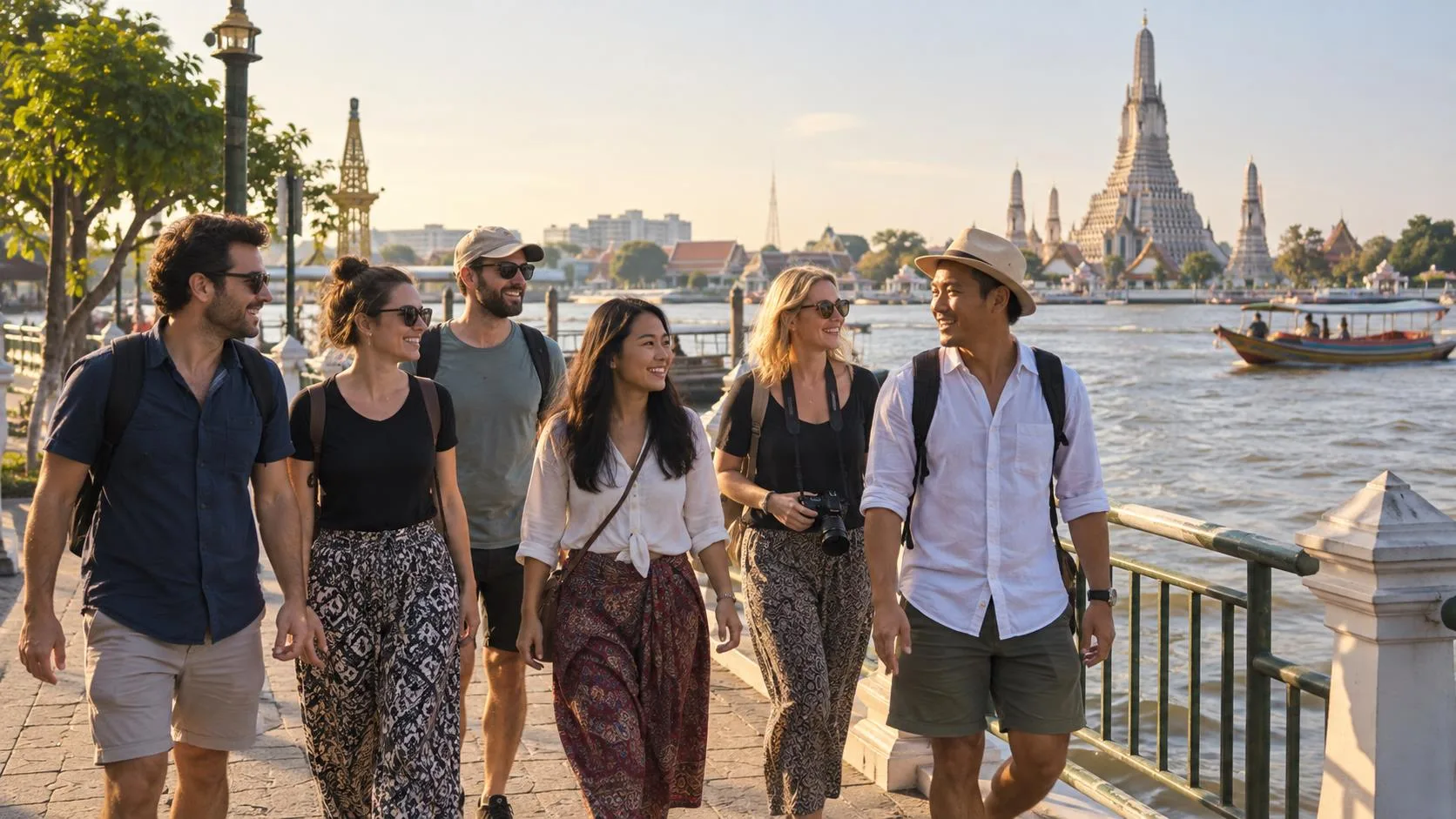
This article is a planning framework for combining cultural stops, outdoor activities and rest over 14 days. It is not a fixed package or a promise that every named place will be included. A structured itinerary can clarify transfers, rest time and activity requirements, but it cannot remove normal travel risks. AsiaTrip EN serves one private closed group of 4 to 20 guests, does not combine unrelated customers, and each accepted proposal is quoted individually in THB.
Key takeaways:
- A 14-day private itinerary for your closed group.
- The route can balance active days and rest, subject to the accepted proposal.
- Accommodation only when the accepted proposal identifies the property or standard, room arrangement, booking responsibility and cancellation terms.
- Possible temple and beach stops selected for the route, season and group.
- Possible stops include local markets and food venues, but only the items named in the accepted proposal form part of the itinerary.
- Licensed guide service only where the accepted proposal explicitly includes it.
- Opportunities to take part in activities such as diving and trekking.
Thailand at a glance
Geography and climate
Thailand borders Myanmar, Laos, Cambodia and Malaysia. Its geography includes northern mountains, the Chao Phraya basin, the Khorat Plateau and long coastlines on the Andaman Sea and Gulf of Thailand. Conditions vary considerably by altitude, region and month, so a single national temperature range or two-season description is not sufficient for planning.
November to February often brings lower humidity and less rain in Bangkok and several other regions, but it is also a busy period. Gulf islands, the Andaman coast and the northern highlands follow different weather patterns. Check current regional forecasts, marine warnings, heat and air-quality conditions for the actual route.
Culture and traditions
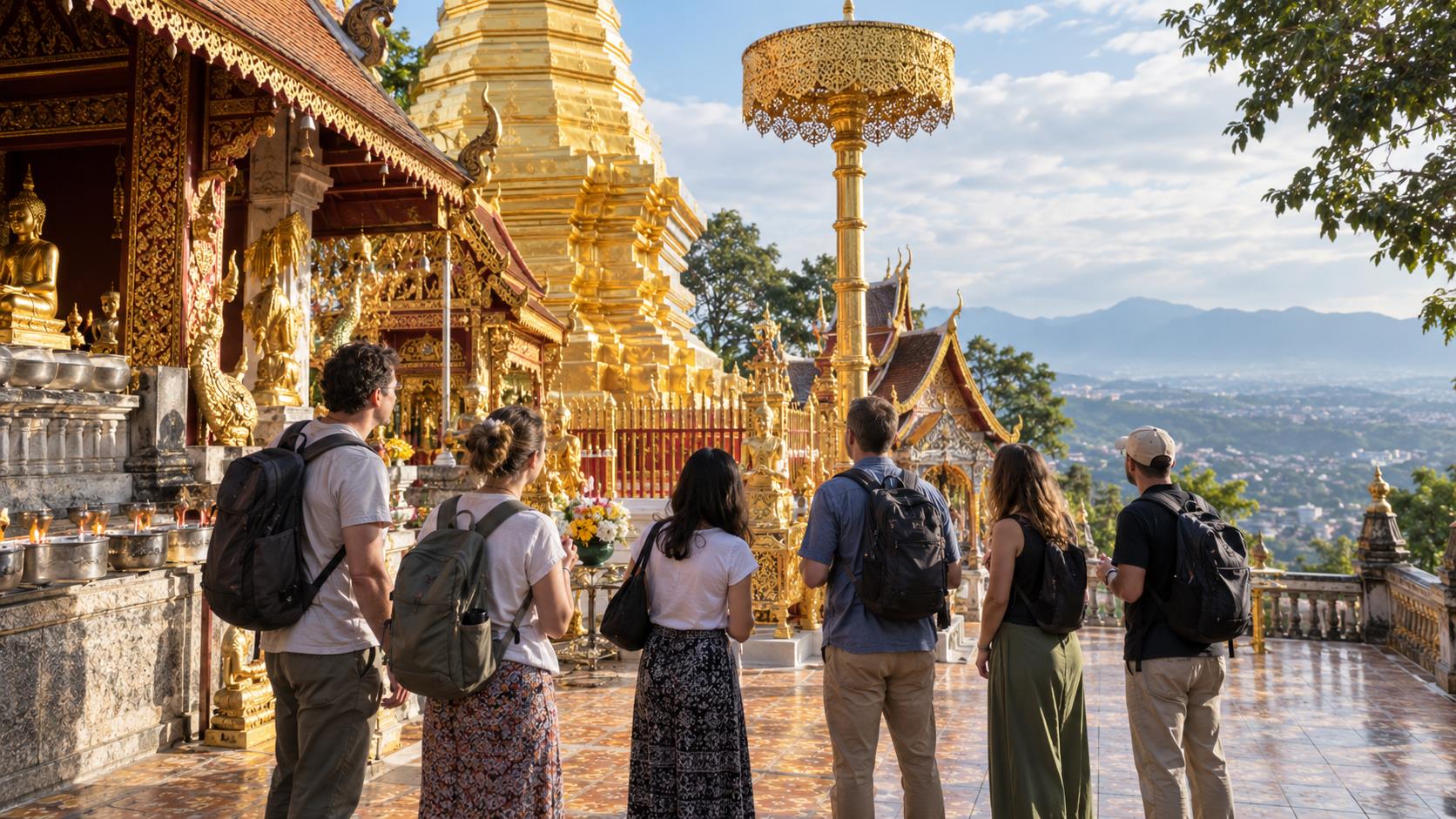
Thailand includes many regional, religious and community traditions shaped by long and varied histories. Buddhist temples are active religious spaces, not simply tourist attractions. Songkran observances also differ by location and include religious, family and public activities beyond the widely photographed water events.
Customs differ across regions, communities, generations and settings. Art, music and food can provide useful context, but no single festival, dish or interaction represents every resident. Observe site-specific rules and avoid treating national stereotypes as facts about individuals.
Currency and local economy
Thailand’s currency is the baht (THB). Exchange rates change, and card acceptance, cash requirements and fees vary by provider and location. Tourism is important to the economy, alongside manufacturing, services and agriculture, but old pre-pandemic figures should not be used as a current planning benchmark.
Travel costs depend on region, season, venue, transport choice and personal requirements. Check current menus and conditions rather than relying on a token street-food price. AsiaTrip does not publish a general EN price list; its accepted proposal is quoted individually in THB for the closed group.
Planning your trip
Best time to visit
There is no single best month for every route. November to February may suit Bangkok and parts of the north, while islands and coastlines can follow different rainfall and sea patterns. Availability, crowds, heat, smoke and local events also affect the choice.
March can bring severe heat and poor air quality in parts of the north, while September can be wet in several regions. Lower demand does not guarantee lower accommodation rates. Compare the specific destinations and dates, then keep alternatives for weather-dependent boats, treks and viewpoints.
Visa requirements and travel restrictions
Before departure, check the entry and visa requirements for the traveller’s nationality, purpose, intended stay and route using official Thai embassy, e-Visa and immigration sources. A longer stay does not automatically mean that a tourist visa is the correct category; confirm the appropriate permission before travel.
Recheck official entry, health and carrier requirements shortly before departure because forms, documentary checks and public-health measures can change. Do not copy an old COVID-era rule into a current itinerary unless an official source still requires it.
Confirm passport validity, onward-travel evidence, the Thailand Digital Arrival Card submission window and any supporting documents with the authorities and carrier relevant to the journey. The TDAC is not a visa.
Travel insurance and health precautions
Review travel insurance before departure, including medical and evacuation limits, declared conditions, exclusions, activities, vehicle use and claims procedures. Cover is determined by the policy wording; this article cannot promise reimbursement for an accident, illness or lost property.
You should also prepare for specific health precautions, such as vaccinations. Vaccination and prevention advice depends on your health history, itinerary and planned activities. Consult a qualified travel-health professional for individual advice before departure.
Discuss medicines, vaccinations and a suitable first-aid kit with an appropriate travel-health professional. Check medical facilities and emergency arrangements for every destination, and carry medicines in accordance with current Thai and carrier rules.
Fourteen-day itinerary: one balanced example
This sample route combines Bangkok, Chiang Mai and one southern base. It is a planning framework, not a fixed package. The final order must reflect actual flights, hotel availability, weather, marine conditions, mobility and the closed group’s priorities. Trying to add both Gulf and Andaman islands would create unnecessary transfers, so this example uses Krabi as the southern base.
Day 1: Arrival in Bangkok
Use the airport transfer named in the accepted proposal or follow the airport’s official taxi and rail procedures. Keep the programme light after a long flight. Check in, rest, obtain a practical amount of THB and have a meal close to the accommodation. Do not schedule a timed attraction unless the actual arrival time leaves a safe margin.
Day 2: Historic Bangkok
Plan the Grand Palace, Wat Phra Kaew and Wat Pho as one compact area, subject to current opening conditions, ceremonies and dress rules. Add Wat Arun only if the group still has enough time and energy. Tickets, transport and a licensed guide are included only when the accepted proposal names them.
Day 3: River, canals or a neighbourhood route
Choose one main theme instead of crossing Bangkok repeatedly. A river or canal route, Chinatown food walk, local market or modern riverside district can each fill the day. Confirm boarding points, accessibility, operating times, dietary requirements and the return journey before departure.
Day 4: Ayutthaya as a day trip
Ayutthaya can be reached by a confirmed private transfer or another suitable transport plan. Select a manageable group of historic sites and allow time for shade, water and lunch. The ruins are exposed to heat, and individual temples have their own access and conduct rules. Return to Bangkok without adding an unrelated evening programme.
Day 5: Travel from Bangkok to Chiang Mai
Use a current domestic flight, train or bus schedule. The plan must include travel to the departure point, check-in, baggage rules and the transfer after arrival. A quiet old-city walk or dinner may be practical, but the day should not be presented as a full sightseeing day.
Day 6: Chiang Mai temples and Doi Suthep
Combine a limited number of old-city temples with Doi Suthep only when the road, weather, steps and group mobility make the sequence realistic. These are active religious places. Visitors should dress appropriately, follow photography restrictions and avoid treating ceremonies as staged attractions.
Day 7: Food, craft or nature programme
Select one activity that suits the group. A cooking class should state the teacher, dishes, allergens, market component and transport. A craft workshop should identify the host, materials and participant requirements. A nature route needs current access, air-quality and weather checks. Nothing is assumed merely because it appears in this article.
Day 8: A slower northern day
Keep one day flexible for rest, a neighbourhood walk, a suitable museum or an activity postponed by weather. If an animal venue is considered, review current welfare evidence and avoid riding, bathing, performances or forced close contact. A venue’s use of the word sanctuary is not sufficient evidence.
Day 9: Travel to Krabi
Fly or use the confirmed connection to the selected southern base. Include baggage limits, airport transfers and hotel check-in. The rest of the day should remain light unless the arrival time makes a short beach or town visit genuinely practical. Do not add Phuket or a Gulf island simply to increase the destination count.
Day 10: Island or coastal day
Choose the route only after checking the marine forecast, park rules and the operator. Confirm boat type, passenger limits, life jackets, pickup, inclusions and cancellation conditions. The operator selects permitted sites according to conditions. A land-based alternative is required when the sea is unsuitable.
Day 11: Krabi mainland or optional climbing
A mainland day can focus on local scenery, a suitable walking route or a slower food programme. Rock climbing is optional and requires a qualified provider, correctly maintained equipment, an ability assessment, suitable weather and clear rescue procedures. It is not appropriate for every traveller.
Day 12: Rest and a weather buffer
Leave space for the beach, a quiet local outing or an activity moved from an earlier day. This buffer prevents one weather cancellation from forcing an unsafe or exhausting sequence. Check swimming conditions, flags and local advice rather than assuming calm water from a photograph.
Day 13: Return to Bangkok
Return to Bangkok before the international departure when the flight schedule requires it. An overnight stay near the final airport can reduce the risk created by a same-day domestic connection. Confirm the airport, because Bangkok has two main airports and a transfer between them takes time.
Day 14: Departure
Allow enough time for the airport transfer, airline check-in, baggage procedures and immigration. The accepted itinerary should name the pickup time and airport. Do not attach another major attraction to departure day unless the confirmed flight time and traffic margin make it genuinely safe.
What the written proposal must confirm
The proposal should distinguish confirmed accommodation, transport, admissions, meals, coordination and any licensed guide service from optional suggestions. It should also state who makes each booking, payment and cancellation terms, baggage limits, meeting points and the procedure for weather-related changes. AsiaTrip EN serves one private closed group of 4 to 20 guests, does not combine unrelated customers and quotes each accepted itinerary individually in THB.
Trip highlights
A balanced 14-day plan can combine historic sites, outdoor activities, food and rest. The value of each stop is subjective, and interactions with residents should be respectful rather than presented as a promised attraction.
If dates coincide with an officially scheduled festival, the group can consider a permitted event after checking tickets, crowd controls, fire restrictions and transport disruption. Snorkelling, plantations and other optional activities require separate checks and are included only when listed in the accepted proposal.
Travel logistics
Long distances may require a domestic flight, train or road transfer. Meals and local transport are not assumed. The accepted proposal should state which bookings AsiaTrip coordinates, who operates each service, the applicable baggage or waiting rules and which costs remain with the travellers.
Do not assume a booking has been made. The accepted proposal should identify each reservation, who makes it and the applicable cancellation terms. Follow the rules of each temple, venue, community and operator rather than relying on broad cultural generalisations.
Bangkok: The vibrant capital
Possible cultural and historic stops
Possible Bangkok stops include the Grand Palace complex, Wat Phra Kaew and Wat Pho. They are active cultural and religious sites with separate tickets, clothing rules, closures and visitor conditions. Confirm current information and select only the stops that fit the group’s pace.
Chinatown can be considered for an evening food walk or market visit. A Chao Phraya River boat journey is another possible way to connect riverside stops. Opening hours, boarding points, accessibility and inclusions must be checked for the actual date.
Local cuisine and dining options
Bangkok has street stalls, markets, neighbourhood restaurants and formal dining venues. Dishes such as pad thai, tom yum and som tam vary by cook and region. Ask about allergens and ingredients rather than describing one venue as an authentic standard for the whole country.
Bangkok also has Michelin-listed venues and other formal restaurants, but listings, chefs, menus, dress codes and prices change. Check current information and make a reservation only when the group wants that style of meal.
Bangkok also has extensive regional Thai and international dining options. Choose venues according to budget, allergies, dietary requirements, location and current opening arrangements rather than assuming that a particular restaurant is included.
Transportation tips
Bangkok transport options include the BTS Skytrain, MRT, buses, boats, taxis and app-based services. The practical choice depends on the route, operating hours, accessibility, luggage and traffic. For a taxi, confirm the fare method, tolls and destination before departure.
A tuk-tuk is one transport option, not an included attraction. Confirm the fare, destination and any waiting charge before departure. Traffic varies throughout the day, so allow enough time and use another mode when it is more practical for the group.
Transport apps can help compare pickup points and estimated routes, but availability, tolls, surge pricing and traffic change. Verify the vehicle and driver in the app, use the official pickup process and allow extra time for appointments and airport travel.
Exploring northern Thailand
Chiang Mai: A cultural centre
Chiang Mai has active Buddhist temples, markets and neighbourhoods with different histories. Possible stops include Wat Phra Singh and Wat Chedi Luang. Visitors should follow dress, photography and conduct rules and should not treat religious sites as decorative backdrops.
Yi Peng and Loi Krathong events vary by year and location. Lantern releases may be restricted or limited to designated events. Confirm official dates, tickets, fire-safety rules, transport disruption and local guidance before adding a festival to the route.
Doi Suthep temple and the surrounding area
Wat Phra That Doi Suthep is an active religious site above Chiang Mai. Access arrangements include a long staircase and may also include a funicular, subject to current operation. Check dress, mobility, weather, opening and ceremony conditions before adding the stop.
Nearby walks vary in access, gradient, maintenance and environmental sensitivity. Check current park or land rules, weather, air quality, footwear and whether a qualified provider is needed. Wildlife sightings are not promised and animals must not be approached or fed.
Khao soi is one northern noodle dish to compare, with ingredients and spice levels that vary by cook. Ask about allergens and dietary requirements, and do not present one dish as the complete northern food tradition.
Local markets and craft workshops
The Sunday Walking Street is one possible Chiang Mai market stop, subject to its current day and operating arrangements. Sellers may be makers, cooperatives or resellers. Ask before photographing people and do not assume that every product is locally made.
A pottery, weaving or carving workshop can be considered when it is led by a suitable host and clearly states the technique, duration, materials, participant age and safety requirements. One class should not be presented as complete access to a community’s culture.
Confirm whether participants make an item, whether it may be taken away and whether additional material or shipping costs apply. Check customs restrictions before travelling with wood, plant, animal or antique materials.
Island hopping in the south
Koh Samui: Beaches and nightlife
Koh Samui has beaches with different development levels, swimming conditions and seasonal exposure. Chaweng Beach has accommodation, dining and nightlife nearby, but noise, currents, water quality and venue hours vary. Select an area that fits the group rather than promising a particular beach experience.
Fisherman’s Village in Bophut can be considered after checking the current market schedule. Fire shows and other performances require a separate safety and venue assessment and are not assumed to be part of the itinerary.
Koh Phi Phi: Snorkelling and diving
Snorkelling around the Phi Phi islands depends on sea conditions, park rules, visibility and participant ability. Potential sites include areas near Phi Phi Leh and Bamboo Island, but an operator must select a permitted site on the day. Coral must not be touched or stood on.
Some certified divers may consider sites such as the King Cruiser Wreck. Suitability depends on certification, recent experience, depth, currents, visibility, sea conditions and the operator’s assessment. Use a properly licensed operator and follow the site briefing.
Koh Lanta: Relaxation and nature
Koh Lanta can suit a quieter island stay, although beach conditions, development and visitor numbers vary by season and district. Compare transport time, swimming conditions and accommodation location. Do not assume a restaurant is family-run or that seafood is locally sourced without checking.
Koh Lanta is also known for its national parks, such as Mu Koh Lanta National Park, where you can explore walking trails through dense forests and coastal areas while enjoying views of the Andaman Sea. It is also worth arranging a kayaking trip to get closer to hidden lagoons and secluded beaches.

Adventure activities
Jungle zip-lining
Zip-lining is an optional high-risk activity. Before booking, check operator licensing, equipment inspection, staff training, participant limits, weather policy, rescue plan and insurance exclusions. A forest setting does not by itself demonstrate environmental responsibility.
An operator may provide information about the surrounding forest, but this should not be assumed without checking staff qualifications and the programme. Photography must follow the operator’s rules and must not distract from safety instructions.
Assessing elephant venues
Venues using the word sanctuary do not all follow the same welfare standards. Observation from a respectful distance is preferable to bathing, riding, performances or other close-contact activities that may be stressful or coercive.
Do not assume a venue is ethical because of its name or marketing. Review how elephants are acquired, housed and handled, whether contact is voluntary, and whether independent welfare information supports the venue’s claims.
Rock climbing in Krabi
Krabi has established rock-climbing areas, including sites near Railay. Route access, bolting condition, tides, weather, instructor availability and participant requirements change. Use a qualified provider and select the route only after an ability and safety assessment.
Climbing in Krabi requires an appropriate route, equipment, supervision and assessment of weather and participant ability. It should not be framed as a competition. Beginners should use a qualified provider and understand the operator’s safety and rescue procedures.
Route availability and grading change by site. Confirm who supplies and inspects the equipment, instructor qualifications, participant limits and insurance. If climbing is unsuitable, the itinerary should provide a practical alternative.
Wellness and relaxation
Traditional Thai massage
Traditional Thai massage uses pressure and assisted movement, but it is not suitable for every traveller. Check the practitioner, hygiene, consent, contraindications, duration and price. Seek medical advice where appropriate and do not assume that a beach service meets the same standards as a regulated clinic or established spa.
Natural oils and herbs are often used during the treatment, enhancing the sense of relaxation. Massage duration, method and price vary by provider. Check the current menu, hygiene standards and practitioner credentials, and disclose relevant health conditions before treatment.
Yoga retreats
Yoga retreats differ in teaching credentials, intensity, accommodation, safeguarding and cancellation conditions. Check whether a programme suits the participant’s experience and health, and verify the exact venue rather than inferring quality from an island location.
A retreat schedule may include movement, meditation, talks or meals, but none should be assumed before reviewing the actual programme. Claims about physical or spiritual benefits require caution. Check instructor credentials, health requirements, food provision and the suitability of the schedule for each participant.
Spa treatments and wellness centres
Wellness centres vary widely. Treatment names and natural ingredients do not prove medical benefit or quality. Check practitioner credentials, hygiene, contraindications, privacy, facilities, price and cancellation terms before booking.
Whether you compare a hotel spa or a local wellness centre, check current prices, hygiene, staff credentials, cancellation terms and the exact treatment offered before booking.
Some wellness centres advertise consultations or lifestyle programmes. Verify the practitioner’s qualifications and scope, and do not treat a general wellness session as medical or dietary advice.
Culinary experiences
Thai cooking classes
Cooking classes have different formats. Some include a market visit; others begin at a kitchen. Confirm who teaches, what each participant prepares, which dishes are covered, whether the meal is included and how allergies or dietary requirements are handled.
A farm visit or shared meal is included only when the selected class states it. Confirm transport, accessibility, food handling, allergens and whether participants may eat or take away the dishes they prepare.
Street food options
Street-food availability, ingredients, hygiene and prices vary by location and time. Dishes such as satay and som tam also vary by cook. Choose busy, orderly stalls, ask about allergens and use current displayed prices rather than assuming food will be cheap.
A market or street-food stop can introduce different dishes, but vendors are working and are not obliged to provide stories, recipes or conversation. Ask before photographing, order respectfully and choose food according to dietary and hygiene needs rather than a generic must-try list.
Fine dining restaurants
Thailand also has formal restaurants with tasting menus and other fixed formats. Awards, chefs, menus and opening arrangements change, so check current official information rather than treating named venues as standing recommendations. Reservations remain subject to each venue’s terms.
Menus, pairings and service formats can change with ingredient availability and venue policy. Check the current menu, taxes, service charges, alcohol rules and dietary options before reserving.
Fine-dining venues differ in menu, service, dress code and accessibility. An advance booking only reserves under the venue’s current terms; it does not guarantee a particular experience. Confirm dietary requests and cancellation conditions directly.
Culture and local events
Festivals and local events
Loi Krathong and Songkran are observed differently across Thailand. Dates, ceremonies, public events and environmental rules vary by place and year. Confirm the official local programme and participate respectfully rather than reducing either event to lanterns or a water fight.
Phi Ta Khon is associated with Dan Sai in Loei province and its dates are announced locally. Attendance requires checking transport, crowd arrangements, photography etiquette and the official programme. A festival visit does not by itself provide a complete understanding of a culture.
Traditional music and dance
Khon performance and Muay Thai events have different histories, conventions and settings. If the group is interested, choose a legitimate venue and explain the context, schedule, seating, dress and photography rules without presenting either activity as compulsory.
A dance performance or workshop is optional. Check the organiser, context, photography rules and whether participation is invited. Watching one performance does not provide complete access to a culture.
Community-led visits
Akha, Karen, Hmong and other communities are living societies, not attractions. Do not assume that a village visit is available or appropriate. If a community-led visit is considered, confirm consent, local ownership, photography rules, payment arrangements and whether residents control how their culture is presented.
Buying an item does not by itself prove community benefit. Ask who produced it and how revenue is distributed, avoid intrusive questions or staged encounters, and accept that a community may decline visitors or photography.
Sustainable tourism practices
Tips for responsible travel
Responsible travel requires choices appropriate to the route. Compare shared transport, walking, rail and private transfers for safety, accessibility, time and environmental impact. Ask who owns a venue or service before claiming that a purchase supports a local economy.
For natural areas, follow park rules, marked routes and waste instructions. Do not remove natural materials, feed or disturb wildlife, or use a reusable item where hygiene or venue rules prohibit it. Sustainability claims should be supported by specific operating practices, not labels alone.
Supporting local economies
Business size or branding does not prove local ownership, employment conditions or community benefit. When this matters to the group, check ownership, sourcing and working practices before selecting accommodation, food venues or shops.
Visitor spending can create both benefits and pressure. Its effect depends on who owns the service, where goods come from, how workers are treated and how revenue is distributed. Do not claim a positive impact without evidence from the specific business or programme.
Wildlife conservation efforts
Wildlife programmes should be assessed individually. Marketing terms such as conservation, sanctuary or ecotourism do not prove animal welfare or conservation impact. Review ownership, animal acquisition, handling, contact, veterinary care, financial transparency and independent evidence before choosing a venue.
Short tourist volunteering at a wildlife venue is not automatically conservation and may create welfare, safety or legal concerns. Prefer observation-led programmes with transparent policies, qualified staff and independent evidence. Avoid riding, bathing, performances, forced feeding and direct contact presented mainly for photographs.
Shopping in Thailand
Night markets and souvenirs
Night markets are optional evening stops whose days and opening hours vary. Bangkok, Chiang Mai and Pattaya have different market formats. Check the current schedule, keep valuables secure and ask politely whether a price is fixed before negotiating.
For textiles, ceramics or carvings, ask about materials, maker identity and origin. A market label does not guarantee authenticity or that revenue reaches a craftsperson. Check customs restrictions before buying wildlife products, antiques or culturally sensitive objects.
Local handicrafts
Markets may sell textiles, carvings and ceramics from makers, cooperatives, factories or resellers. Ask about origin, materials and maker identity. A purchase supports a craftsperson only when the supply chain makes that connection credible.
Sellers may describe a product as Lanna, Isan, handmade or traditional. Ask who made it, where it was produced and what materials were used instead of relying on a label alone.
Fashion and design boutiques
Independent boutiques and larger retailers offer different products and price points. Verify designer and material claims instead of assuming that a small shop is local, original or sustainable.
If the group wants time for shopping, choose an area that fits the route and budget. Enjoyment and uniqueness are subjective, and the itinerary should not promise either.
Fashion retailers may make claims about traditional influence, local production or environmentally preferable materials. Treat these as product claims that require supporting information about origin, fibres and manufacturing.
Travel safety and etiquette
Common scams and how to avoid them
For transport, use an official queue, a clearly identified operator or a reputable app where available. Confirm the fare method, tolls and destination before departure. An app reduces some ambiguity but does not remove all risk. Licensed-guide requirements and identification should be checked separately.
Quality, authenticity and legal origin cannot be inferred from a certificate displayed by a seller. Compare products, keep receipts where relevant and avoid restricted wildlife materials, counterfeit goods and high-pressure sales. Negotiate only where the seller indicates that it is appropriate.
Local customs and tips on behaviour
Rules about shoes, clothing, physical contact and conduct depend on the home, temple, venue and host. Do not touch another person without consent. Follow posted guidance, ask when unsure and avoid presenting etiquette as a fixed rule shared by every Thai person.
Etiquette varies by setting. Observe posted rules, ask before photographing people or ceremonies, keep public behaviour considerate and follow the lead of hosts. Avoid turning broad cultural advice into rigid claims about every person in Thailand.
- Respect personal space and consent
- Follow shoe and clothing rules at the specific venue
- Ask before photographing people or ceremonies: permission
- Keep public behaviour considerate of the setting
Learn a few polite phrases, listen carefully and accept that gestures can have different meanings. A smile does not replace consent, clear communication or respect for boundaries. Residents are not responsible for creating a traveller’s cultural experience.
- Use clear, polite communication: respect
- Observe local and venue-specific guidance: context
- Join conversations only when invited: consent
- Accept misunderstandings and ask calmly: clarity
Emergency contacts and resources
Before departure, save current emergency contacts from official Thai and consular sources, along with the insurer’s assistance number. Police, tourist assistance, fire and medical emergencies use different services, so do not rely on one number for every situation.
Note suitable medical facilities for each destination, not only Bangkok, and understand the insurer’s referral or payment procedure. Share the itinerary and emergency contact plan with the group without making a blanket claim about the quality or availability of care.
Keep digital and offline copies of insurance, passport details, accommodation addresses and important contacts. Agree how the closed group will communicate if separated and who should be contacted first, while recognising that AsiaTrip cannot replace emergency services.
Thailand in 14 days: a private adventure and beach route
A 14-day private route can combine cities, food, beaches and temples without joining unrelated travellers. The final itinerary is prepared only after the closed group’s requirements and practical constraints are confirmed. No destination, activity, emotional outcome or level of safety is guaranteed.
A 14-day route can balance planned activities and rest when travel time is realistic. A coordinator handles only the logistics stated in the proposal, while a licensed guide is included only when that service is named. The article does not promise a particular emotional outcome or cultural access.
Official information to check before travelling
- Thailand Digital Arrival Card for the current arrival form and official instructions.
- Thai e-Visa for current visa information and the official application channel.
- Thai Meteorological Department for current forecasts and warnings.
- Thailand Tourist Police for official traveller assistance information.
- Airports of Thailand for current airport information and passenger notices.
- UNESCO: Historic City of Ayutthaya for the World Heritage property description.
FAQ
Q: What is included in a 14-day private itinerary?
A: Nothing is assumed beyond the accepted written proposal. It should list accommodation, meals, transport, admissions, coordination and any licensed guide service separately. Communication for the EN version is in English.
Q: Which places will be visited during the trip?
A: The route can combine Bangkok, Chiang Mai and one island region, but the final stops depend on season, travel time and the accepted proposal.
Q: Is the trip suitable for families with children?
A: A family route can be prepared, but suitability depends on the children’s ages, mobility, health, activity rules and the final pace.
Q: Which activities can be considered for the route?
A: Temples, trekking, beach time and a local festival can be considered when dates, mobility, weather, permissions and operating conditions allow.
Q: Is it possible to book additional excursions?
A: Optional activities can be discussed separately. Diving requires an appropriate operator and participant assessment. Wildlife activities must be checked for animal-welfare concerns; elephant riding is not presented as a default option.
Q: What dining options are available during the trip?
A: Meals are included only when listed in the accepted proposal. Dietary requests must be disclosed in advance and confirmed by the relevant restaurant or supplier.
Q: What documents do I need for a trip to Thailand?
A: Passport, visa and entry requirements depend on nationality, purpose, route and date. Check official Thai sources and suitable insurance before departure.
Related: Thailand with children.
Related: Trip from Phuket to Bangkok: 1 to 2 days.
Related: Thailand holidays: a practical guide (2026).
Related: Wat Arun Bangkok: a guide to the Temple of Dawn.
Related: ICONSIAM Bangkok: a guide to the shopping centre on the Chao Phraya.
Related: Thailand travel agency: how to compare services and conditions.
Related: AsiaTrip travel guides and practical articles.
Related: Hotels in Krabi Ao Nang: how to choose.
No comments