

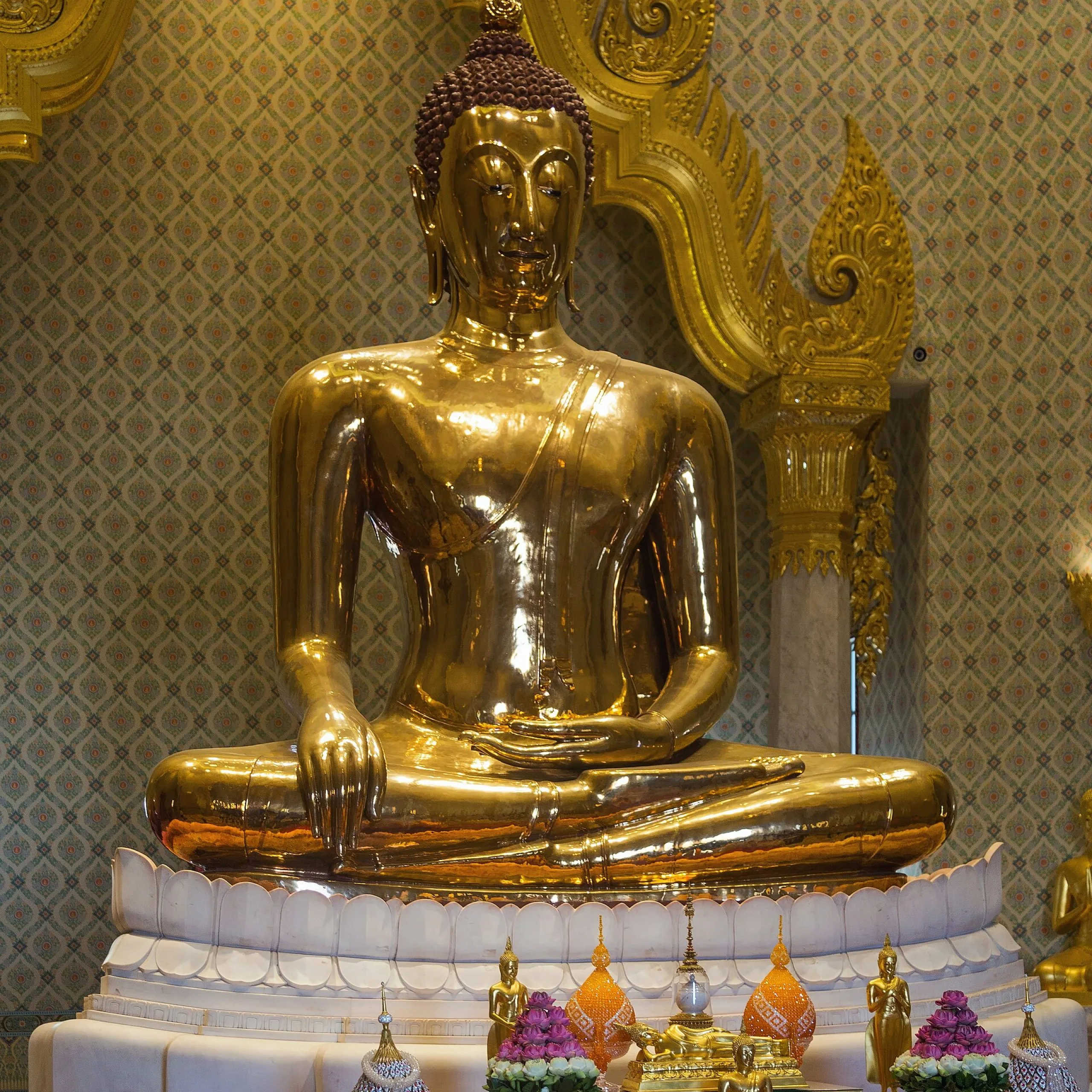
Wat Traimit, often called the Temple of the Golden Buddha, stands at the eastern edge of Bangkok’s Chinatown. Its main attraction is Phra Phuttha Maha Suwan Patimakon, a seated Buddha image about 3 metres tall and weighing about 5.5 metric tonnes. Guinness World Records recognises it as the world’s largest solid-gold sculpture.
This guide explains what makes the temple important, how the statue’s gold was revealed, what to expect during a visit and how to combine Wat Traimit with Yaowarat. Opening arrangements, exhibition access and admission rules can change, so confirm the current details before travelling rather than relying on an old price or timetable.
Wat Traimit works particularly well as the starting point for a Chinatown day. It is close to Hua Lamphong MRT station, the Chinatown Gate and the streets leading towards Yaowarat. The temple visit is focused and manageable, while the surrounding district can fill several more hours.
Why Wat Traimit and the Golden Buddha are special
The Golden Buddha is remarkable for both its material and its history. The image is associated stylistically with the Sukhothai period, although its exact date and original location are not known with certainty. Its elegant proportions, flame-like ushnisha and earth-touching hand gesture are characteristic of an important tradition in Thai Buddhist art.
The official name of the image is Phra Phuttha Maha Suwan Patimakon. For most visitors, however, the scale is easier to understand through two figures: approximately 3 metres in height and 5.5 tonnes in weight. These measurements are confirmed by the Guinness World Records account of the sculpture.
The story beneath the plaster
For a long period, the gold was hidden beneath an outer coating of plaster. The usual explanation is that the covering protected the image from theft during a time of conflict, but the statue’s early history is not fully documented. It is better to treat this as the most widely accepted interpretation rather than a complete record of every event.
In 1955, while the statue was being moved, part of the plaster broke away and revealed the gold underneath. The discovery transformed the understanding of the image. What had appeared to be a large stucco Buddha was recognised as an exceptional work made from solid gold.
The most memorable part of Wat Traimit is not simply the amount of gold. It is the contrast between the modest outer covering and the significance of what remained concealed beneath it.
A living place of worship
Wat Traimit is a visitor attraction, but it is also an active Buddhist temple. People may be praying, making offerings or attending religious activities while tourists move through the building. A quiet voice, modest clothing and patient movement around worshippers are part of a respectful visit.
The image has religious and cultural meaning that goes beyond its material value. Take time to observe the posture, face and hand position before taking photographs. If a ceremony is taking place, follow the instructions of temple staff and give participants enough space.
Practical information for visiting Wat Traimit
Wat Traimit is in Bangkok’s Samphanthawong district, near the entrance to Chinatown. The Tourism Authority of Thailand describes it as a short walk from Hua Lamphong MRT station. This makes the metro a practical starting point for many visitors, although the best route may depend on your hotel and the conditions on the day.
Do not plan around a fixed admission price or assume that every museum area will always follow the same schedule. Temple halls, exhibitions and ticket arrangements can operate differently during religious events, maintenance or special occasions. Check current official information and the signs at the entrance.
| Visit detail | What to check or prepare |
|---|---|
| Location | Wat Traimit is near the Chinatown Gate and Yaowarat area in Bangkok’s Samphanthawong district. |
| Public transport | Hua Lamphong MRT station is within walking distance. Review the current station exits and walking route before setting out. |
| Time at the temple | Allow roughly 45 to 75 minutes for an unhurried visit. Add time if the museum areas are open and you want to see them. |
| Clothing | Cover shoulders and knees and be ready to remove footwear where required. |
| Photography | Follow the signs and staff instructions in each hall. Rules may differ during ceremonies or special events. |
| Access and tickets | Confirm current opening arrangements, exhibition access and any admission charge before your visit. |
| Best combination | Continue towards the Chinatown Gate, Yaowarat Road, Wat Mangkon or nearby historic streets. |

When to go
An earlier visit can be more comfortable because the temperature is usually lower than later in the day. Morning light can also work well for the white-and-gold exterior. Crowd levels vary, however, and religious holidays can change the normal rhythm of the site.
If you want to experience Yaowarat after dark, visit the temple first and continue through Chinatown later. The temple and the evening food streets have very different atmospheres, which is precisely why they make a good combination.
How long to allow
About an hour is a useful starting point for the temple itself, but do not treat that as a guaranteed schedule. Stairs, queues, museum access and time spent observing the image can all affect the visit. A relaxed half-day allows you to include Chinatown without rushing.
For a broader overview of the city, compare this plan with the practical guide to Bangkok attractions. It will help you decide whether Wat Traimit belongs in a focused Chinatown route or a longer day covering several parts of Bangkok.
How to visit Wat Traimit step by step
The complex is not difficult to navigate, but a simple order helps you pay attention to the right details and keeps the visit calm.
- Arrive with enough time: avoid fitting the temple into a few hurried minutes between unrelated attractions.
- Check the entrance information: confirm access, ticket arrangements, photography rules and any areas closed that day.
- Dress for an active temple: cover shoulders and knees before entering and remove shoes wherever signs require it.
- See the Golden Buddha carefully: notice the face, hands, seated posture, proportions and surface rather than treating it only as a photo subject.
- Read the historical material: where the exhibition areas are open, use them to understand the statue’s covering, movement and discovery.
- Walk down without rushing: terraces and exterior details provide a transition from the prayer hall to the surrounding city.
- Continue towards Chinatown: choose the Chinatown Gate, Yaowarat, Wat Mangkon or a food route according to the time of day.
This order keeps the temple at the centre of the visit. It also avoids the common mistake of spending more time planning the next meal than looking at the image that makes Wat Traimit historically significant.
What to see at Wat Traimit and nearby
Wat Traimit is best understood as a small group of related experiences rather than one photograph. Some areas may have separate access rules, so use the following list as a planning guide and check what is available when you arrive.
- The Golden Buddha: the principal image and the reason most visitors come to the temple.
- The main hall: a religious space where visitors should remain quiet and avoid blocking worshippers.
- Historical displays: exhibitions may explain the statue’s history and the surrounding Chinese community.
- The temple exterior: white walls, gold details and elevated levels create strong views from different angles.
- Chinatown Gate: a nearby landmark that introduces the Yaowarat district.
- Yaowarat Road: the main commercial and food street, especially lively later in the day.
- Wat Mangkon Kamalawat: an important Chinese Buddhist temple with a different architectural and devotional character.
- Song Wat and Talat Noi: historic streets, old shophouses and riverside neighbourhood details for visitors with more time.
From Wat Traimit to Yaowarat
The Tourism Authority of Thailand presents Wat Traimit as a natural first stop on a Chinatown route from Hua Lamphong. From the temple, continue towards the Chinatown Gate and then into the commercial streets. Traffic is busy, so use pedestrian crossings and allow more time than the map alone may suggest.
Yaowarat is known for gold shops, Chinese-Thai businesses, pharmacies, markets and food. The district changes during the day. Shops dominate many daytime streets, while evening brings more food stalls and illuminated signs.
If food is a priority, use the Bangkok street-food guide to plan what to try without turning the temple visit into a rushed prelude to dinner.
The history of the Golden Buddha
The statue’s style is associated with the Sukhothai artistic tradition. The precise date of casting and the full route by which it reached Bangkok remain uncertain. Avoid accounts that present every stage as fully documented.
What is established is that the image was hidden beneath plaster and that the gold was revealed when the outer covering was damaged during a move in 1955. The discovery became one of the best-known stories attached to a religious object in Bangkok.
Why the concealment matters
The plaster protected the material value from view. It may have been applied to deter theft during conflict, but the absence of a complete early record means that careful wording is appropriate. The surviving image is evidence; some details about motive and timing remain interpretation.
That uncertainty does not reduce the statue’s importance. On the contrary, it helps separate the documented object from the legends that have grown around it. The Golden Buddha can be appreciated as a religious image, a major work of Thai art and a remarkable historical survival.
Why the discovery still attracts attention
The contrast is immediately understandable. A plain outer surface concealed a sculpture of extraordinary material value. The story is dramatic, but the temple should not be reduced to a treasure narrative. The image remains an object of devotion.
Look first at the Buddha image as part of a living temple. The story of the gold becomes more meaningful when it is placed beside the site’s religious purpose.
Wat Traimit with children, a camera or a private itinerary
Visiting with children
The focused route can work well for families because the central story is easy to explain. Tell children that the statue looked like plaster until damage during a move revealed the gold. Keep the visit short enough for their attention span and explain temple behaviour before entering.
Stairs and heat may affect some families, so check current accessibility information and take breaks where appropriate. Do not promise lift access or unrestricted movement without confirming the facilities in use on the day.
Photography and respectful behaviour
The exterior and the Golden Buddha offer strong photographic subjects, but permission should never be assumed. Check the signs in each area, avoid flash where prohibited and do not step in front of people who are praying.
Morning light is often gentler on the exterior than the harsher light around midday. Inside, expose for the gold carefully and accept that reflections can be strong. A respectful photograph is better than moving into a restricted or disruptive position.
Adding Wat Traimit to a private Bangkok plan
AsiaTrip can include the area in a private itinerary for one closed group of 4 to 20 guests. Unrelated customers are not combined. The route and individual quote are confirmed in THB after the group’s requirements are known, and no public EN price is implied by this guide.
If you want help arranging the day, review the private day-tour options. The confirmed plan should state the meeting point, transport, included services and the language of coordination before booking.
A half-day Wat Traimit and Chinatown route
Begin near Hua Lamphong and walk to Wat Traimit. Allow time for the Golden Buddha and any open historical displays. Then continue past the Chinatown Gate towards Yaowarat. This sequence moves from a quieter religious setting into one of Bangkok’s busiest urban districts.
During the afternoon, explore shops, side streets or another temple. If you stay until evening, use the extra time for food rather than trying to add several distant attractions. The official TAT guide to the MRT Blue Line and Yaowarat is a useful transport reference.
A sensible pace
Maps can make Chinatown look compact, but heat, traffic and crowded pavements slow the route. A half-day is more comfortable when it has one central temple, one neighbourhood walk and time for a meal.
Visitors who want a quieter experience can finish earlier. Those who enjoy busy food streets can remain for Yaowarat after dark. The Tourism Authority of Thailand’s Chinatown route gives additional context for nearby cultural stops.
FAQ about Wat Traimit and the Golden Buddha
Where is Wat Traimit?
Wat Traimit is in Bangkok’s Samphanthawong district, near the Chinatown Gate and Yaowarat area. Hua Lamphong MRT station is within walking distance.
Is the Golden Buddha really made of solid gold?
Yes. Guinness World Records identifies it as the world’s largest solid-gold sculpture. The image is about 3 metres tall and weighs about 5.5 metric tonnes.
How much time do you need?
Allow roughly 45 to 75 minutes for the temple, with extra time if exhibitions are open and you want to see them. A temple and Chinatown combination works better as a half-day than as a rushed stop.
What should you wear?
Wear clothing that covers shoulders and knees. Remove shoes where required, keep your voice low and follow staff instructions in religious areas.
Can you take photographs?
Rules can change by area and occasion. Check the signs and current instructions, especially in the prayer hall or during ceremonies.
Do you need a guide?
No. The temple can be visited independently. A well-prepared private itinerary may be useful if you want historical context, coordinated transport or a route linking several Chinatown locations. Confirm the actual included services and language before booking.
Summary
- Wat Traimit: a working Buddhist temple at the edge of Bangkok’s Chinatown.
- The Golden Buddha: a solid-gold seated image about 3 metres tall and weighing about 5.5 tonnes.
- History: the gold was revealed in 1955 after plaster was damaged during a move.
- Planning: verify current access, opening arrangements, photography rules and any admission charge.
- Respect: dress modestly and give worshippers enough space.
- Best combination: continue to the Chinatown Gate, Yaowarat and nearby historic streets.
Wat Traimit offers a clear, memorable introduction to Bangkok’s Chinatown. The visit is compact, but the story of the Golden Buddha rewards careful attention. Plan enough time to see the image respectfully, then explore the surrounding district at a pace that suits your group.
No comments