

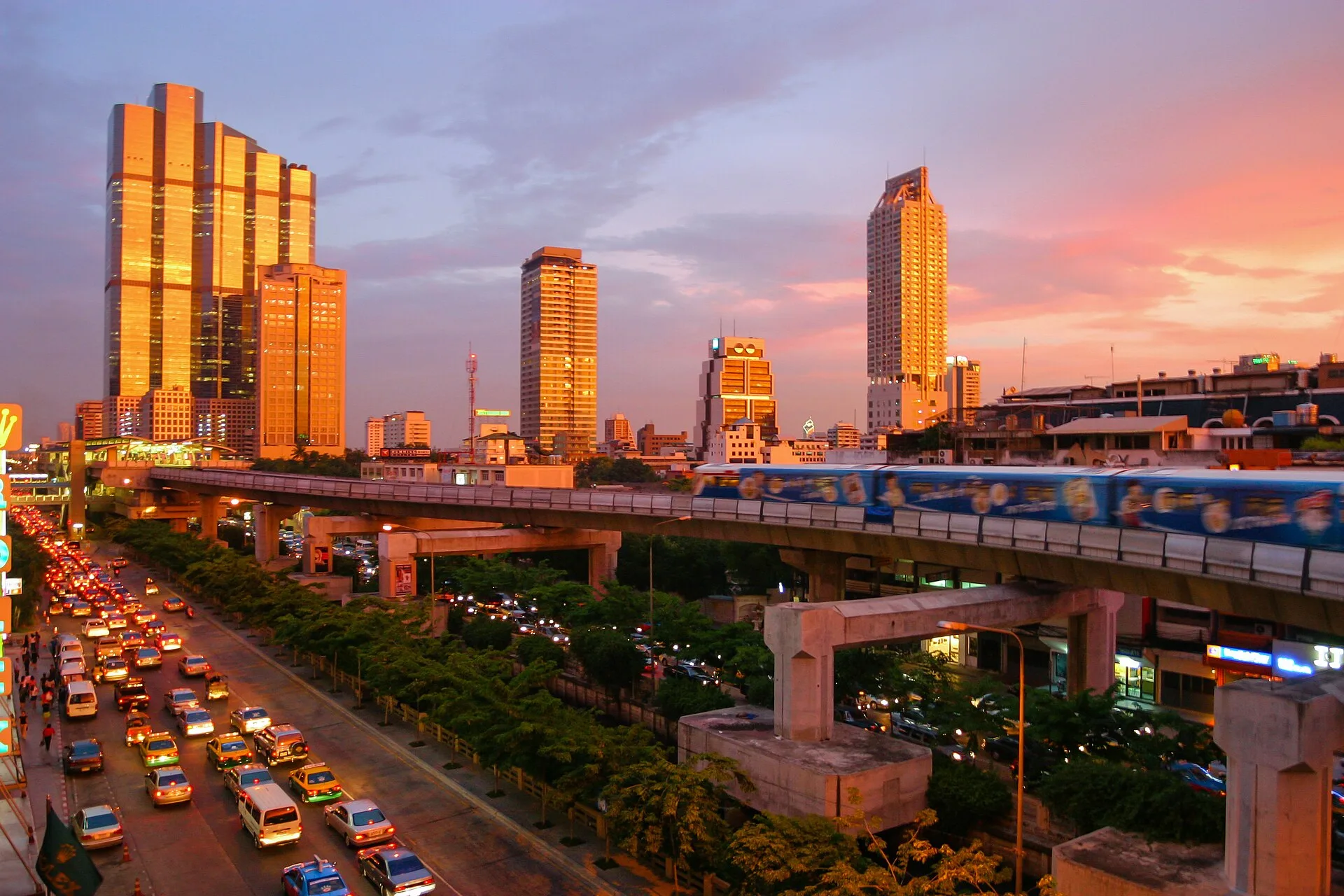
Getting around Bangkok can feel confusing at first. The city is extensive, the heat affects how far you want to walk, and road traffic can change a journey completely. A simple plan becomes much easier once you match each part of the city with the transport that serves it best.
Do not rely on one mode for every journey. A practical day may combine the BTS Skytrain or MRT with a Chao Phraya boat and a short taxi or ride-app journey for the final stretch. This can reduce time spent in traffic without making the route unnecessarily complicated.
This guide explains how the main systems fit together, which option suits common visitor routes, how to travel from both airports and which mistakes are easiest to avoid on a first visit.
Getting around Bangkok: how the city works
Bangkok does not have one compact tourist centre. Hotels, temples, shopping districts, markets and nightlife areas are spread across a large city. Plan transport in Bangkok around the location, the time of day and the nearest useful station or pier.
Traffic is the biggest challenge. During rush hour, a short taxi ride can take longer than travelling across half the city by train. That is why routes along the BTS Skytrain and MRT lines are the most convenient for tourists.
Rail does not reach every visitor area. The Old City, the Grand Palace, Wat Pho and Khao San Road often call for a boat, a road transfer or a combination of both. Check the final part of the route before setting off.
The simplest rule for choosing how to get around
Use the BTS or MRT when the rail network follows your route. Consider a boat for riverside sights. For a direct journey away from stations, a metered taxi or ride app can be useful when traffic is manageable. See our practical guide to using Grab in Thailand. Treat a tuk-tuk as an occasional experience rather than the default option.
Before leaving your hotel, it is worth checking two things: the nearest BTS or MRT station and the actual driving time. Maps often show a big difference depending on the time of day.
In Bangkok, the winner is not the person who chooses the cheapest ride. It is the person who chooses a ride that avoids traffic.
Comparing the BTS, MRT, boats, taxis and tuk-tuks
The table below compares how each option works rather than quoting prices that may change. Check the current fare and operating information on the relevant operator website, at the station, in the app or at the ticket counter before travelling.
| Transport | Best for | How payment works | Main advantage | What to watch out for |
|---|---|---|---|---|
| BTS Skytrain | Sukhumvit, Siam, Silom, malls and hotels | Varies | Fast travel above the traffic | BTS and MRT are separate networks, so check the ticket or payment method required for each journey |
| MRT | Chatuchak, Chinatown and the area around Sukhumvit station | Varies | Good connections to many districts | Accepted tickets and contactless payment options can differ by line and operator |
| Airport Rail Link | Travel from Suvarnabhumi Airport | Varies | Rail journey unaffected by road congestion | Inconvenient with lots of luggage |
| Chao Phraya boats | Wat Arun, Wat Pho, ICONSIAM and the Old City | Varies | Avoid road traffic | Check the flag colour and pier |
| Taxi | Door-to-door trips, at night or with more luggage | Depends on distance and traffic | Convenience and air conditioning | Ask the driver to use the meter |
| Grab or Bolt | When you want to see the fare before the ride | Varies with demand | Enter your destination in the app | Availability, waiting time and the quoted fare can change with demand |
| Tuk-tuk | A short ride for the experience and photos | Negotiable | Bangkok atmosphere | Can cost more than a taxi |
| Motorbike taxi | Very short trips through traffic | Agree or confirm the fare before the ride | Can be practical for a short local journey | Use the passenger helmet and avoid this option with luggage |

How to plan a trip around Bangkok step by step
Good planning can save you a lot of time in Bangkok. It is not just about choosing the shortest route. Avoiding traffic, heat, rain and rush hour matters more.
- Check the nearest station to your hotel. Staying close to the BTS or MRT works best.
- Check whether your destination is near a train line. If it is, take the train instead of a taxi.
- For routes by the river, check the nearest pier. A boat often beats a car.
- Allow extra time during the morning and evening rush periods. Congestion varies by route, weather and day, so compare the live driving time with a rail option.
- Set off early for the airport. Rain can bring traffic to a standstill very quickly.
- Do not plan too many attractions on opposite sides of the city. You will use up your energy travelling.
- Save your hotel name in Thai. This helps when taking a taxi or tuk-tuk.
It is also useful to carry small banknotes. They come in handy on boats, buses and short rides. Not every driver is willing to change large notes.
It is also a good idea to check station exits. BTS and MRT stations can have many exits. Choosing the wrong one can add several minutes of walking in the heat.
The best ways for tourists to get around Bangkok
Most tourists want to keep things simple. You do not need to learn the whole transport network. A few options are enough to cover most popular routes.
- BTS Skytrain: a practical choice for Sukhumvit, Siam and Silom when your starting point and destination are close to its lines.
- MRT: useful for Chatuchak, Chinatown and many connections across the city. Check the current route map for the line and interchange you need.
- Airport Rail Link: a traffic-independent connection between Suvarnabhumi Airport and stations including Makkasan and Phaya Thai. Consider the walk and onward transfer when travelling with luggage.
- Chao Phraya Express Boat: useful for selected riverside stops. Services, flags, timetables and pier availability can change, so check the operator information for the day of travel.
- Grab: useful when you want to enter the destination in the app and review the quoted fare before confirming. Availability depends on the pickup point and time.
- metered taxi: a good choice for families, luggage or rainy weather. Be prepared for traffic, though.
- tuk-tuk: a good option for a short ride and a taste of the local atmosphere. Agree on the fare before getting in.
City buses, on the other hand, are harder for beginners. They can be cheap, but require patience. If you are only staying for a short time, learning how to use them may not be worthwhile.
Motorbike taxis can be practical for a short local journey, but they are not suitable with luggage or when you are uncomfortable travelling on two wheels. Use the passenger helmet, secure it correctly and choose another option if you feel unsure.
Getting from Suvarnabhumi and Don Mueang airports to the city centre
Bangkok has two main airports. Suvarnabhumi handles many international flights. Don Mueang often handles low-cost airlines and domestic routes.
It is worth planning your airport transfer before you arrive. After a long flight, it is easy to make an expensive choice. It helps to know two or three backup options.
Suvarnabhumi: Airport Rail Link, taxi and private transfer
The Airport Rail Link provides a rail connection from Suvarnabhumi to Makkasan and Phaya Thai without depending on road traffic. Check the current operating information and allow for the walk and transfer to the MRT, BTS or your final road connection.
This is a good option if you have a small suitcase. It also works well during rush hour. With children or large bags, however, a taxi may be more convenient.
A taxi can take you directly to your hotel. Use the official taxi area, keep the dispatch slip where one is provided and confirm how the metered fare, airport charge and any expressway tolls will be handled. Current airport arrangements should be checked after landing.
Don Mueang: taxi, city train and MRT connections
The simplest option from Don Mueang is to book a taxi or use an app. It is convenient when your hotel is not near a station. Check traffic before you decide, though.
The SRT Red Line serves Don Mueang and runs towards Krung Thep Aphiwat. From there, continue by the connection that fits your destination. The official Red Line map identifies both Don Mueang Airport and the interchange at Krung Thep Aphiwat, but the full journey still requires more planning than a direct car.
After landing, do not choose the cheapest option at any cost. Choose an option you can manage after a long journey.
Common mistakes when using Bangkok transport and how to avoid them
The most common mistake is planning Bangkok as if it were a small city. Distances look harmless on the map. In reality, travelling through the city centre can take a long time.
The second mistake is choosing a hotel without considering transport. A lovely hotel far from a station can make every day harder. Location can matter more than a pool.
The third mistake is not planning the return journey. Taxi availability can tighten near busy venues, while rain and peak demand may increase app waiting times or change the quoted fare. Check the return options before the last part of your day.
When to avoid taking a taxi
Taxis are not a bad option. Problems arise at the wrong time and in the wrong place. They are least convenient near busy shopping centres, office buildings and major intersections.
If your destination is near the BTS or MRT, the train is usually better. This is especially true for Sukhumvit, Siam, Asok, Silom and Chatuchak. Traffic can be very heavy in these areas.
When a boat is better than a car
A boat is a great way to visit attractions along the river. Wat Arun and Wat Pho, the Grand Palace and ICONSIAM are well connected by piers. A boat ride also gives you a break from the streets.
Check the current pier and service before you leave. Not every boat stops at every pier, route flags matter, and individual piers can close temporarily.
The best transport routes for a first visit to Bangkok
On your first visit, it is a good idea to plan your days by district. This helps reduce travel. It is also easier to choose transport for each part of the city.
For a temple day, plan around the river. You can start at Sathorn Pier and take a boat towards Wat Pho and Wat Arun. Then finish the day at ICONSIAM or Asiatique.
For a shopping day, plan around the BTS. Siam, Chit Lom, Phloen Chit and Asok have plenty of malls. Travelling by train is easier than taking taxis between them.
A market day works well with the MRT. Chatuchak is near train stations. Chinatown is also well served by the MRT, especially around Wat Mangkon.
You can plan an evening out more flexibly, but check the last train for the line you intend to use. If rail service has ended, a taxi or an available ride app may be needed for the return journey.
Remember the heat, too. Even a short walk on the map can be tiring. Sometimes it is better to travel one stop or book a short ride.
FAQ: common questions about “getting around Bangkok”
Is Bangkok transport difficult for tourists?
No, if you start with the simple options. The easiest are the BTS, MRT, Airport Rail Link and taxi apps. After a day, most routes become clear.
Is it better to stay near the BTS or MRT?
The best option is to stay near a station that suits your plans. The BTS is very convenient in Sukhumvit, Siam and Silom. The MRT works well for Chatuchak, Chinatown and several transfer points.
Are tuk-tuks in Bangkok safe?
A tuk-tuk is an open vehicle in busy traffic, so sit securely and keep bags under control. Confirm the destination and total fare before setting off. Decline pressured detours or shopping stops that were not part of your plan.
What is the best way to get from Suvarnabhumi to the city centre?
The Airport Rail Link avoids road congestion and can work well with manageable luggage and a useful onward connection. A taxi or pre-arranged transfer may be more practical for a late arrival, children, several bags or a hotel far from a convenient station.
Are boats worth using in Bangkok?
Yes, especially for selected riverside stops and the Old City. They avoid road congestion and offer a different view of Bangkok. Check the current route, flag, timetable and pier before travelling.
Summary
- Getting around Bangkok works best when you combine several options. The BTS and MRT are the mainstays.
- Traffic can significantly change travel times. During rush hour, the train often beats a taxi.
- Chao Phraya boats are great for temples, the river and the Old City.
- Grab and Bolt are useful for late-night journeys, luggage and harder-to-find addresses.
- A hotel near a station saves time, money and energy every day.
If you are planning your first stay in Bangkok, start with a simple route. Choose accommodation near transport that matches your plans, explore one area at a time and check current operator information before travel.
AsiaTrip arranges private tours for one closed group of 4 to 20 guests, without combining unrelated customers. Each itinerary and quote is prepared individually in THB. If you want help connecting Bangkok attractions into a realistic private plan, contact AsiaTrip.
Routes, accepted payment methods, timetables, fares and pier availability can change. Before travelling, check the official BTS website, the official Bangkok MRT information, the Chao Phraya Express Boat service page and the official SRT Red Line website.
No comments