

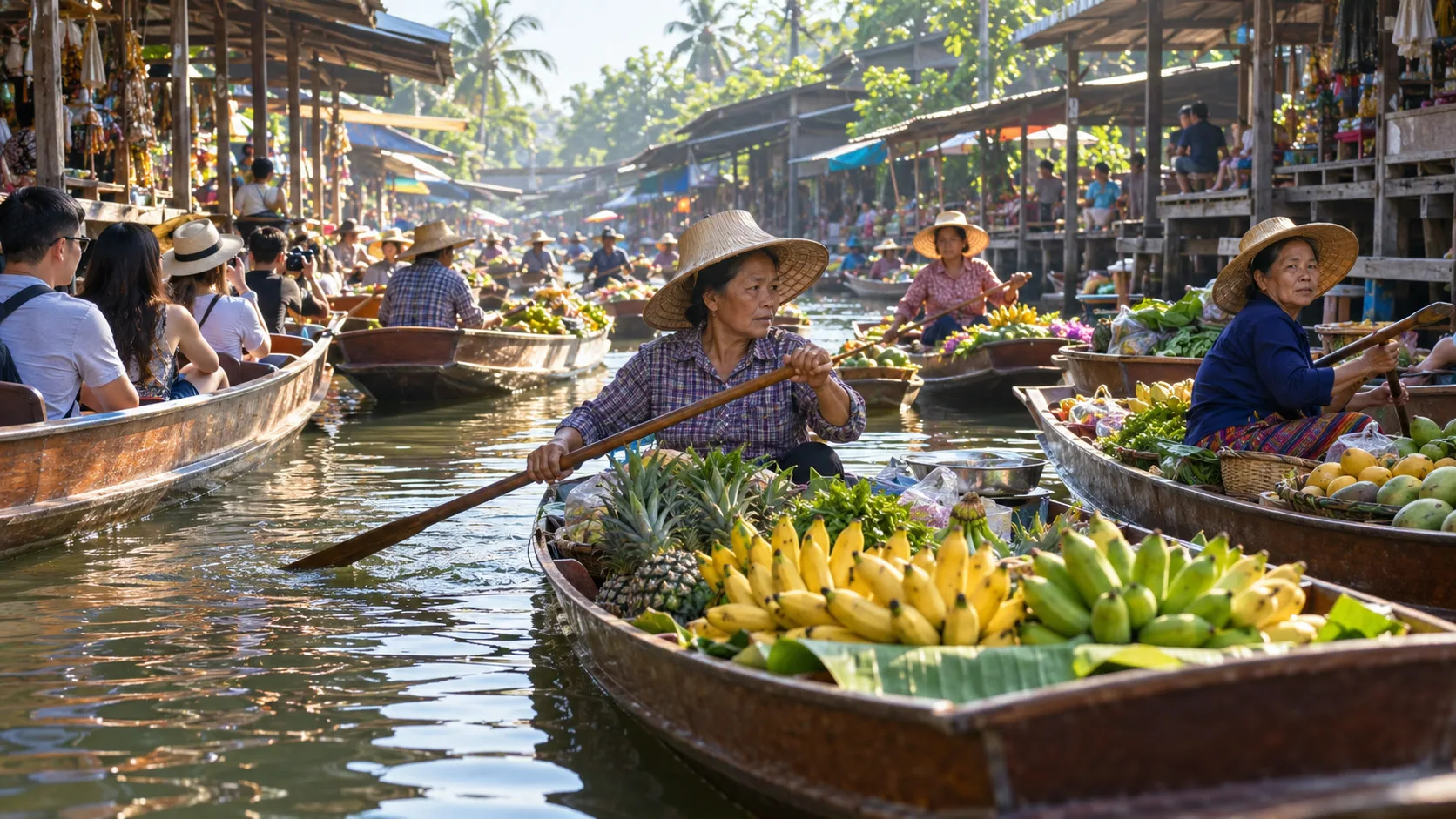
Damnoen Saduak Floating Market is one of Thailand’s best-known canal markets. Its fruit-laden boats and narrow waterways have appeared in travel photographs for decades. The market is in Ratchaburi Province, outside Bangkok, and works best as an early day trip rather than a quick stop squeezed between central-city attractions.
It is also important to arrive with realistic expectations. Damnoen Saduak is popular, highly photographed and organised around visitors. It is not a hidden village market untouched by tourism. At the same time, the canal network, wooden buildings, vendors, food and agricultural surroundings still provide a useful introduction to the history of water-based trade in central Thailand.
The official Tourism Authority of Thailand listing for Damnoen Saduak describes the market’s canal setting and history. TAT also provides broader information about Ratchaburi Province. Check current local information shortly before travelling because opening patterns, boat operations, traffic and individual stalls can change.
What Damnoen Saduak Floating Market is really like
The central visitor area combines vendors in small boats, shops along the canal and piers offering boat trips. Fruit, drinks, cooked food and souvenirs appear throughout the route. Some sellers paddle; others remain beside the bank. Depending on the time and day, visitors may encounter a photogenic flow of boats or a quieter canal with fewer active vendors.
The experience has two layers. The first is the famous market scene, which is busy, commercial and designed partly for tourism. The second is the wider canal landscape, where orchards, homes, temples and older trading areas show why waterways mattered to the district. A boat route that includes more than the busiest retail channel can provide a broader view, but the exact route must be agreed before boarding.
A market shaped by canals
Tourism Authority of Thailand records that the Damnoen Saduak Canal was created on the initiative of King Rama IV to connect waterways used for transport and trade. The project took more than two years and was completed during the reign of King Rama V. The canal extends for about 32 kilometres and has more than 200 branches.
For generations, boats allowed farmers and traders to move fruit, vegetables and other goods from surrounding agricultural areas. Modern roads and retail changed everyday shopping habits, while the floating market became an important visitor attraction. That history explains both the genuine waterway setting and the market’s modern tourism focus.
When to visit Damnoen Saduak
Early morning is usually the most practical period. The temperature is lower, the light is softer and more boat-based activity may be visible. Arriving early also creates time to continue to another Ratchaburi or Samut Songkhram attraction without rushing.
There is no exact arrival time that guarantees a particular number of boats or an uncrowded canal. Coach schedules, weekends, holidays, weather and seasonal travel patterns all influence the atmosphere. A market can be lively and crowded at the same time. Anyone promising a private or empty canal during normal visitor activity is making a claim that cannot be guaranteed.
| Planning point | Practical approach | Why it matters |
|---|---|---|
| Departure from Bangkok | Leave early and allow extra road time | Traffic can change the journey in both directions |
| Time at the market | Allow time for a walk and an optional boat route | Rushing encourages poor decisions at the first pier |
| Boat choice | Confirm route, duration, total price and stopping points first | Different boats and piers may offer different experiences |
| Food and shopping | Carry small cash and compare before buying | Payment options and visitor pricing vary |
| Weather | Bring sun and rain protection | Boats provide limited shelter and conditions change quickly |
| Second stop | Choose one compatible nearby attraction | A focused day is more comfortable than an overloaded route |
How long to allow
The market itself does not require a full day, but the complete journey from Bangkok does. Time is needed for road transfers, finding the correct pier, a boat trip if chosen, walking, food and a possible second attraction. A short visit may be enough for photographs; a longer canal route provides more context.
Do not build a tight airport connection or fixed appointment immediately after the market. Road conditions can make the return less predictable than the outward journey. Keep a buffer, especially on weekends and public holidays.
Choosing a boat without pressure
A boat is optional, but it can reveal parts of the canal that are difficult to see from the bank. The important step is understanding the offer. Before paying, ask whether the boat is paddled or motorised, how long the route takes, which canals it enters, whether it stops at shops and where it returns.

Questions to ask before boarding
- What is the total price for the whole boat or for each passenger?
- How long is the trip from departure to return?
- Is the route limited to the main market or does it enter surrounding canals?
- Are shopping stops optional, and can they be skipped?
- Does the boat return to the same pier?
- Is an appropriate life jacket available for every passenger?
- Can a child, older traveller or person with limited mobility board safely?
If the answers are unclear, step back and compare another option. There is no need to accept the first offer immediately. A clear agreement is more important than a small difference in price.
Paddle boat or motorboat
A paddle boat moves slowly and suits the compact market area. It is quieter and keeps passengers close to the vendors. A motorboat can cover a wider canal route, but it is noisier and may move too quickly for close market observation. The best choice depends on whether the priority is the famous market scene or the broader canal landscape.
Boat availability and routes are operational matters. Confirm them locally for the date of travel. Do not assume that a route shown in an old video is still offered in the same form.
Exploring on foot
Visitors can see part of the market without taking a boat. Walkways and bridges provide views over the canal, access to fixed stalls and places to watch vendors pass below. Walking first can help the group understand the layout before deciding whether a boat adds value.
Surfaces may be narrow, uneven or wet. Watch for steps and boat ropes near the water. People with limited mobility should ask about the exact pier and boarding arrangement rather than relying on a general claim that the market is accessible.
Photography from the bank
Bridges and canal bends create useful viewpoints. Early light is normally easier than harsh midday sun, but respect vendors and other visitors. Ask before taking a close portrait. Avoid blocking narrow paths or leaning over a moving boat for a photograph.
Long lenses can compress the canal and make it appear more crowded than it feels. Wide-angle images show more context but can distort people at the edges. A varied set of photographs is more honest than presenting one tightly packed scene as the entire market.
What to eat and drink
Offerings vary, but visitors may see fruit, coconut products, noodles, grilled snacks, sweets and drinks sold from boats or bank-side stalls. Choose food that is cooked thoroughly and served hot. Look at how ingredients are stored and how quickly a stall turns over customers.
If someone has a food allergy, communicate it clearly in Thai where possible. Shared utensils and cooking surfaces can make complete separation difficult. Travellers with strict dietary needs may prefer a planned restaurant stop rather than relying entirely on spontaneous market food.

Useful food-market habits
- Start with small portions if the group wants to try several items.
- Carry tissues, hand sanitiser and drinking water.
- Use small cash notes and confirm the price before ordering.
- Do not assume that every product described as local was produced nearby.
- Dispose of waste carefully and keep plastic away from the canal.
Shopping and bargaining
Souvenirs, clothing, hats, crafts, packaged food and decorative items are common. Quality and origin vary. Compare similar items at several stalls before buying. If bargaining is appropriate, keep it polite and brief. A disagreement over a small amount is not worth turning the visit unpleasant.
Do not buy wildlife products, protected species, antiques of uncertain origin or items that may create customs problems. For food products, check packaging and destination-country rules before carrying them home.
How to avoid an impulse purchase
Decide in advance what the group actually wants to buy. Keep the first part of the walk observational, then return to a chosen stall if the item still seems worthwhile. This reduces pressure and makes it easier to compare quality.
Getting from Bangkok to Damnoen Saduak
The market is roughly 100 kilometres from central Bangkok, depending on the starting point and route. Road travel is the simplest option for most short-stay visitors. A private car with a driver gives control over departure time and makes it easier to add a second stop. A taxi or app-booked car requires a clear agreement about the return journey and waiting time.
Public transport combinations may be possible, but they take more planning and can leave a final local transfer. Timetables and terminals change, so verify current information rather than relying on a detailed old itinerary. For a first visit with limited time, a confirmed road arrangement is usually easier to manage.
What a transport agreement should state
- Pickup location and time.
- Whether the vehicle waits at the market.
- Any second stop and the order of the route.
- Where the trip finishes.
- What is included in the quote.
- Whether boat tickets, meals and attraction fees are separate.
A driver is not automatically a licensed tourist guide. Transport and guiding should be described separately. If the group needs explanations throughout the day, confirm the guiding service explicitly.
Combining Damnoen Saduak with Maeklong Railway Market
Damnoen Saduak and Maeklong are often combined because they lie in the same broader direction from Bangkok. The pairing can work well: one stop focuses on canals and boats, while the other is a functioning market beside an active railway.
The train is not a performance scheduled for visitors. It operates as transport, and the market adjusts around it. Check the current railway schedule and follow staff instructions. Stand behind the safe boundary, keep bags and camera equipment clear of the track, and never enter the line for a photograph as a train approaches.
Read the English Maeklong Railway Market guide and verify operational details with the official Tourism Authority of Thailand listing. A missed train movement can substantially change the timing of the day, so the route needs a buffer.
Do not overload the return journey
Adding a third distant attraction can turn the day into repeated transfers. If the group wants more than the two markets, choose something genuinely compatible with the route and opening hours. A relaxed lunch or a short local stop may be more useful than another headline attraction.
Is Damnoen Saduak authentic or touristy?
It is both a real canal environment with a long trading history and a major tourism attraction. Pretending it is untouched by visitors creates false expectations. Dismissing it entirely also ignores the waterway, agricultural landscape and people who continue to work there.
The visit is most satisfying when treated as an introduction to canal-based commerce rather than proof that daily life across Thailand still looks exactly like this. Visitors seeking a quieter community experience may prefer Lao Tuk Luck or another local market, but those places have different operating patterns and should be researched separately.
Who is likely to enjoy it
- First-time visitors who want the classic floating-market scene.
- Photographers comfortable with a busy, commercial environment.
- Families able to manage an early start and careful boat supervision.
- Groups combining the market with Maeklong.
- Travellers interested in the wider canal district as well as shopping.
Who may prefer another plan
Travellers looking for a quiet, purely local market with few visitors may be disappointed. The same applies to anyone who dislikes early departures, bargaining, narrow boats or crowded walkways. A different Ratchaburi community visit or a Bangkok canal route may fit better.
Weather and seasonal conditions
The market operates in a tropical climate. Even an early visit can become hot and humid, while a sudden shower can make walkways slippery and reduce visibility from the boat. Shade on the water is limited. A hat, water and sunscreen are useful throughout the year, and a light rain cover is worth carrying when showers are possible.
Weather also affects road travel and the pace of the canal. Heavy rain can slow the journey from Bangkok, change where passengers board and make a long boat route less comfortable. Do not rely on a general dry-season description as a forecast for the actual morning. Check a current forecast and ask the operator how poor weather would affect the plan.
Air quality can vary across central Thailand. Travellers with respiratory or cardiovascular conditions should consult current information and follow their own medical guidance. If heat, rain or air quality makes the original route unsuitable, shorten the boat portion or choose a covered stop rather than forcing the schedule.
Children, older travellers and accessibility
Children can enjoy the boats and fruit stalls, but they require close supervision near the water. Confirm a suitable life jacket and keep children seated during the ride. Bring sun protection, water and a small snack they will reliably eat.
For older travellers or anyone with limited mobility, the main issue is boarding. Some boats sit low in the water and require a large step. Ask for a photograph or precise description of the pier if mobility is important. A walking-only visit may be the safer choice for some guests.
What to bring
- Light clothing and comfortable shoes with grip.
- A hat, sunscreen and drinking water.
- A compact rain cover or umbrella in unsettled weather.
- Small-denomination cash.
- A secure bag that stays close to the body.
- Any essential medication.
- A phone with the pickup point saved offline.
Keep camera equipment simple. Space in a small boat is limited, and changing lenses while the boat moves increases the risk of dropping equipment or blocking other passengers.
Private arrangements with AsiaTrip
AsiaTrip EN can arrange a visit for one existing closed private group of 4 to 20 guests. Unrelated customers are not combined. The route is discussed for that group, including the pickup point, preferred pace and whether Damnoen Saduak is combined with Maeklong or another compatible stop.
An individual quote is prepared in THB. There is no public package price on this page. The confirmed arrangement states what is included, such as private transport, local coordination, guide, boat trip, tickets or meals. A driver is not described as a licensed guide unless that service has been specifically confirmed.
Browse the English private-tour collection for route ideas or use the English contact page to request an individual arrangement.
Frequently asked questions
Is Damnoen Saduak Floating Market worth visiting?
It can be worthwhile for the classic canal scene, early-morning atmosphere and combination with Maeklong. It is also tourist-oriented. The decision depends on whether that famous market experience matches the group’s interests.
What is the best time to arrive?
Early morning is generally the most practical period for lower heat and greater market activity. No exact time guarantees a quiet canal or a particular number of boats. Check current local information for the date of travel.
Do you have to take a boat?
No. Walking areas and bridges provide views of the canal and access to fixed stalls. A boat adds a different perspective and can enter the wider canal network, depending on the agreed route.
How much should a boat cost?
Prices vary by pier, boat type, route, duration and whether the quote is for the whole boat or each passenger. Confirm the total before boarding and compare an unclear offer. This guide does not present a fixed current price because it may become inaccurate.
Can Damnoen Saduak and Maeklong be visited on the same day?
Yes, they are commonly combined. The order should reflect road conditions, current market activity and the actual railway timetable. Keep a buffer instead of planning every minute around an old schedule.
Is the market suitable for children?
It can be, with close supervision, an early start and a suitable boat arrangement. Confirm life jackets and boarding conditions. Families that prefer not to use a boat can still see part of the market on foot.
Final checklist
- Confirm current market information shortly before travel.
- Leave Bangkok early and keep a road-time buffer.
- Ask for the boat route, duration and total price before paying.
- Check life jackets and boarding conditions for the whole group.
- Carry small cash, water, sun protection and rain cover.
- Verify the current train schedule if combining the visit with Maeklong.
- Confirm every included service in a private arrangement.
Damnoen Saduak is best approached with curiosity and clear expectations. It is a famous tourism site within a genuine canal landscape, not an untouched secret. An early start, a carefully chosen boat route and a realistic day plan make it easier to appreciate both sides of the experience.
No comments