

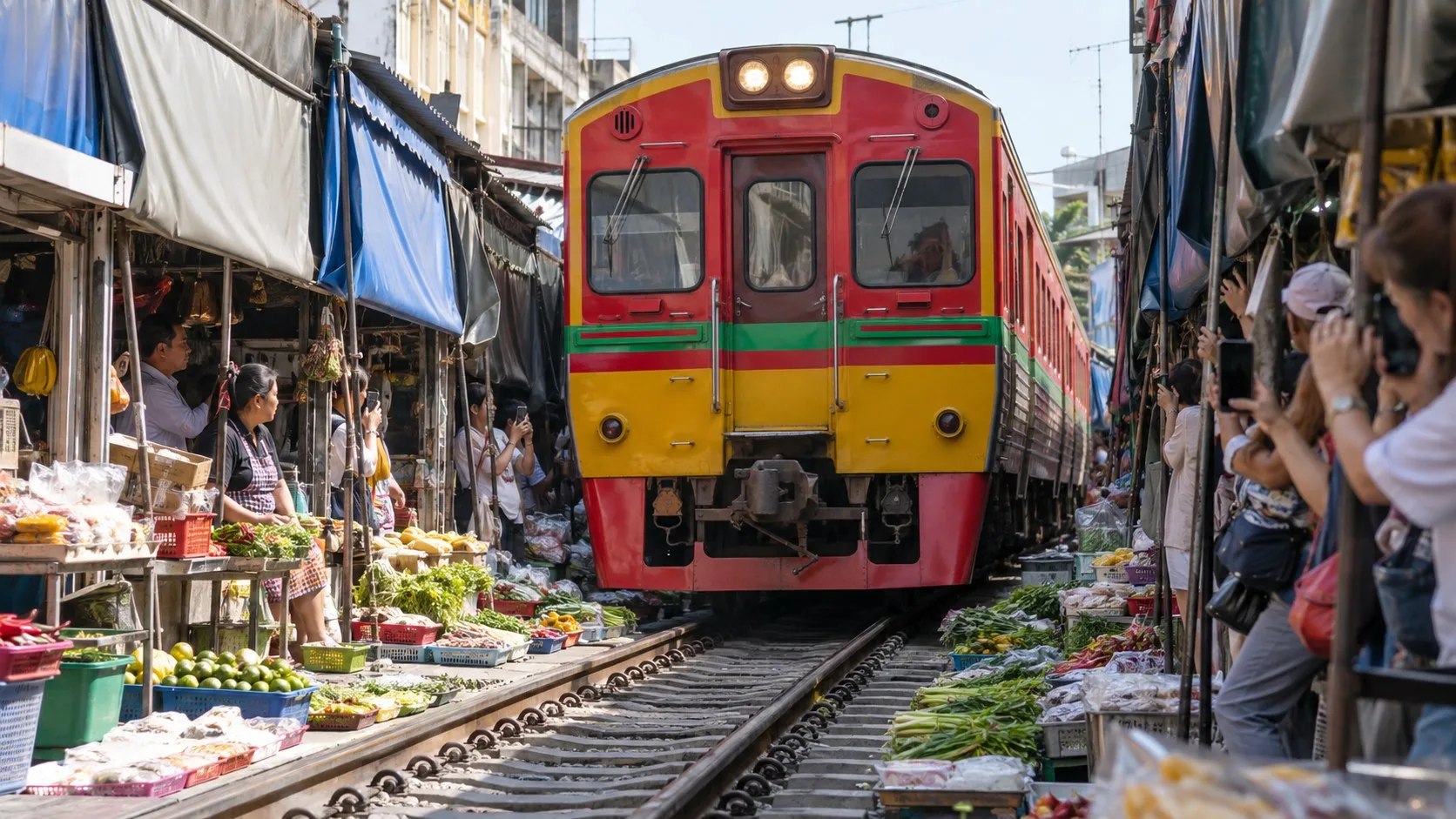
Maeklong Railway Market is a working food market beside Mae Klong station in Samut Songkhram. Its stalls extend close to an active railway line. When a train approaches, vendors fold back their awnings, clear the required space and resume trading after it has passed. The scene is remarkable, but it is not a staged attraction. People are working here, trains are operating and visitors must follow local instructions.
This guide explains what the market is, how to plan the journey from Bangkok, where to verify current train information and how to watch the train safely. It also covers market etiquette, food, photography and useful nearby stops. Timetables, transport arrangements and opening patterns can change, so the practical checks below matter more than a copied list of old times.

Why Maeklong Railway Market is unusual
The market is often called Rom Hoop Market or Talat Rom Hup, a name associated with the folding umbrellas and awnings. It sits near Mae Klong railway station in the compact provincial capital. Fresh produce, seafood, herbs, curry pastes and everyday groceries are sold along the narrow trading lane. The railway is part of the market’s daily environment rather than a display installed for tourists.
The Tourism Authority of Thailand identifies Rom Hoob Market as one of the attractions of Samut Songkhram and places it beside Mae Klong station. That official description is useful because online articles sometimes treat the train passage as a show and overlook the market’s local role.
The most memorable moment begins before the train is visible. Vendors respond to familiar signals, move baskets that need more clearance and fold the awnings. Visitors are directed away from the track. The train passes slowly through a space that looked like a market aisle moments earlier. Once it clears, trading resumes. Watching the full sequence is more interesting than arriving only for a quick photograph.
Check the current train information before travelling
Do not plan your day around train times copied from an old blog post. The Maeklong line is an operating railway, so services can be changed, delayed or temporarily adjusted. Check the current information published by the State Railway of Thailand, then confirm again with the station or your organiser close to the visit.
Allow extra time. Road traffic from Bangkok is variable, while a local rail journey includes connections and a river crossing. Arriving at the last minute can leave you without a safe viewing position. It can also encourage rushed behaviour around an active track. A sensible plan includes enough margin to walk through the market before the train approaches.
| What to confirm | Why it matters | Reliable approach |
|---|---|---|
| Current train movements | Published times can change | Check State Railway of Thailand information and confirm locally |
| Road travel time | Bangkok traffic varies by day and departure point | Leave a generous buffer rather than planning to the minute |
| Local transport connection | Independent rail travel involves separate sections | Verify each leg and the river crossing before departure |
| Nearby market schedule | Amphawa and other markets have their own operating patterns | Use current official information for the date of your visit |
| Weather | Heat and rain affect comfort and walking conditions | Carry water and light rain protection, and wear secure footwear |
How to get to Maeklong from Bangkok
Mae Klong is southwest of central Bangkok. The best transport option depends on the time you have, the number of people in your party and whether the journey itself is part of the experience. There is no single correct choice.
Private road transport
A car or van with a driver is the simplest option for a family or a closed group that wants to combine several stops. It avoids the rail changes required on the independent route and allows the day to be adjusted around current conditions. Travel time still depends on traffic, so private transport does not make an exact arrival time guaranteed.
AsiaTrip arranges tours only for one existing closed private group of 4 to 20 guests. Unrelated customers are not combined. An individual quote is prepared in THB after the route, date, pickup point and group requirements are confirmed. There is no public package price on this page.
Independent train journey
The independent rail route can be rewarding for travellers who enjoy local transport and have a flexible day. It normally uses the separate rail section from Wongwian Yai to Maha Chai, a walk and ferry crossing, then the Ban Laem to Mae Klong section. It is not one direct train from central Bangkok. Each connection should be checked against current operating information.
This option needs more time and attention than a road transfer. It may not suit travellers with limited mobility, heavy luggage or a tightly scheduled onward journey. If you choose it, keep enough time for finding the pier, crossing the river and reaching the next station without rushing.
Public road transport
Public vans and buses may serve the area, but departure points and operating arrangements can change. Confirm the terminal and service on the day rather than relying on an old article. This can be an economical route, although it offers less control over arrival time and nearby stops.

Safety when the train approaches
The train moves through a confined working space. Slow speed does not remove the danger. A carriage is heavy, clearance is limited and the crowd can make sudden movement difficult. Treat every warning as an instruction, not as part of a performance.
- Leave the tracks as soon as vendors or railway staff begin preparing for the train.
- Stand only in the position indicated locally. Do not assume a gap is safe because another visitor is using it.
- Keep phones, cameras, straps and selfie sticks within the safe standing area.
- Do not lean towards the carriage, step forward for a final photograph or touch the train.
- Keep children beside an adult and hold their hand before the train arrives.
- Do not place a tripod, bag or pushchair where it blocks the aisle or an escape route.
- Wait until the train has completely passed and vendors begin reopening the space before moving back.
A good photograph is never worth ignoring a warning. Choose a place with stable footing and enough room before the crowd tightens. Take a few photographs, then watch the scene directly. The change from market lane to railway and back again is easier to understand when you are not looking only through a screen.
Respect a working market
Maeklong is not a film set. Vendors need access to their produce, customers and storage areas. Keep the trading lane clear, especially while people are moving awnings and baskets. Ask before taking a close portrait. A simple gesture towards the camera is often enough to request permission.
Do not handle fresh food unnecessarily. If you want to buy something, point clearly, confirm the price and pay without creating an obstruction. Aggressive bargaining over a small purchase is inappropriate. Seafood and other perishable goods also need practical handling, so consider whether an item can be transported safely before buying it.

What you may see and eat
The precise selection changes with the season and time of day. Common sights include fish and shellfish from the region, vegetables, herbs, tropical fruit, dried ingredients, curry pastes and prepared snacks. The food market is part of the experience, not just a background for the train.
If you want to taste something, choose a busy stall with food handled hygienically and cooked items served hot. Drink sealed water in warm weather. People with allergies should not assume that a snack is free from seafood, peanuts or other ingredients simply because they are not visible. Ask clearly, and skip an item if the answer is uncertain.
How long to allow
The market itself is compact, but the visit should not be planned to the minute. Time is needed to walk from the station area, understand where the train will pass, find a safe place and explore the stalls without blocking trade. The appropriate stay depends on the confirmed train movement and whether you want to see only one passage or spend longer in town.
For most visitors, Maeklong works best as one part of a broader day in Samut Songkhram or nearby Ratchaburi. It does not need to be stretched into an all-day attraction. A calmer plan with one or two compatible stops is usually better than racing through a long list.
Combining Maeklong with a floating market
Maeklong is frequently combined with Damnoen Saduak because the two places can fit into a morning route when current schedules and traffic allow. The experiences are different: Maeklong is a working food market on a railway, while Damnoen Saduak is known for canal traffic and boat-based commerce. Read our guide to floating markets near Bangkok before choosing which atmosphere suits your day.
There is also a dedicated Maeklong and Damnoen Saduak day trip guide and a private railway and floating market tour page. These pages describe the intended route, but availability, the current train movement and the final sequence still need confirmation for the selected date.
Amphawa and Wat Bang Kung
Amphawa has a different rhythm and should not be treated as an automatic substitute for a morning floating market. The Tourism Authority of Thailand information for Amphawa is the right place to check its current visitor details. Its schedule and character may suit a later visit, depending on the day.
Wat Bang Kung can add a cultural stop in the same province. If you include a temple, wear clothing that covers shoulders and knees, behave quietly and follow local signs. Combining the market with too many distant attractions can make the day feel rushed, so travel time should guide the final choice.
Photography without causing problems
The strongest photographs show context: the stalls, the folded awnings, the people maintaining a safe corridor and the train moving through the lane. A very tight crop of the carriage may look dramatic, but it does not explain the place. Use a normal or moderately wide view from an approved position.
Do not use a drone over a dense market without confirming every legal and local requirement. Do not use flash close to a driver’s line of sight. Avoid filming strangers at close range for long periods. If a vendor signals that photography is unwelcome, stop immediately.
Accessibility and family planning
The market has narrow passages, uneven surfaces, crowds and an active railway. These conditions can be difficult for wheelchairs, pushchairs and visitors who need stable footing. Ask about the current access route before travelling. A private vehicle may simplify transport, but it does not remove the physical limitations inside the market.
Families should explain the safety rules before reaching the tracks. Keep children close even between trains because carts, shoppers and goods occupy the same narrow space. Bring water, sun protection and only the equipment you can carry without obstructing others.
Common planning mistakes
- Using an old timetable: confirm current rail information instead of copying times from a search result.
- Arriving at the last moment: build in a buffer for traffic, connections and finding a safe position.
- Standing on the track for a photograph: clear the railway as soon as preparations begin.
- Blocking the market: vendors and local shoppers have priority in the working space.
- Planning too many stops: allow for realistic travel time and changing conditions.
- Assuming every floating market follows the same schedule: check each attraction separately.
- Believing private transport guarantees an exact time: traffic and railway operations remain outside the driver’s control.
Frequently asked questions
Is Maeklong Railway Market a real market?
Yes. It is a working local food market beside an active railway near Mae Klong station. The train passage is striking, but trade continues before and after it.
Are the train times always the same?
No schedule should be treated as permanent. Check the State Railway of Thailand and confirm current information locally or with the organiser close to the visit.
Can I stand on the tracks before the train arrives?
Visitors may walk through the market area when local conditions allow, but the tracks must be cleared promptly when vendors or staff prepare for a train. Never remain there for a photograph after warnings begin.
Is the market suitable for young children?
Families can visit, but adults must keep children beside them and follow safety instructions closely. The combination of crowds, narrow passages and an active railway requires constant attention.
Is there a public AsiaTrip price for this trip?
No. AsiaTrip does not publish a fixed package price for this private arrangement. An individual quote is prepared in THB for one existing closed group of 4 to 20 guests after the requirements are confirmed.
Can unrelated travellers join the same AsiaTrip group?
No. Unrelated customers are not combined. The arrangement is prepared for one existing closed private group.
What should I combine with Maeklong?
Damnoen Saduak is a common morning combination. Amphawa or Wat Bang Kung may fit a different schedule. Choose after checking the current operating information and realistic travel time.
Plan the visit responsibly
Maeklong Railway Market is memorable because ordinary trading and an active railway share a very small space. The best visit respects both. Verify current train information, arrive with time to spare, stand where local people direct you and keep the market clear for those who work there.
If your group wants help planning the route, review the private tours from Bangkok or contact AsiaTrip with the date, pickup area and number of travellers. The response can then address the current timetable, a realistic sequence of stops and an individual quote in THB without making assumptions about availability.
No comments