

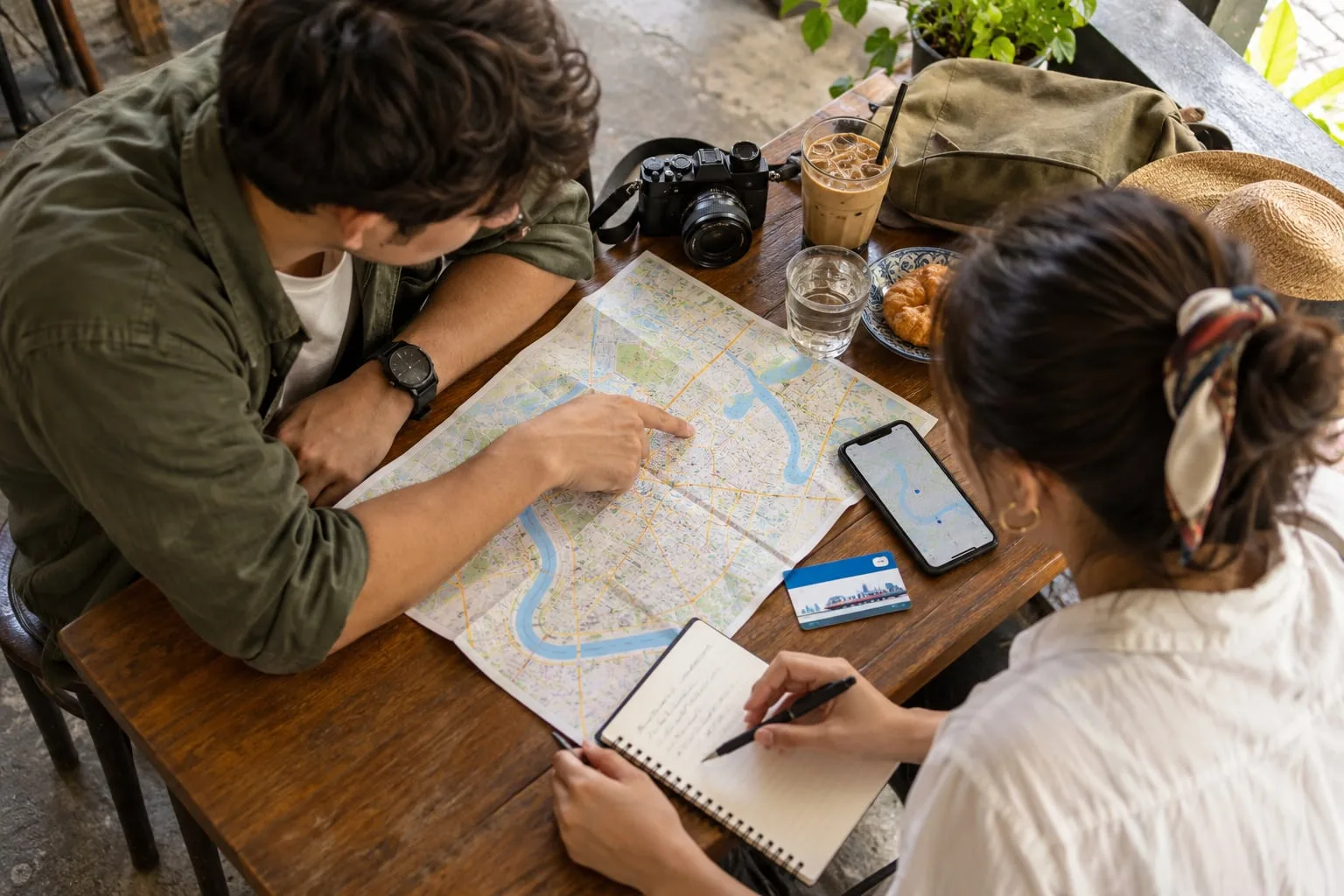
Bangkok combines historic temples, riverside neighbourhoods, public parks, markets, contemporary art and panoramic viewpoints. This guide groups 16 places to visit in Bangkok by area, travel time and practical conditions so that you can build a realistic three-day plan.
Opening hours, admission rules, transport schedules and temporary closures can change. Confirm current details on the official visitor pages linked in the relevant sections before travelling.
If you would rather start with a shorter list, use the top 10 places in Bangkok to identify your priorities before arranging a day in the city.
Below are 16 specific places, from the Grand Palace and Wat Arun to Talat Noi and BACC. The timing notes form a practical three-day outline, but they should be adjusted for the weekday, weather, mobility needs and the current opening schedule.
If you are focusing on the three major riverside temples, see the separate itinerary covering the order of visits, tickets and dress code for Wat Arun, Wat Pho and the Grand Palace in one day.
Before you start: a private Bangkok itinerary
AsiaTrip arranges private Bangkok itineraries for one closed group of 4 to 20 guests. Unrelated customers are not combined. Each itinerary is prepared by individual quote in THB, with no public package price list.
How the route is confirmed
The route can combine selected places from this guide, but the final stops, order, duration and meeting point are confirmed before payment. The written quote states whether transport, admission tickets, a boat trip, local coordination or licensed guiding is included.
AsiaTrip coordination and licensed guiding are separate services. When a licensed guide is included, the written quote states the guide language and scope. The language of this website does not prove the language of an individual service.
Who this format may suit
A private itinerary can suit first-time visitors, families and groups that do not want to join unrelated travellers. Any accessibility, pace or mobility requirements should be provided before the route is confirmed.
How to prepare
Bring clothing that meets temple rules, drinking water and comfortable footwear. Any additional preparation instructions depend on the confirmed itinerary.
1. The Grand Palace and Wat Phra Kaew
The Grand Palace and Wat Phra Kaew form the ceremonial heart of historic Bangkok and are a logical starting point for a first visit to the old city.

Why visit
The palace complex served as the royal residence and administrative centre from the late eighteenth century. Wat Phra Kaew houses the Emerald Buddha, one of Thailand’s most important religious images. The complex brings royal history, architecture and active religious practice together in one place.
What you will see
The complex contains dozens of buildings and pavilions, including the Chakri Throne Hall and Dusit Maha Prasat Hall. Gilded roofs, murals depicting the Ramayana on the walls around Wat Phra Kaew and guardian statues at every entrance create an atmosphere no photograph can capture.
Allow at least two hours to explore. The complex is much larger than it looks on the map.
Getting there and how long to allow
Tha Chang Pier is close to the palace, while taxi and app-based transport are alternatives depending on traffic. The official Grand Palace visitor information currently lists daily opening from 08:30 to 16:30, ticket sales until 15:30 and a foreign-visitor ticket of THB 500. Ceremonies can change access, so recheck the official page on the day.
Dress code and common mistakes
Visitors must dress respectfully. The official rules prohibit sleeveless or revealing tops, shorts, short skirts, torn trousers and tight exercise clothing. Wear suitable clothes before arrival rather than relying on finding a last-minute solution at the entrance.
Best time to visit during a three-day itinerary
Plan your visit for the morning of day one, before the sun gets high and the crowds build up. The complex can get very crowded in the afternoon, making the visit less enjoyable.
2. Wat Pho
Wat Pho is a few hundred metres from the Grand Palace, and most tourists combine the two in one trip. That is a good idea, because the temple is one of the oldest and largest in Bangkok and deserves time of its own.
Why visit
Wat Pho is an important religious and educational site. Inscriptions throughout the complex preserve knowledge including traditional medicine, literature and astronomy, which is why the temple is often described as an early public centre of learning.
What you will see
The main attraction is the 46-metre-long Reclining Buddha, covered in gold leaf, with mother-of-pearl inlays on the soles of its feet. The complex also contains nearly 400 smaller statues and dozens of pagodas. The grounds are extensive, so bring water.
Walk the full length of the Reclining Buddha along its side to see the 108 symbols of the Dharma engraved on the soles of its feet.
Getting there and how long to allow
Allow roughly 60 to 90 minutes for the main halls and grounds. The official Wat Pho visitor plan currently lists opening from 08:00 to 19:30, a THB 300 ticket for foreign visitors and free entry for children under 120 cm. Recheck before travelling.
Thai massage at the temple
The temple grounds include a traditional medical and massage school. The official visitor page lists current massage services and prices, but availability can vary. Treat a massage as a separate service rather than assuming it is included with temple admission.
Best time to visit during a three-day itinerary
Plan to visit Wat Pho immediately after the Grand Palace, ideally before noon on day one. The two places are close to each other and make a natural pairing logistically.
3. Wat Arun
Wat Arun, or the Temple of Dawn, is one of Bangkok’s most recognisable riverside landmarks. Its central prang is decorated with ceramic and porcelain details that reward a closer look.

Why visit
The temple stands on the west bank of the Chao Phraya, opposite Wat Pho, and the view from the river is one of the most beautiful in the city. The tower looks different at every time of day: it glows white in the morning, while in the evening golden floodlights illuminate it and reflect in the river.
What you will see
The complex contains four smaller prangs surrounding the central tower, as well as an ordination hall with a Buddha statue. You can climb the prang to a certain height, where you will have a view of the river and the nearby temples on both banks.
How to cross the river
A small cross-river ferry connects the Tha Tien area with the Wat Arun side. Pier arrangements and fares can change, so check the signs and destination before boarding rather than relying on an old route description.
Keep small cash available for local river transport and follow the current boarding instructions at the pier.
Photos, stairs and safety on the prang
Access around the prang can involve steep steps. Use the handrail, follow barriers and staff instructions, and avoid climbing while holding a phone or camera. Accessibility varies across the historic site.
Best time to visit during a three-day itinerary
Late afternoon can provide softer light, but plan around the current closing time. The Tourism Authority of Thailand listing currently states daily opening from 08:00 to 18:00 and a foreign-adult ticket of THB 200.
4. Chao Phraya river boats
The Chao Phraya River is the transport backbone of old Bangkok and one of the best ways to travel between attractions without getting stuck in traffic. Think of it not just as a way to get around, but as an attraction in its own right.
Why visit
Seeing Bangkok from the water gives a different perspective from walking its streets. River services can also connect several old-city attractions without crossing the most congested roads.
How river transport works and how to buy a ticket
Chao Phraya services use coloured route flags and different stopping patterns. The timetable was revised in 2026, so do not assume the orange route runs all day or every day. Check the official Chao Phraya Express Boat schedule, confirm the direction at the pier and follow the current ticket instructions.
Avoid unmarked boats that approach tourists at the main piers. Fares for foreign visitors can be many times higher than the regular fare.
Best piers for the attractions in this itinerary
Three piers cover most of the places in this article: Tha Chang (N9) serves the Grand Palace and Wat Pho, Tha Tien (N8) is the starting point for Wat Arun, and Sathorn (Central) connects directly to the BTS Skytrain.
How to avoid traffic and overpaying
Road traffic can be slow during commuter periods. A scheduled river service may avoid part of that delay, but it does not serve every destination. Before accepting a private long-tail boat, confirm the complete price, route, duration and return point.
Best time to visit during a three-day itinerary
Take the river boat on the morning of day one to travel from the city centre area straight to the Grand Palace. The ride takes around 15 minutes and gives you an immediate feel for the city.
5. Chinatown and Yaowarat
Yaowarat is the commercial and cultural centre of Bangkok’s Chinatown. The neighbourhood combines temples, gold shops, markets, long-running restaurants and evening street food.

Why visit
Chinatown is one of the capital’s oldest and most distinctive districts. Yaowarat Road runs past gold shops, tea houses, long-running restaurants and market stalls. English is not available everywhere, but menus with photos and simple translation tools can help. The area has a different pace and character from Bangkok’s main visitor districts.
Street food, neon lights and the atmosphere after dark
After dark, the district changes completely. Red and gold neon lights illuminate the streets, and food carts appear outside the shops. Be sure to try pad thai, oysters fried on a hot plate and crab soup, served by street vendors lining Yaowarat Road from the evening onwards.
Come after 18:00, when the district really comes alive and the food selection is at its widest.
What to see beyond the food
Chinatown is about more than food. Wat Traimit houses the world’s largest solid gold Buddha statue, weighing more than five tonnes. Nearby, you will also find narrow alleys with paper factories and incense shops that have been operating here for generations.
Getting there and getting around
Wat Mangkon MRT station is the most direct rail stop for central Yaowarat. Hua Lamphong can work for Wat Traimit and Talat Noi, while Sam Yot is better for the western end. Walk within each cluster rather than assuming a fixed road-travel time.
Best time to visit during a three-day itinerary
Plan your visit for the evening of day two, when temperatures are lower and the district is at its best.
6. Talat Noi
Talat Noi is an old port district just next to Chinatown, which most tourists pass through without stopping. It is one of the most overlooked places among the things to do in Bangkok, especially if you are interested in places with history and character.
Why visit
The district developed around river trade and workshops. Historic shophouses, shrines, old machinery businesses, warehouses and newer creative spaces now sit side by side in a living neighbourhood.
Street art and the most interesting alleyways
For years, murals and street art installations have appeared on the walls of Talat Noi, attracting photographers and urban art fans from around the world. An alley off Talat Noi Road winds through narrow passageways whose walls are covered with work by local and international artists.
These lanes are residential and commercial spaces, not a set. Photograph people and private property only with permission, and keep doorways clear.
Cafés and places to take a break from the heat
There are several small cafés tucked away in old shophouses, serving good coffee and offering a moment of relief from the sun. Bangkok’s daytime heat can be exhausting, so a shaded break with a cold drink is a necessity, not a luxury.
How to combine Talat Noi with Chinatown
The two places are a few minutes apart by an easy walk along the river. Visit Talat Noi before Chinatown to start with a calmer atmosphere and end the evening at the food stalls on Yaowarat Road.
Best time to fit it into a 3-day itinerary
Visit Talat Noi in the late afternoon on your second day, just before heading out to Chinatown in the evening. The walk takes about an hour and leads you straight to Yaowarat.
7. Wat Saket and the Golden Mount
Wat Saket stands beside the artificial hill known as the Golden Mount. The route to the summit combines a temple visit with broad views over the old city. Check the current entrance arrangements at the site.
Why it’s worth a visit
Most Bangkok temples are viewed from street level. Wat Saket offers something different: a hilltop view across the entire historic centre, including the roof of the Grand Palace and the spire of Wat Arun rising above the trees. The hill is 78 metres high and can be seen from many points in the Rattanakosin district.
Climbing the Golden Mount step by step
A spiral path winds around the hill, shaded by trees and lined with bells along the way. Take your time, as you’ll pass dozens of small shrines and prayer plaques that are part of the experience. The climb takes 10 to 15 minutes.
Ring one of the bells near the summit. It’s a tradition followed by locals and visitors alike.
Views and the best times for photos
The best light for photos is early in the morning or an hour before sunset, when the city loses the harsh white glare of midday. From the summit, you can see a panorama stretching for several kilometres in every direction, including the distinctive skyline with high-rise buildings in the background.
Getting there and how long to spend
Wat Saket is near Bamrung Mueang Road. Allow roughly 45 to 60 minutes, including the climb and time at the summit. Road travel time varies significantly with traffic.
Best time to fit it into a 3-day itinerary
Plan your visit for the morning of your second day, before heading towards Chinatown or the markets. The hill is usually quiet before noon, and the short visit leaves the rest of your itinerary intact.
8. Khao San Road
Khao San Road is one of those Bangkok attractions that people have strong opinions about. Some love its energy and international crowds; others give it a wide berth. It’s worth stopping by at least once to make up your own mind.
Why it’s worth a visit
Khao San Road has been the epicentre of backpacker culture in Southeast Asia since the 1980s. The street is just under a kilometre long, but it’s packed with dozens of bars, food stalls, souvenir shops and tattoo parlours. It has a unique atmosphere, and walking among travellers from all over the world is an experience you won’t find anywhere else in the city.
What to do and what to avoid
The street is ideal for an evening stroll and dinner outdoors with live music. If you’re feeling adventurous, you can also try fried insects from the stalls near the entrance. Avoid buying electronics or watches from sellers who approach you from doorways, as the quality of these products rarely matches their price.
Spend no more than two hours on Khao San Road. After that, it gets too noisy to enjoy a meal or conversation.
Prices, touts and noisy bars
Prices on Khao San can be higher than in less tourist-oriented districts, especially in bars and venues aimed at international visitors. Confirm the full fare before taking a rickshaw or tuk-tuk, or use a transport app that shows the price and route.
Safety in the evening and at night
As in any crowded nightlife area, keep valuables in a closed bag, watch your drink and use a traceable transport service for the return journey. Conditions change by time and exact street, so avoid treating a general safety label as a guarantee.
Best time to fit it into a 3-day itinerary
Plan Khao San Road for the evening of your second or third day, as a relaxed end to a busy day of sightseeing. It’s not a place for the morning or afternoon.
9 and 10. Lumpini and Benjakitti parks
Bangkok doesn’t let up: the heat, noise and crowds can be exhausting after a full day exploring Bangkok attractions. Lumpini and Benjakitti are the two largest green spaces in the city centre and the best places to find some peace and quiet without leaving town.
Why they’re worth a visit
Lumpini Park covers more than 57 hectares and opens early in the morning. You’ll see runners, retirees practising tai chi and families with children, all beneath trees that provide real relief after hours in the sun. Benjakitti is a short distance away and, after its expansion in 2022, became one of the capital’s most modern parks.
How to take a break from the city without wasting time
Treat a park as a proper part of the itinerary rather than only a gap between sights. A 30 to 60 minute walk by Lumpini’s lake or along Benjakitti’s wetland paths changes the pace of the day. Bike availability and rules can change, so confirm them locally before relying on a rental.
Monitor lizards, running, boats and the best park entrances
Wild water monitor lizards live in Lumpini and wander freely around the lake. It’s not a zoo; they’re simply part of the urban wildlife. You can also rent a pedal boat on the lake. Lumpini’s main entrance is on the Rama IV side. The most convenient entrance to Benjakitti is near Sukhumvit MRT station.
Monitor lizards are wild animals. Keep a respectful distance, do not feed them and do not block their route to the water.
Getting there and travelling between the parks
Lumpini is right by the MRT station of the same name. Benjakitti is near Sukhumvit MRT station, less than a five-minute walk away. You can take a taxi between the parks or walk there in about 15 minutes.
Best time to fit them into a 3-day itinerary
Visit the parks early in the morning on your third day, while the temperature is still manageable, and see how Bangkok residents really start their day.
11. Chatuchak Market
Chatuchak is a vast weekend market with thousands of stalls across numbered sections. It is better treated as a half-day district than as a quick stop between unrelated attractions.
Why it’s worth a visit
The market offers almost everything, from clothes and jewellery to antiques and ceramics, as well as plants, pets and vintage furniture. Prices are many times lower than in shopping malls, and you won’t find the same range anywhere else in the city.
What to buy and what to skip
Crafts, fabrics, ceramics, plants, art and vintage goods are spread across different sections. Compare quality and prices before buying branded or electronic goods, and check export restrictions before purchasing antiques, wildlife products or plants.
Payment methods vary by stall. Carry some small-denomination cash, but keep it secure and use electronic payment only when you understand the amount shown.
Finding your way around and bargaining
The market is divided into numbered sections. Save a map before entering and agree on a meeting point if your group separates. Some vendors negotiate and others use fixed prices. Ask politely for the best price rather than assuming an aggressive percentage reduction.
When to visit and how to get there
Chatuchak is open on weekends only, from 9:00 to 18:00. You can get there by MRT or BTS, travelling from the city centre to Chatuchak Park or Mo Chit station in around 15 minutes.
Best time to fit it into a 3-day itinerary
Plan your visit for the morning of your third day, on a Saturday or Sunday, before the sun and crowds make shopping uncomfortable.
12. Jodd Fairs
Jodd Fairs is a popular evening market for food, drinks and casual browsing. It has changed locations more than once, so an old map pin or blog post may send you to a closed site.
Why it’s worth a visit
This market stands out from others in the city for its scale and variety. It isn’t aimed solely at tourists. It’s a place where Bangkok residents come for dinner and an evening stroll. The atmosphere is relaxed, music plays in the background, and people move freely between the rows of stalls.
What to eat and how to order if you don’t speak Thai
Most stalls have photos of the dishes at the counter or on signs, so you can simply point to what you’d like. Be sure to try mango sticky rice, grilled pork skewers and Thai waffles with different fillings. Prices are shown in Arabic numerals, so they’re easy to understand.
Bring small notes, as some vendors can’t give change for large bills.
Dealing with crowds and choosing a stall
The market fills up after 19:00, so come earlier if you want to browse the stalls at a relaxed pace. When choosing what to eat, look for queues at individual stalls, as a long queue is a reliable sign of good food.
Getting there and the best time to visit
The former Rama 9 site has closed. Before travelling, confirm the current venue, opening days and nearest MRT station on Jodd Fairs’ official social channels, because these details have changed repeatedly.
Best time to fit it into a 3-day itinerary
Plan your visit for the evening of your third day. After a busy day of sightseeing, the market is a pleasant way to end your stay in the city, with no rush and good food.
13. Asiatique Riverfront
Asiatique is a riverside entertainment complex opened in former port warehouses dating from the early 20th century. It’s one of those Bangkok attractions that brings shopping, dining and river views together for a relaxed evening.
Why it’s worth a visit
Asiatique stands out for its old port atmosphere, preserved red-brick warehouses and wide promenades along the Chao Phraya. Unlike the noisy markets in the city centre, there’s plenty of room to stroll without squeezing between stalls.
The Ferris wheel, framed by the river and the lights of Bangkok at night, makes for striking photos with little effort. It’s especially suitable if you’re travelling with children or looking for a quieter evening.
What to do if you have 2 to 3 hours
The complex combines shops, restaurants, attractions and a long riverside promenade. Check individual attraction times and prices separately rather than assuming they follow the shopping area’s schedule.
Arrive at Asiatique after 18:00, when the complex’s lights come on and the atmosphere noticeably improves.
Riverside views and a relaxed evening plan
The riverside promenade is the best part of Asiatique. Sit at a table and watch the barges passing along the Chao Phraya. A walk along the waterfront takes about 20 minutes and offers a peaceful change of pace after a busy day of sightseeing.
Getting there and getting back late
The official Asiatique transport page currently lists a free shuttle between Sathorn and Asiatique piers from 16:00 to 23:30 at roughly 25 to 30 minute intervals. Recheck the same day, especially for the last return. Road journey time and app-based fares vary with demand and traffic.
A taxi booked through an app is a safer choice late in the evening, as the fare is set before the ride and you don’t have to negotiate with the driver.
Best time to fit it into a 3-day itinerary
Plan Asiatique for the evening of your second or third day, as a quieter alternative to livelier places. It’s a great way to end a busy day without having to return to your hotel early.
14. King Power Mahanakhon SkyWalk
King Power Mahanakhon is one of Bangkok’s tallest and most recognisable towers. Its indoor and outdoor observation levels include a glass-floor area and panoramic city views.

Why it’s worth a visit
For city views among Bangkok attractions, Mahanakhon is in a class of its own. The view from the 78th floor takes in central Bangkok, the curves of the Chao Phraya on the horizon and a tangle of motorways and BTS tracks that look like a scale model from this height. The city is particularly striking at night.
How to plan your visit around sunset
A sunset ticket is one of the best choices you can make when planning this stop. Book your entry for one hour before sunset, so you can watch the city’s colors change gradually and take photos both in daylight and after dark in a single visit.
Check the exact sunset time in Bangkok before booking, as it shifts by several minutes depending on the season.
Preparing for the glass floor and wind
The glass floor is an exposed part of the outdoor experience. If you are uncomfortable with heights, follow staff instructions and decide whether it is suitable for you. The open-air terrace can be windy, so secure loose items and bring a light layer if needed.
Getting there and planning your visit
The building is beside Chong Nonsi BTS station, Exit 3. The official King Power Mahanakhon site currently lists SkyWalk opening from 10:00 to midnight, last access at 23:00, and time-based ticket prices. Check the live calendar before choosing a slot because prices and weather access can change.
Where to fit it into a three-day itinerary
Plan Mahanakhon for the evening of your second or third day, as the highlight of your stay. After two days of exploring at street level, the view from above gives you a completely new perspective on a city you have already started to get to know.
15. Jim Thompson House
Jim Thompson House is one of the Bangkok attractions that stands out from the temples and markets. This intimate residence, hidden among bamboo beside the Saen Saep Canal, brings together history, art, and Thailand’s silk industry in one place.
Why visit
Jim Thompson was an American entrepreneur who settled in Bangkok after the Second World War and revolutionized the export of Thai silk to Western markets. His home is not a museum in the traditional sense, but an authentic space where he lived and collected Asian art for more than twenty years.
What you will see and learn about silk
The residence consists of six connected houses built in the traditional Thai style and filled with a collection of porcelain, Buddha figurines, and Asian textiles. The guide leading visitors through the interiors explains where each piece came from and how Thompson chose the specific silk designs that helped him win over markets in Europe and the United States.
Notice the staircase in one of the houses. Thompson deliberately installed it in the opposite direction from tradition to ward off evil spirits.
What the visit is like and how long it takes
Entry to the main house is by a museum-provided guided tour, not by the AsiaTrip private-group model. The official museum site currently lists daily opening from 10:00 to 17:00, an adult ticket of THB 250, reduced admission for visitors aged 10 to 21 and free entry for younger children accompanied by an adult. It also states that walk-in tours are available and that museum guides work in several languages. Confirm the current language and waiting time at the ticket office.
Getting there and what to combine nearby
The nearest station is National Stadium BTS, a one-minute walk from the entrance. MBK shopping centre and the Bangkok Art and Culture Centre are also nearby, so it is easy to combine these places in one outing.
Where to fit it into a three-day itinerary
Plan Jim Thompson House for the middle of your third day, when the air conditioning indoors offers a break from the heat and you have the energy to listen to the guide at a relaxed pace.
16. Bangkok Art and Culture Centre
The Bangkok Art and Culture Centre, known as BACC, is a multi-storey contemporary art centre in the heart of the Siam shopping district. Among all the Bangkok attractions, this place stands out as a space where Thai and international contemporary art meet under one roof, completely free of charge.
Why visit
BACC has more than a dozen galleries spread across several floors, with regularly changing exhibitions of painting, photography, installations, and design. Entry to most spaces is free, making it one of the rare attractions in central Bangkok that does not add to your travel budget.
How to approach the exhibitions when you are short on time
You do not have to visit every floor to get something worthwhile from BACC. Go up to the top floor and work your way down, stopping only at exhibitions that catch your interest. The building has a circular interior gallery that makes it easy to find your way around and lets you take in the scale of the exhibitions from above without entering every room.
Check the board by the entrance for current exhibitions. The programme changes every few weeks, so it is worth seeing what is on before you start.
A good combination with Siam and the shopping centres
BACC faces MBK Center and Siam Discovery at Pathumwan Intersection. It combines naturally with the Siam shopping area or Jim Thompson House, depending on the route and current exhibitions.
Getting there and practical tips
The third-floor entrance connects to National Stadium BTS station. The official BACC visitor page currently lists opening Tuesday to Sunday from 10:00 to 20:00, closure on Mondays and free entry to exhibitions except for special events.
Where to fit it into a three-day itinerary
Plan BACC for the middle of your third day, when the heat outside is at its most uncomfortable. The air-conditioned interiors offer a chance to cool off, and the nearby BTS station makes it easy to move on to your next stop.
What next
You now have 16 specific places and a framework for three days in Bangkok. The sequence works best when you group the riverside temples, Chinatown and Talat Noi, and the Siam or Silom attractions instead of crossing the city repeatedly.
If you would rather not plan every detail yourself, AsiaTrip can prepare a private Bangkok itinerary for one closed group of 4 to 20 guests. Unrelated customers are not combined. The individual quote in THB lists the confirmed route and every included service.
Compare private tours from Bangkok or send your dates, group size and priorities for an individual proposal.
For a shorter city selection, continue with what to see in Bangkok in one to three days. For a longer day outside the capital, compare the private Erawan Falls and River Kwai route.
Related: Bangkok floating markets: a guide to the floating markets.
Related: Grand Palace Bangkok: a complete guide to the Grand Palace.
Related: Sky bars in Bangkok: a guide to the best bars.
Related: Private Day Tours in Thailand.
No comments