

What to see in Kanchanaburi depends on how much time you have and whether history, nature or a slower riverside stay matters most to you. The province lies west of Bangkok, but its main attractions are spread across a large area. Around Kanchanaburi town you will find the Bridge over the River Kwai, war cemeteries and museums. Farther west and north are the surviving railway route, Hellfire Pass, Erawan National Park, Sai Yok and quieter stretches of river and forest.
This guide helps you choose the places that fit your trip rather than forcing every name onto one rushed itinerary. It covers the practical order of a visit, realistic planning ranges, transport, one-day and two-day routes, and the historical context needed to visit the memorial sites respectfully. Conditions, opening arrangements, train times and park access can change, so use the official links in this article to check the details shortly before travelling.
Kanchanaburi works particularly well for travellers who want to combine the landscapes of western Thailand with a serious account of the Second World War. Turquoise limestone pools, forest trails and temples sit alongside cemeteries and remnants of the Thailand-Burma Railway. That contrast is the province’s defining feature, and it deserves more than a quick photo stop outside Bangkok.
Start in Kanchanaburi town: the bridge, cemetery and museum
For a first visit, Kanchanaburi town is the most practical starting point. The Bridge over the River Kwai is the province’s best-known landmark and is close enough to the town centre to combine with the Kanchanaburi War Cemetery and a museum on the same day. The bridge formed part of the wartime railway, and damaged sections were reconstructed after the war. It is both an active railway structure and a memorial landscape, not simply a viewing platform.
Visitors may be able to walk beside the tracks when railway operations allow, but trains have priority. Follow signs and staff instructions, stay within the designated pedestrian areas and do not step onto the line for a photograph when a train is approaching. The Tourism Authority of Thailand’s bridge listing provides the official location and background.
The surroundings contain cafés, restaurants, small shops and river views. These are useful for a break, but they should not replace the historical visit. A better sequence is to see the bridge, then spend time at the Kanchanaburi War Cemetery and a museum that explains the railway. The cemetery is near the centre of town and is maintained by the Commonwealth War Graves Commission.
Why the memorial sites matter
The Thailand-Burma Railway was built by the Japanese military during the Second World War using Allied prisoners of war and a much larger Asian labour force, often referred to as rōmusha. Disease, malnutrition, violence and extreme working conditions caused enormous loss of life. The Commonwealth War Graves Commission’s educational resource records 6,982 war graves at Kanchanaburi War Cemetery. The suffering and deaths of Asian labourers are also fundamental to the history, even though their names and exact numbers are less completely documented.
Keep voices low in cemeteries, do not climb on memorials and avoid using graves as photo props. At Hellfire Pass and other railway sites, allow time to read the interpretation rather than treating the location as scenery. The historical value of Kanchanaburi comes from connecting the bridge, railway, cemeteries and labour history into one account.
Kanchanaburi is not only a collection of viewpoints. Its natural landscapes and wartime sites form one complex story, and the memorial places should be visited with care.
Kanchanaburi attractions compared
The distances in Kanchanaburi are easy to underestimate. The table below gives planning ranges, not guaranteed visit times. Add time for traffic, meals, weather, queues and the current operating schedule. If you use public transport, the same route may require substantially longer.
| Place | Best suited to | Planning range | Important point |
|---|---|---|---|
| Bridge over the River Kwai | First visits and wartime history | About 45 to 90 minutes | Combine it with the cemetery and a museum for context. |
| Death Railway and Tham Krasae | Railway history and river scenery | About 2 to 4 hours | Check the State Railway of Thailand timetable and the section operating on your date. |
| Hellfire Pass | Detailed historical interpretation | About 2 to 3 hours | Allow time for the centre and trail; bring water and suitable footwear. |
| Erawan Waterfalls | Forest walks and waterfalls | About 4 to 6 hours | Check current park access, water conditions and trail restrictions. |
| Wat Tham Suea | Temple architecture and rural views | About 1 to 2 hours | Dress respectfully and consider the steps, heat and sun exposure. |
| Sai Yok Noi | A short stop near the Nam Tok route | About 45 to 90 minutes | Water flow and the character of the stop vary by season. |
| Mueang Sing Historical Park | Architecture and regional history | About 1 to 2 hours | Check opening arrangements and carry sun protection. |
| A riverside stay | A slower pace and access to western Kanchanaburi | One night or longer | Choose the location for the next day’s route, not only for the view. |

A one-day trip cannot comfortably cover every row. For most travellers, the clearest choice is either a history-focused route around the town and railway, or a nature-focused route built around Erawan. Combining both is possible only with an early start, disciplined timing and limited additional stops.
Seven places that explain Kanchanaburi
- Bridge over the River Kwai: the most recognisable landmark and a useful starting point for understanding the railway.
- Kanchanaburi War Cemetery: a formal place of remembrance in town. Read the cemetery information and visit quietly.
- Death Railway and Tham Krasae: a surviving section of railway beside the river and cliffs. Train operations and access must be checked for the date of travel.
- Hellfire Pass: a deep railway cutting and memorial trail with interpretation from the Australian Government’s Hellfire Pass centre.
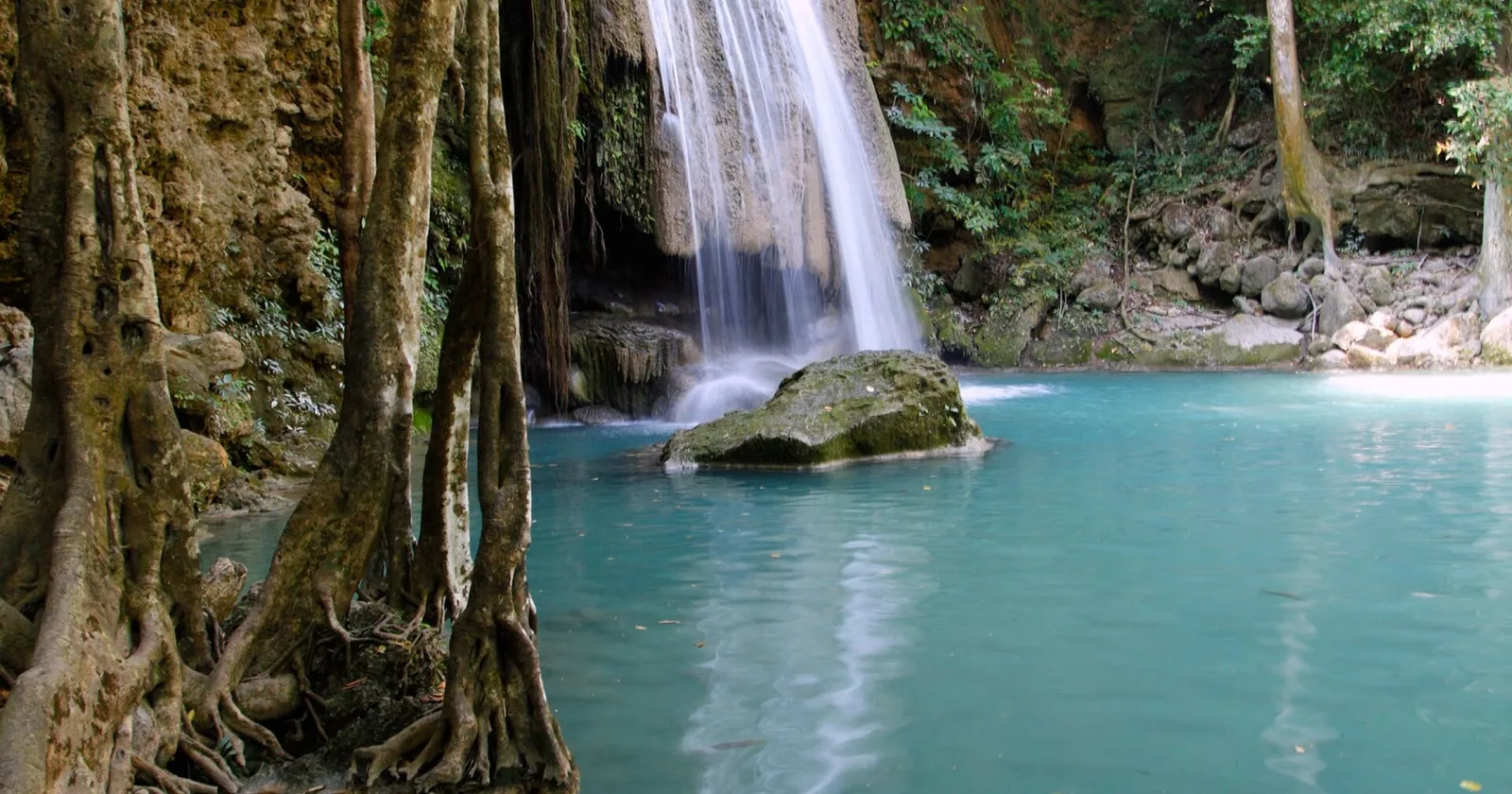
- Erawan National Park: a forest park known for a seven-tier limestone waterfall system and natural pools.
- Wat Tham Suea: a temple complex outside the centre, known for its large Buddha image, architecture and views over fields.
- Sai Yok and Nam Tok: a broader area of waterfalls, river scenery, caves and accommodation that suits a slower western Kanchanaburi route.
These places show different aspects of the province. They do not need to be completed as a checklist. Erawan and Hellfire Pass each deserve a substantial part of a day, while the town’s bridge, cemetery and museum work well as a connected group.
A history-focused route: railway, cemeteries and Hellfire Pass
Kanchanaburi is one of Thailand’s most important Second World War destinations. A coherent history route begins in town with the bridge, cemetery and museum, then continues west towards Tham Krasae and Hellfire Pass if time allows.
- Bridge over the River Kwai: the familiar landmark and part of the railway route.
- Kanchanaburi War Cemetery: the burial place of thousands of Allied prisoners of war.
- Thailand-Burma Railway Centre: an independent museum opposite the cemetery that provides historical interpretation.
- Tham Krasae: a section where the railway follows the cliff beside the Khwae Noi River.
- Hellfire Pass: Konyu Cutting, a former railway cutting and memorial trail.
- Nam Tok: the present terminus for regular rail services on this side of the historic route, subject to the current timetable.
The railway was much longer than the section that operates today. Do not assume that a ticket to Kanchanaburi includes the bridge, Tham Krasae and Nam Tok at convenient times. Check the State Railway of Thailand timetable, the departure station in Bangkok and the return options for your exact date. Weekend excursion trains and regular services follow different schedules.
Hellfire Pass lies farther from Kanchanaburi town. The Australian Government’s Anzac Portal explains the history of the cutting and the memorial trail. Conditions on the longer walking route can be hot and demanding. Check current access at the interpretive centre, carry water and turn back if weather, footwear or fitness makes the trail unsafe.
Trying to add Hellfire Pass to a late start from Bangkok usually leaves too little time for interpretation. A night in Kanchanaburi, Sai Yok or another location chosen for the next day’s route makes the visit calmer and more meaningful.
Erawan Waterfalls and the natural side of Kanchanaburi
Erawan National Park is the province’s best-known natural attraction. Its waterfall descends through seven principal tiers over limestone formations. Water colour and flow change with rainfall, sediment, light and seasonal conditions, so photographs from another month are not a guarantee of what you will see.
The lower tiers require less walking, while reaching the upper levels involves a longer forest route with steps, roots and potentially slippery surfaces. Access to individual tiers may be restricted because of water levels, storms, fire risk, maintenance or park rules. The official Department of National Parks page for Erawan is the appropriate place to check park information, and recent park notices should be reviewed shortly before departure.
Bring drinking water, suitable footwear and sun and rain protection. If swimming is permitted, follow the designated areas and staff instructions. Natural pools can contain rocks, changing depths and currents. Families should supervise children closely, and visitors with limited mobility should assess the route rather than assuming that all seven tiers are accessible.
Erawan is best treated as a half-day nature visit, not a quick stop. Leave room for the trail, changing conditions and a comfortable return.
Other natural areas include Sai Yok Noi, Sai Yok National Park and the landscapes around Srinakarin Dam. They offer different experiences and should not be grouped together simply because they appear close on a map. Verify the actual road distance, park status and the amount of walking before adding them to the same day.
Temples, viewpoints and less obvious stops
Kanchanaburi is not limited to wartime history and waterfalls. Wat Tham Suea, also written as Wat Tham Sua, is a temple complex in Tha Muang district. Its large Buddha image, pagodas and views over the surrounding fields make it a worthwhile stop when the route passes south of Kanchanaburi town. Shoulders and knees should be covered in active worship areas, and footwear must be removed where indicated.
The complex includes stairs and exposed areas. Visit at a time that is suitable for the weather and your group rather than promising ideal light or low crowds. Photography should not interrupt worship or block paths.
Wat Ban Tham is another temple known for an entrance shaped like a dragon’s mouth and a staircase leading towards cave areas. It requires more climbing than a quick roadside stop. Check current access and decide whether the route suits everyone in the group.
Mueang Sing Historical Park preserves Khmer-influenced remains and adds an earlier layer of regional history. It is not a substitute for Angkor, nor does it need that comparison to be worthwhile. Its value lies in the architecture, archaeological setting and evidence of historical connections across mainland Southeast Asia.
A riverside hotel can change the pace of the trip, especially after a long route west. However, distances between the town, Erawan, Sai Yok and Hellfire Pass remain significant. Before booking, compare the property’s location with the next day’s plan, meal options, transport access and any boat transfer requirements.
How to plan Kanchanaburi from Bangkok
One day: choose one clear theme
A one-day trip from Bangkok requires an early departure and a limited programme. One option is a history day with the bridge, cemetery, museum and a carefully timed railway section. Another is a nature day with Erawan plus one short historical stop if transport and park hours permit. Erawan and Hellfire Pass should not both be treated as quick add-ons.
Road travel varies with the pickup point, weekday, traffic and stops. A map estimate is not a promise. Build in a buffer for the return to Bangkok, particularly if you have an evening flight, train or fixed reservation.
AsiaTrip arranges private tours for one closed group of 4 to 20 guests. Unrelated customers are not combined. The route and included services must be confirmed in the written proposal, and the quote is prepared individually in THB. There is no public EN price list. A link to an offer does not guarantee a particular date, guide language, admission, meal or activity until those details have been agreed.
Two days: history first, nature second
Two days provide a more balanced first visit. On day one, see the bridge, cemetery and museum, then continue to Tham Krasae if the railway schedule and road plan work. Stay either in Kanchanaburi town for easy dining and transport or farther west if that better supports the next morning.
On day two, visit Erawan with enough time for the trail, or choose a Sai Yok and Hellfire Pass route focused on history and river landscapes. Erawan and Hellfire Pass are in different directions from some accommodation areas, so compare the actual route before deciding to combine them.
Three days: add temples and a slower river stay
A third day creates room for Wat Tham Suea, Wat Ban Tham, Mueang Sing Historical Park or a slower stay near the river. It also provides a weather buffer. This is useful when park conditions or a train schedule changes, because the entire visit does not depend on one tightly packed day.
Practical planning before you go
Transport
Road and rail both connect Bangkok with Kanchanaburi, but they suit different plans. The train is part of the experience and can work well for a railway-focused journey. Buses and vans may be practical for reaching Kanchanaburi town. A car with a driver offers more flexibility for Erawan, Sai Yok, Hellfire Pass and temples that are spread across the province.
Confirm where a Bangkok train departs, because not every service uses the same station. Check the current timetable and do not build a connection around an old blog post. For road travel, clarify the pickup location, luggage capacity, child-seat needs and return point before departure.
Weather and seasons
The cooler part of the dry season, often around November to February, can be more comfortable for walking, but it may also be a popular travel period. Hot-season temperatures increase the strain of exposed trails and temple stairs. During wetter periods, waterfalls may have stronger flow, while paths can become slippery and access may change.
Air quality, storms, flooding and fire conditions can also affect parks. Check official notices close to the visit instead of treating a general seasonal description as a guarantee.
Clothing and safety
Use footwear with reliable grip for waterfall and memorial trails. Carry water and protection from sun and rain. For temples, bring clothing that covers shoulders and knees. Keep luggage light at Erawan and protect electronics from water.
Do not enter caves, water or closed trail sections against local instructions. Travel insurance, medical needs and mobility requirements should be considered before committing to a route. A private vehicle improves flexibility but does not remove the physical demands of stairs, heat or uneven ground.
Choosing accommodation
Accommodation in town is useful for restaurants, the cemetery, museums and transport connections. Riverside properties farther west may offer a quieter setting and shorter access to some nature and railway sites. Check the precise map position, road access and transfer method. The phrase “on the River Kwai” can cover a broad area and does not tell you how long the next day’s drive will take.
Frequently asked questions about Kanchanaburi
Is Kanchanaburi worth visiting on a first trip to Thailand?
It can be an excellent contrast to Bangkok and the islands because it combines significant wartime history, rivers, forest, waterfalls and temples. Whether it belongs in your first itinerary depends on your total time and interest in these subjects.
How many days should I spend in Kanchanaburi?
One full day allows a selective route. Two days are more practical for combining the town’s history with Erawan or western Kanchanaburi. Three days allow a slower pace, temples and a riverside stay. The right duration depends on the actual locations chosen, not only the number of attractions.
Can I visit Kanchanaburi from Bangkok in one day?
Yes, but the programme must be limited. Choose either a coherent history route or Erawan with one short additional stop. Do not plan the bridge, cemetery, a long train ride, Hellfire Pass and all seven waterfall tiers as one comfortable day.
Which is better, Erawan or Hellfire Pass?
They serve different interests. Erawan is a national park visit focused on forest and waterfalls. Hellfire Pass is a memorial and historical site. If both matter to you, use separate parts of a two-day itinerary rather than reducing either to a brief stop.
Is Kanchanaburi suitable for families with children?
It can be, provided the route matches the children’s ages, heat tolerance, walking ability and interest. Water, railway areas and steep or slippery paths require close supervision. A night in the province and fewer stops may be more comfortable than a very long day from Bangkok.
What is the easiest way to travel around the province?
A car with a driver gives the greatest flexibility for dispersed attractions. Public transport can work for the town and selected railway stops, but it requires more time and timetable planning. Compare the route, not just the transport price.
Is the bridge enough for a Kanchanaburi visit?
The bridge is a useful starting point, but it does not explain the full history. Add the cemetery and a reputable museum, and consider the railway or Hellfire Pass if time permits. This provides context for what the bridge represents.
When should I visit?
There is no single guaranteed best month. The cooler dry season can be comfortable, the hot season requires careful pacing, and wetter months may bring fuller waterfalls together with slippery trails or restrictions. Check the forecast, park notices and train operations for your dates.
Summary: what to see in Kanchanaburi
- For historical context: combine the bridge, Kanchanaburi War Cemetery and a museum.
- For railway history: consider Tham Krasae and Hellfire Pass, with current access and train times confirmed.
- For nature: give Erawan several hours and follow current national park rules.
- For temples and views: add Wat Tham Suea when it fits the route and your group’s mobility.
- For a balanced first visit: use two days rather than forcing history and nature into one rushed schedule.
- For a quieter pace: choose accommodation according to the next day’s route and allow time beside the river.
Kanchanaburi deserves attention beyond its famous bridge. The province becomes much more meaningful when the railway and memorial sites are understood together, and when Erawan, Sai Yok and the temples are planned according to real distances and current conditions. Choose fewer places, verify the practical details and leave time to experience them properly.
Related guides: browse the private tour catalogue and read the practical Bangkok guide.
No comments