

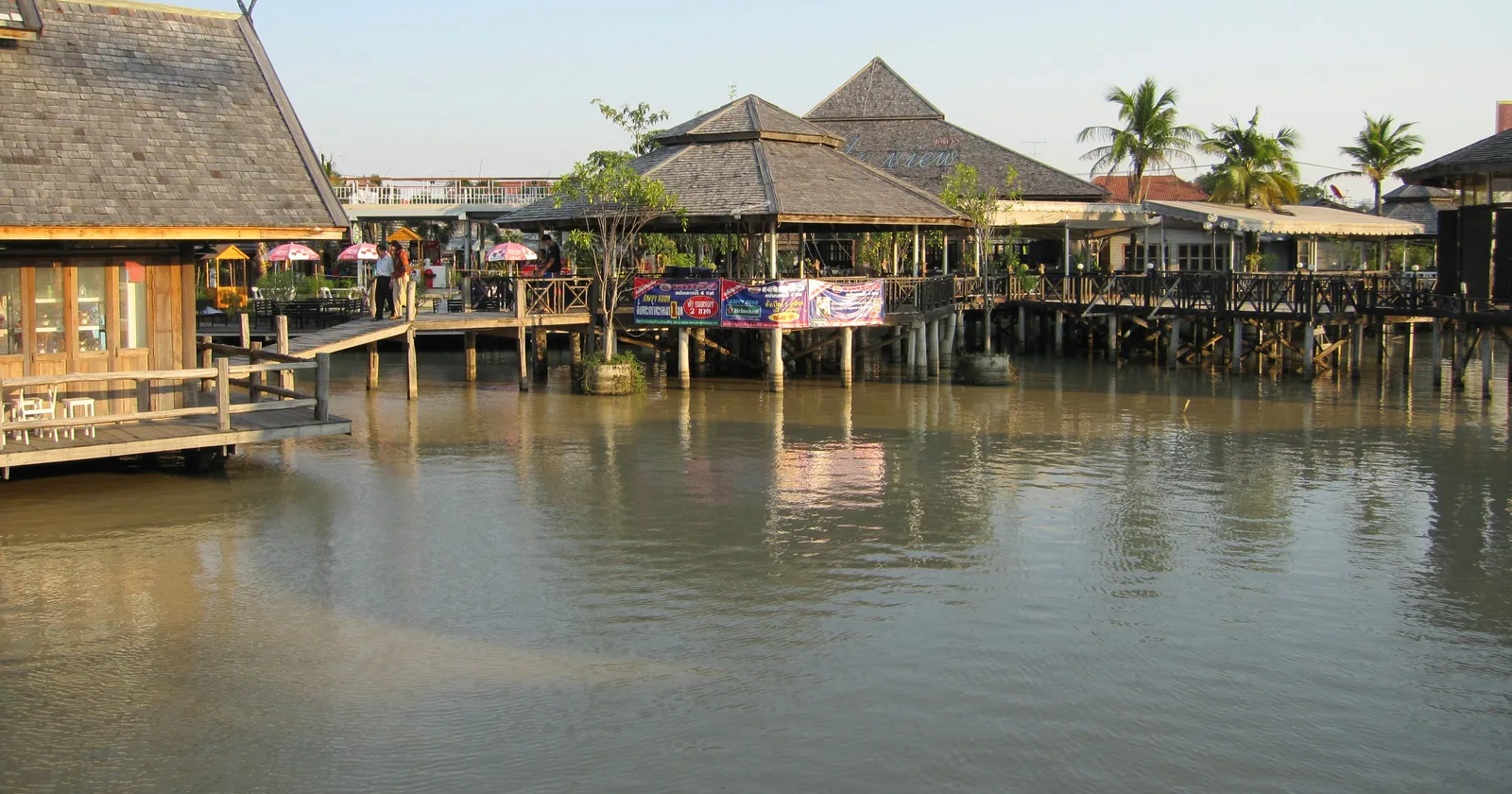
Pattaya Floating Market, also known as the Four Regions Floating Market, is a purpose-built visitor attraction in Pattaya, Chon Buri. Its canals, wooden walkways, food stalls, craft shops and cultural displays introduce themes associated with northern, central, northeastern and southern Thailand. It should not be confused with a working local market that developed around everyday trade.
This guide explains what the attraction is, how to reach it, how much time to allow, what to check before buying a ticket and how to combine it with other places around Pattaya. Opening arrangements, ticket categories, boat rides and performances can change, so confirm the current details shortly before you visit.
The attraction brings several displays into one walkable site, which can be useful when your time in Pattaya is limited. Whether it suits you depends on your interest in staged cultural attractions, food, shopping and photography. Travellers seeking an everyday neighbourhood market may prefer a different experience.
Floating Market Pattaya: what is Pattaya’s floating market?
Pattaya Floating Market presents food, crafts, architecture and performances through displays themed around four parts of the country: the north, central Thailand, the northeast and the south. The Tourism Authority of Thailand listing describes the site as a cultural attraction built around the traditions and products of those regions.
The market was created as an organised tourist attraction. Do not expect a rough, local market without commercial elements. On the other hand, this organised layout makes it convenient. There are walkways, food stalls, boats, shops and photo spots.
Pattaya Floating Market covers a large area near Sukhumvit Road. In practice, you explore it on foot, with an optional boat ride. The wooden walkways let you see most of the stalls at your own pace.
Four regions of Thailand in one place
The regional layout is central to the attraction’s concept. Displays associated with the north may emphasise woodwork, crafts and textiles, while central Thailand is represented through canal-side architecture, food and woven goods. Southern displays may feature coconut products, batik and coastal themes. These are curated selections, not complete definitions of each region.
Displays associated with Isan, the northeast, may include silk, woven goods and familiar foods such as sticky rice or som tam. Use the signs and displays as prompts for further learning rather than assuming that a single commercial site represents everyday life across a large and diverse region.
The site combines education and entertainment, but it offers a curated interpretation rather than a complete picture of regional life. Treat it as an introduction that may prompt further exploration, not as a substitute for visiting communities and markets elsewhere in Thailand.
Pattaya Floating Market is an organised visitor attraction. Understanding that distinction helps you judge the experience on its intended terms.
Floating Market Pattaya in practice: opening hours, transport and time to allow
Check current opening hours, admission rules and the last entry or boat time before travelling. The Tourism Authority of Thailand listing provides the attraction’s location and contact details, but live schedules and ticket inclusions may be updated by the operator. Do not rely on an old screenshot, blog post or reseller description as your only source.
The site is beside Sukhumvit Road, south of central Pattaya. Depending on your starting point, options may include an app-booked car, taxi, arranged transfer or a route with a driver. Travel time from central Pattaya or Jomtien varies with traffic, pickup location and road conditions, so allow a buffer and confirm the return plan before entering.
| Visit detail | Practical information | Tip for visitors |
|---|---|---|
| Location | Sukhumvit Road, southern Pattaya | Compare an app-booked car, taxi or arranged transfer from your actual starting point |
| Time to allow | Often around 2 to 3 hours, depending on activities | Allow extra time for food, a boat ride or scheduled performances |
| Timing | Choose a time that fits the verified opening schedule | Consider heat, rain, traffic and your other stops; crowd levels cannot be guaranteed |
| Type of attraction | A tourist attraction themed around Thai culture | Do not expect a typical local market without tourists |
| Tickets | Admission and packages can change | Confirm the date, entry, boat ride, meal, show and cancellation terms before paying |
| Who it suits | Visitors interested in a structured cultural attraction | Check heat, walking surfaces, accessibility and supervision needs for your group |
How much time should you allow?
A focused walk may be possible in under two hours, while food, shopping, photographs, a boat ride or a performance can extend the visit. For most plans, use two to three hours as a planning range rather than a promise. Add a buffer if the attraction is one stop in a tightly timed day.
A boat ride is an activity within the attraction, not transport to another destination. Its route, duration, operating status and capacity may vary. Ask what the ticket includes and whether you need to reserve a time before deciding.
Heat, humidity and rain can affect the experience throughout the day. Carry drinking water, use sun protection and wear footwear that is comfortable on wooden walkways. After rain, surfaces may be slippery. Anyone with reduced mobility should ask the venue about current access conditions rather than assuming that every route or boat is suitable.
How to explore Pattaya Floating Market step by step
A practical approach is to walk the main route first, then decide how much time to give to food, photographs, shopping or a boat ride. This lets you compare the available options before committing to an activity or carrying purchases around the site.
- Start with the map at the entrance: check the layout of the walkways, regions and boat points.
- Walk the first loop: look at the stalls, prices and photo spots.
- Choose food after comparing options: do not stop at the first stall.
- Decide whether to take a boat ride: choose it if you want a fuller experience.
- Leave shopping until the end: it is easier to negotiate and you will not have to carry souvenirs around.
- Confirm your return journey: traffic varies, and the pickup point may differ from the entrance you used.
Walk or take a boat?
Walking may be sufficient if your aim is to see the buildings, displays and stalls. The walkways pass through the main areas, although individual routes or access conditions may change. A boat ride should be treated as a separate optional experience rather than a requirement for seeing the site.
A boat offers a different view of the canals, buildings and stalls. It may appeal to families and photographers, but comfort, safety, accessibility and child supervision should be assessed for your group. Participation is optional unless a particular package states otherwise.
Check what is included in the package price. Some tickets cover entry only. Others include a boat ride, a meal or a show. Ask exactly what your chosen option includes.
When should you go to avoid crowds?
Crowd levels change with the day, season, holidays, organised groups and special events. A weekday may be quieter than a busy weekend, but this cannot be guaranteed. If space and comfort matter, ask the venue about expected conditions for your date.
For photography, consider the direction and intensity of the light as well as the verified opening schedule. Roofs and walkways create mixed light, and rain may change the scene quickly. Do not block narrow routes or photograph people closely without permission.
What to eat and buy at Pattaya Floating Market
Food is one of the main reasons to visit. You will find street food, sweets, fruit and drinks. Some dishes are presented as part of the show, but you can still try many Thai flavours.
- Pad Thai: classic noodles with egg, tofu, prawns or chicken.
- Mango sticky rice: sweet coconut rice with ripe mango.
- Som tam: spicy green papaya salad typical of Isan.
- Grilled skewers: a quick snack to enjoy as you walk.
- Tropical fruit: mango, pineapple, rambutan, mangosteen or longan.
- Thai tea: sweet tea with milk and ice.
- Handicrafts: wooden ornaments, bags, fabrics and small souvenirs.
How to choose food and avoid disappointment
Choose food using your own judgement. Look for clean preparation areas, appropriate storage, freshly cooked dishes and clear handling of ingredients. A busy stall is not, by itself, proof of hygiene or suitability for a particular allergy.
Ask about chilli, seafood, nuts and other ingredients before ordering, while recognising that cross-contact may occur in small kitchens. Requests such as “a little spicy” are interpreted differently from stall to stall. Travellers with serious allergies should not rely on a casual verbal assurance alone.
Prices may differ from those at an everyday local market. Read the displayed menu and price before ordering, then decide whether the food, convenience and setting fit your budget. Do not assume that a themed location guarantees a particular portion, ingredient or level of quality.
What souvenirs are worth buying?
Lightweight items such as cotton bags, pouches or small craft pieces may be easier to carry. Check materials, workmanship and origin if local production matters to you. A product sold in a themed market is not automatically handmade or produced in the region it represents.
Compare several stalls before buying a higher-priced item and ask what it is made from and where it was produced. Some prices may be fixed. If negotiation is welcomed, keep it brief and polite; if it is not, decide whether the stated price is acceptable.
Is Pattaya Floating Market authentic or touristy?
This question comes up often. The answer is both, but in different ways. Floating Market Pattaya is not an old market that grew naturally out of everyday trade. It is a planned attraction for visitors.
The attraction can still be useful as a curated introduction to architecture, food, clothing and crafts. It is neither an ethnographic museum nor an ordinary neighbourhood market, so interpret its displays in that commercial and educational context.
First-time visitors may appreciate the clear layout and range of displays. Travellers looking for an everyday market may find the site too commercial. Decide whether the attraction’s purpose matches your interests before paying for entry or optional activities.
The biggest mistake is expecting a local market without tourists. This is a cultural attraction, not a hidden Pattaya secret.
Who will enjoy this attraction most?
Pattaya Floating Market may suit families, couples and first-time visitors who want a structured attraction. Children may enjoy the boats and colourful setting, but adults remain responsible for supervision around water, walkways, food and crowds.
Older visitors and anyone with limited mobility should consider heat, distances, resting places, steps, uneven surfaces and access to boats. Contact the venue for current accessibility information and plan breaks according to individual needs.
Budget-conscious travellers should compare admission and activity costs with the experience they want. Food and souvenirs may be available in other settings without an entry fee, while the canals and themed displays are specific to this attraction.
When might another market be a better choice?
If your itinerary includes Bangkok, you could compare Pattaya’s purpose-built attraction with other canal or market experiences. Damnoen Saduak, Amphawa and local community markets have different locations, schedules and levels of tourism. Choose according to the actual route and experience you want rather than assuming that one is universally better.
If you are staying in Pattaya, the local attraction may require less travel than a separate Bangkok-area market. Compare total journey time, admission, opening arrangements and the character of each option before committing a day.
Pattaya Floating Market with Bangkok, Jomtien and Nong Nooch: how to plan your day
Pattaya Floating Market can be combined with places south or east of central Pattaya, such as Jomtien, Nong Nooch Tropical Garden or Khao Chi Chan. A workable combination depends on opening times, ticketed entry slots, traffic, weather and how long your group wants at each stop.
Build the order around the least flexible reservation or closing time. Keep meals and transfers realistic, and avoid treating map estimates as fixed travel times. A shorter plan with two well-paced stops is often more comfortable than trying to fit every nearby attraction into one day.
A visit from Bangkok is possible, but road conditions can make a same-day itinerary long and unpredictable. Compare a day trip with an overnight stay in Pattaya, especially if the market is only one of several planned stops.
A half-day plan for people staying in Pattaya
After confirming the day’s opening time, travel towards Sukhumvit Road with a buffer for traffic. Explore on foot first, then decide whether food, shopping or a boat ride deserves more time. Afterwards, return to your hotel or continue to Jomtien only if the timing remains comfortable.
This compact approach can suit a short stay because it leaves room for rest and unexpected delays. Families should adapt it to children’s age, heat tolerance, meals and supervision needs rather than treating one timetable as suitable for everyone.
A full-day plan with attractions around Pattaya
A full-day outline might combine one reserved attraction, Pattaya Floating Market and one flexible stop such as Jomtien. Confirm each venue’s current schedule and the travel order before setting out. Remove a stop if the timetable leaves no room for meals, rest or traffic delays.
Pre-arranged transport can simplify a multi-stop plan, while app-booked rides or taxis may suit a more flexible day. Compare the whole route, waiting arrangements, vehicle capacity and price before choosing. No transport option removes the need for realistic buffers.
A day trip from Bangkok
For a day trip from Bangkok, set the departure time only after checking current road conditions, the attraction’s opening schedule and any timed bookings. Keep the number of stops limited and agree on a return plan before setting out.
Khao Chi Chan or Nong Nooch may fit the same geographical direction, but combining them is optional. Monitor the time during the day and remove a stop if traffic, weather or fatigue makes the original plan unrealistic.
Common mistakes when visiting Pattaya Floating Market
A common planning mistake is arriving without checking the ticket terms. Some offers may cover entry only, while others may add a boat ride, meal, show or another activity. Compare the date, inclusions, exclusions and cancellation terms before paying.
Another mistake is ignoring heat and weather. Choose a visit time that works with the verified schedule, take appropriate sun or rain protection and adjust the pace rather than relying on a universal “best” hour.
Another mistake is packing too much into the day. Food, photographs, shopping and optional activities all take time. Keep other stops limited and make one of them easy to remove if the visit or transport takes longer than expected.
How can you avoid paying too much?
First, decide what you actually want to do. If you do not care about taking a boat, buy the basic option. If you want the full experience, a package with a boat ride may make sense. The important thing is to make an informed choice.
When shopping, compare similar items and ask whether the price is fixed. If negotiation is accepted, keep it polite and proportionate. A seller’s decision not to reduce a price is not a problem that requires further pressure.
How should you prepare for the heat?
Carry drinking water, choose lightweight clothing and use suitable sun protection. Heat and humidity affect people differently, so slow down, use shaded rest areas and follow medical advice relevant to your own health.
Plan meals according to your own health and dietary needs. Small portions can make it easier to sample several dishes, but food choices should be guided by ingredient information, preparation and personal tolerance.
FAQ: common questions about “Floating Market Pattaya”
Is Pattaya Floating Market worth visiting?
It can be worthwhile if you want a purpose-built cultural attraction with food, shopping, canals and optional activities. It may be less suitable if your priority is an everyday local market. Decide using current ticket details and the type of experience you prefer.
How much time do you need for Pattaya Floating Market?
Plan roughly two to three hours for a general visit, then adjust for your pace, food, shopping, a boat ride or performances. This is a planning range, not a fixed duration.
Do you need a ticket for Pattaya Floating Market?
Admission rules, prices and package inclusions can change. Confirm the current terms for your visit date and check whether the offer covers entry only or also includes a boat ride, meal, show or other activity.
Is Pattaya Floating Market suitable for children?
It may suit families, but adults should assess heat, walking distance, water edges, boat access, food needs and supervision for each child. Ask the venue about current facilities if you require a pushchair route, changing space or other specific support.
How do you get to Pattaya Floating Market from the centre?
Possible options include an app-booked car, taxi or arranged transfer. The journey time depends on your pickup point and traffic on Sukhumvit Road. Confirm the destination pin, fare method and return pickup before travelling.
Is a boat ride at the market compulsory?
A boat ride is generally offered as an optional activity, but check the current ticket terms. The walkways provide access to much of the attraction. Choose the boat only after confirming the route, duration, price, accessibility and suitability for your group.
What foods might you find at the floating market?
Available vendors and menus change. Mango sticky rice, noodle dishes, som tam, grilled snacks, fruit and Thai tea are common examples to look for, but choose according to current availability, preparation, ingredients and dietary needs.
Arranging a private visit with AsiaTrip
AsiaTrip’s English offer covers private tours for one closed group of 4 to 20 guests. Unrelated customers are not combined. The itinerary and transport plan are discussed for your group, then quoted individually in THB. There is no public EN price list.
Admission, boat rides, meals, shows and other third-party services are included only when they appear in the agreed quotation. Availability, language support, licensed guiding and accessibility must be confirmed for the specific date. A website description does not confirm a booking.
When asking for a plan, provide the page you are viewing, your preferred date, group size, pickup area and any mobility, dietary or child-seat requirements. AsiaTrip can then explain what can be arranged without inventing availability or adding unrelated customers to your party.
Summary
- Pattaya Floating Market: a purpose-built cultural visitor attraction in Pattaya.
- What it combines: food, shopping, photographs, canals and regional cultural displays.
- Timing: verify opening arrangements, then consider heat, rain, traffic and crowd expectations.
- Who it may suit: visitors comfortable with a commercial, structured attraction rather than an everyday local market.
- Key thing to remember: treat it as a tourist attraction, not a local market.
- Possible combinations: Jomtien, Nong Nooch or Khao Chi Chan, provided the current timings remain realistic.
Pattaya Floating Market can add a colourful, structured stop to a Pattaya itinerary, but it does not replace an everyday local market. Check current opening and ticket information, decide whether optional activities matter to your group and leave enough time for transport. If its commercial format matches your expectations, it can be combined with the beach or another nearby attraction at a realistic pace.
No comments