

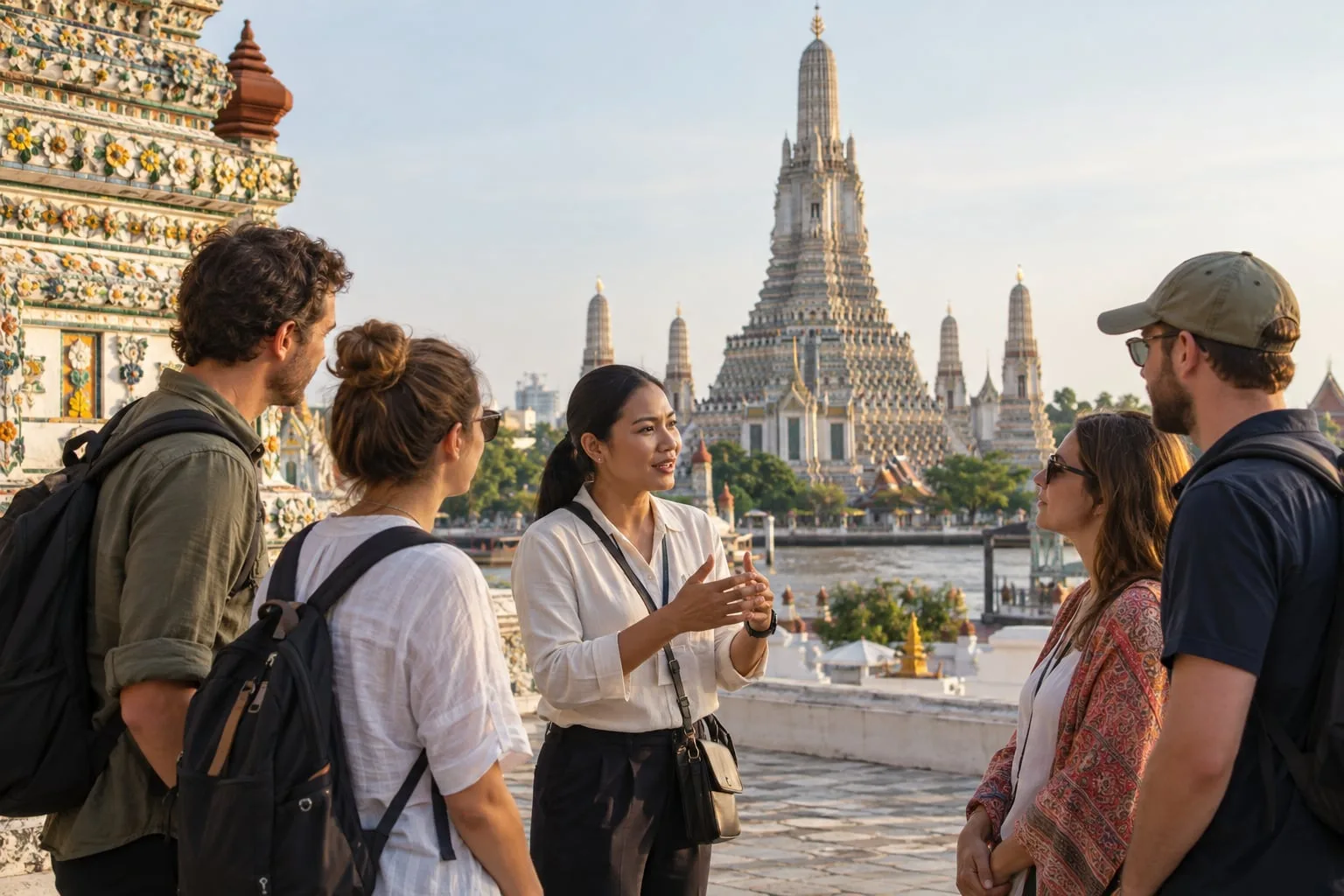
Exploring Thailand as part of a large coach party and travelling with someone who can respond to your questions are two very different experiences. A private guide in Thailand can help explain what you are seeing, adapt the pace within the agreed plan and make local customs easier to understand. The value comes from the person’s verified qualifications, knowledge, communication and clearly defined role, not simply from the word “private”.
The market can be confusing because similar labels are used for very different services. One listing may provide only a driver. Another may include a licensed guide, transport and admission arrangements. A third may cover itinerary coordination without a guide accompanying you throughout the day. Comparing only the headline description can therefore lead to false assumptions about what is included.
AsiaTrip prepares private Thailand itineraries for one closed group of 4 to 20 guests. Unrelated customers are not combined. Each EN enquiry receives an individual quote in THB, and the written proposal identifies the itinerary and confirmed services. This guide explains how guiding differs from driving and coordination, what affects a quote and what to check before booking.
What a private guide in Thailand means
The phrase “private guide” sounds precise, but it is often used loosely online. In practical terms, you need to know who will accompany your group, whether that person is authorised to guide, which language will be used, how many hours are covered and whether transport is a separate service.
Thailand’s Department of Tourism oversees tour-business and tourist-guide licensing. Its official systems include guide licence renewal and the Thailand Smart Tour platform. This is different from the Tourism Authority of Thailand, which promotes tourism but is not the authority that issues guide licences. The distinction matters when you check a provider’s claims.
Private guide or private tour: what is the difference?
A private guide is a person who provides guiding within the scope of their licence and the agreed service. A private tour is the complete arrangement purchased by one party. It may include a guide, vehicle, driver, tickets, meals or coordination, but none of those elements should be assumed unless they appear in writing.
A private tour can follow a fixed route or allow agreed flexibility. Likewise, hiring a guide does not automatically include transport, admission fees or unlimited changes. Ask how much of the day is predetermined, what can be adjusted and who decides when weather, traffic or closures affect the plan.
“Private” should mean that the service is reserved for your party. It does not, by itself, define the guide’s qualifications or everything included in the price.
For AsiaTrip’s EN offer, the booking is for one closed group of 4 to 20 guests. The written proposal should still state whether licensed guiding is included, who provides transport, which service language has been confirmed and what happens if the itinerary needs to change.
Types of guide and coordination services
Before selecting a service, identify the role you actually need. The most common arrangements include:
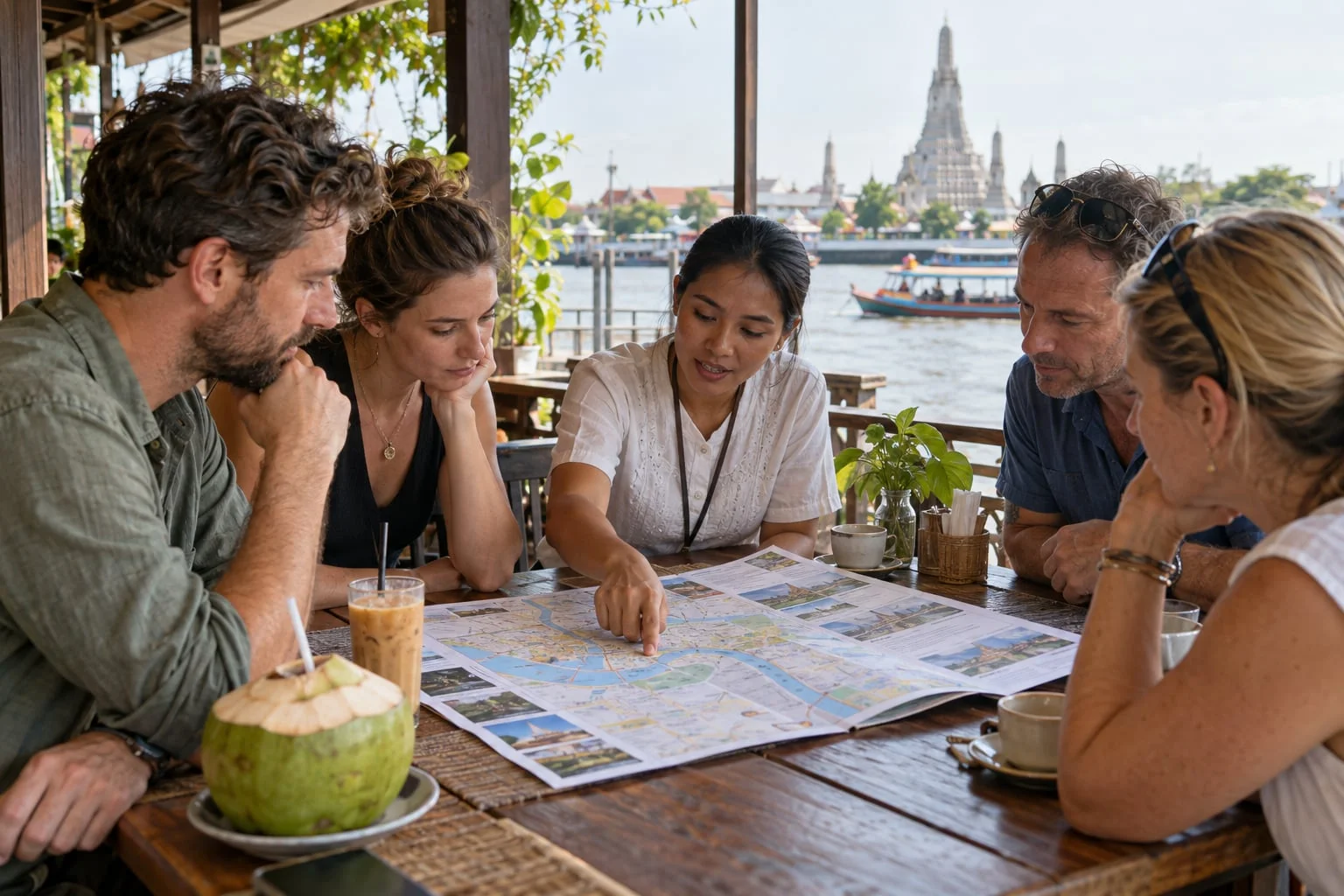
- Licensed guiding for a day: interpretation and guiding at agreed places during specified hours.
- Multi-day guiding: the same or different licensed guides across several days, with the exact regions, hours and handovers identified.
- Driver and vehicle: transport between agreed points. A driver is not automatically a licensed guide.
- Itinerary coordination: planning, reservations and contact support. This does not automatically mean that a guide accompanies the group.
- Guided transfer: transport combined with licensed guiding when both roles are explicitly included.
A longer route may combine several of these services. For example, a private multi-day itinerary may use one driver, different regional guides and local boat operators. The proposal should identify each role rather than describing everyone simply as “the guide”.
Who can legally provide guiding?
Professional tourist guides in Thailand operate within a licensing system administered by the Department of Tourism. The Department provides official guide training, examination and licence-renewal systems. Its Thailand Smart Tour platform also uses licence details when tour businesses arrange guide work.
Ask for the guide’s name and licence details before the service begins, then check that the licence category is relevant to the work being offered. A transport provider, coordinator or local contact may perform a useful role without being the person authorised to conduct professional guiding. The important point is that each person’s function is described accurately.
For current official information, consult the Department of Tourism guide-licence learning system and Thailand Smart Tour. The Tourism Authority of Thailand’s newsroom also confirms that the Department of Tourism oversees travel-business and tour-guide licensing.
Why choose a private guide?
A good private arrangement gives your party more attention than a large group tour. You can ask questions at the moment they arise, spend time on the aspects that interest you and understand the practical context behind a place. That does not mean every request can be accommodated. Temple opening times, ticket rules, traffic, safety restrictions and the agreed duration still set real limits.
Context instead of a repeated script
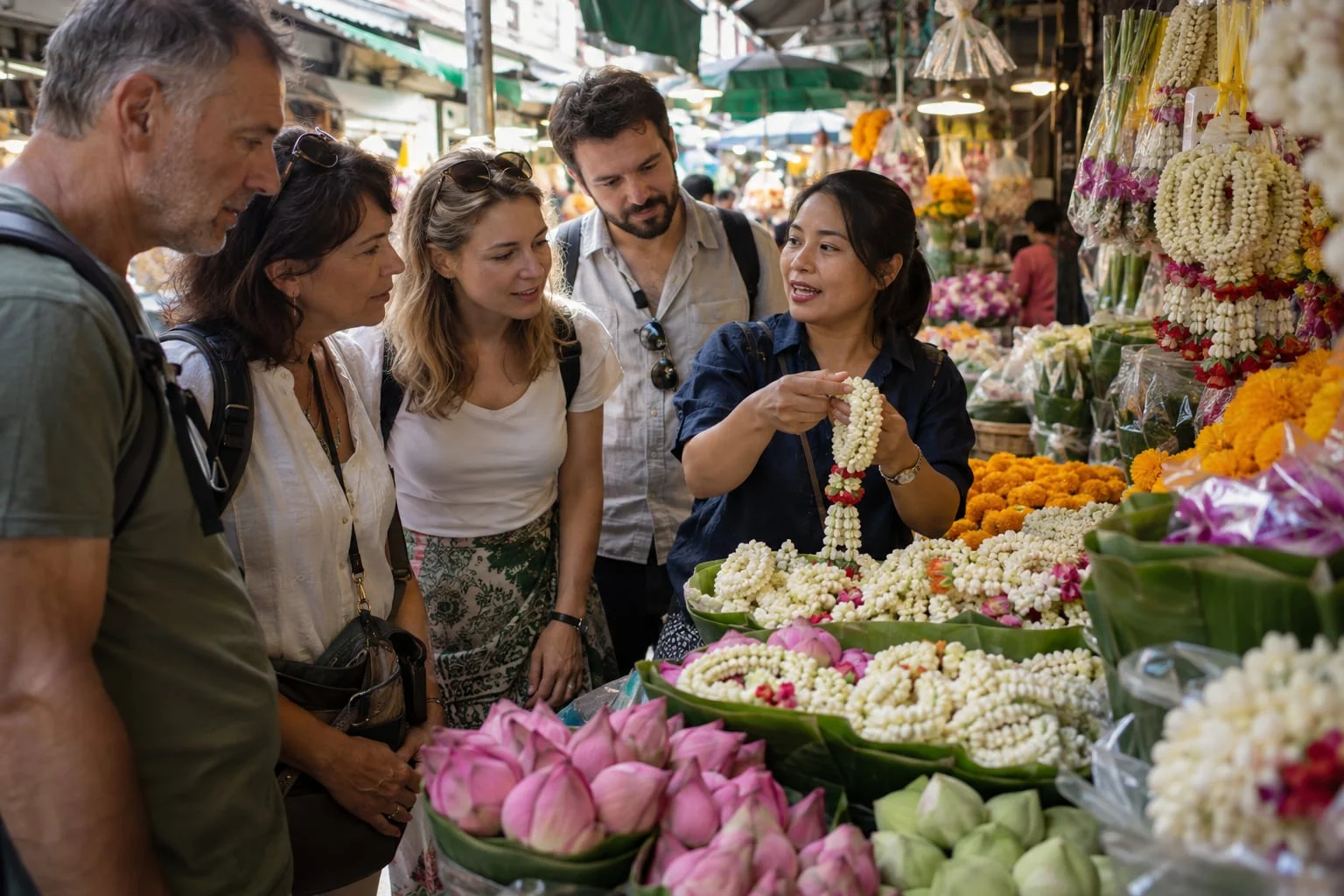
Guiding is most useful when it adds context that is hard to obtain from signs or a short online description. At a temple, this may include etiquette, architecture and the meaning of a ceremony. At a market, it may involve explaining ingredients, customs and how the area fits into everyday local life.
A private guide may also suggest neighbourhoods, markets or food stops suited to the group’s interests, provided those additions are practical and agreed. Treat any promised stop, meal, ticket or activity as confirmed only when it appears in the written itinerary.
The written proposal should identify each provider’s role, service language, availability and scope. The language used on a website does not prove which language the person providing the service will use.
Cultural explanation can make a journey more respectful as well as more interesting. Temple dress, gestures, photography rules and local standards of behaviour vary by place. A knowledgeable guide can explain those expectations before a misunderstanding occurs.
Help with practical changes
Weather, traffic and temporary closures can affect even a carefully planned day. A guide or coordinator who knows the area can explain the options and help the group choose a workable alternative within the agreed service. The provider should not promise control over conditions that no one can guarantee.
Clarify who is responsible for checking opening times, arranging tickets and contacting drivers. If the itinerary covers islands or several regions, ask how handovers between operators work and who you should contact if a connection is delayed.
How much does a private guide in Thailand cost?
There is no dependable universal daily rate. Quotes vary according to location, date, duration, guide language, licence category, transport, admission arrangements and the amount of planning required. Compare written quotes for the same scope rather than comparing a driver-only figure with a complete guided itinerary.
The Polish source for this article contained broad illustrative amounts in PLN. They were not an AsiaTrip tariff and are not carried into the EN offer as a public price list. AsiaTrip provides an individual quote in THB for each EN enquiry, based on the confirmed itinerary and included services.

Compare the service, not only the amount
| Service type | What to verify in writing |
|---|---|
| Driver and vehicle | Vehicle, pickup, route, waiting time, overtime and whether guiding is excluded |
| Licensed guide without transport | Licence details, language, hours, meeting point, region and ticket arrangements |
| Licensed guide with transport | Guide, driver, vehicle, route, pickup, parking, overtime and admission arrangements |
| Itinerary coordination | Bookings, local contacts, response times, changes and services that remain the traveller’s responsibility |
A driver and a licensed guide perform different roles. Confirm who provides each service before paying.
What affects the final quote?
Location and logistics are major factors. Bangkok, Phuket, Chiang Mai, Krabi and remote areas have different transport patterns, guide availability and operating costs. A route that crosses regions may require several providers, additional travel time or overnight arrangements.
Dates also matter because demand changes across the year and around public holidays. Multi-day work may be quoted differently from separate one-day bookings, but a longer itinerary is not automatically cheaper. Language availability, early starts, late finishes, private boats and last-minute changes can all affect the final amount.
Ask whether taxes, tickets, meals, parking, tolls, guide expenses and overtime are included. If the quote uses a deposit, confirm the payment schedule and cancellation terms. AsiaTrip’s individual THB quote should identify every service included in the EN itinerary rather than relying on a generic package price.
How to choose a guide and check the licence
Selecting a guide is about more than reading a short profile. You are choosing someone who may influence your schedule, understanding of the destination and response to unexpected changes. A few checks before payment make the arrangement easier to compare and document.
Check the licence and relevant experience
Request the guide’s full name and licence details. Check that the person presented as the guide is the person who will actually provide the service. If a company cannot identify the guide until later, ask when that information will be confirmed and what happens if the assigned person changes.
Relevant experience depends on the route. A guide who knows Bangkok’s temples may not be the same person best suited to a national park, diving excursion or multi-region journey. Ask about the places on your itinerary and how the guide handles closures, mobility needs or a slower pace.
Reviews can provide useful context, but read them critically. Look for consistent comments about punctuality, knowledge, communication and problem solving. Do not rely only on star ratings, and do not assume that a review for one guide applies to every subcontractor used by a company.
What to agree before booking
Ask for a written scope that covers the route, dates, working hours, meeting point, service language, guide name or assignment process, transport, tickets and payment terms. If meals or food stops matter to your group, confirm whether they are included, merely suggested or paid directly on the day.
Discuss accessibility, health limitations and preferred pace before the itinerary is finalised. This information helps the provider assess what is practical. It should not be treated as a guarantee that every location can accommodate every need.
A short call can help you assess communication, but the binding details should remain in writing. Save the agreed itinerary and contact information where every adult in the group can access them.
What to agree before the first day
Once the booking is confirmed, review the practical details again. Check the meeting place, start time, expected finish, clothing requirements, transport plan and what to bring. If the service involves several providers, make sure you know who is responsible for each stage.
Share the information that affects the plan
Tell the provider about your group’s interests, walking tolerance, dietary requirements and any time-sensitive reservations. Give enough detail to allow sensible planning, but do not send unnecessary sensitive information through an insecure channel.
Confirm how the provider will notify you about weather, closures or a change of guide. Agree on the contact method and what to do if you cannot find each other at the meeting point.
Clear written arrangements are not a sign of distrust. They help the traveller, guide, driver and coordinator work from the same plan.
What a typical day may look like
There is no single standard routine. The day may begin with a hotel pickup, a meeting at a station or a rendezvous at the first attraction. The guide should explain the sequence of stops and any practical rules that affect the group.
Within the agreed time, a private group may be able to pause for questions, adjust the order of nearby stops or spend longer at a place that proves especially interesting. Significant route changes can affect tickets, transport and the finish time, so they need to be agreed rather than assumed.
At the end of the day, check the next meeting details if the itinerary continues. Raise any concern promptly so the provider has a chance to address it before the next stage of the trip.
In conclusion
Choosing a private guide in Thailand comes down to verification and clarity. Check who is licensed to guide, separate guiding from driving and coordination, compare like-for-like written scopes, confirm the service language and understand the payment and cancellation terms.
AsiaTrip’s EN itineraries are prepared for one private, closed group of 4 to 20 guests, without combining unrelated customers. The individual quote in THB identifies the confirmed route and services. If you want help shaping a route, use the English trip planner and describe your group, dates and priorities without assuming that a guide, meal, ticket or transport service is automatically included.
Related: Thailand: what to know before you go.
Related: Generali travel insurance terms and conditions.
Related: Dusit Palace Bangkok: a guide to the royal district.
No comments