

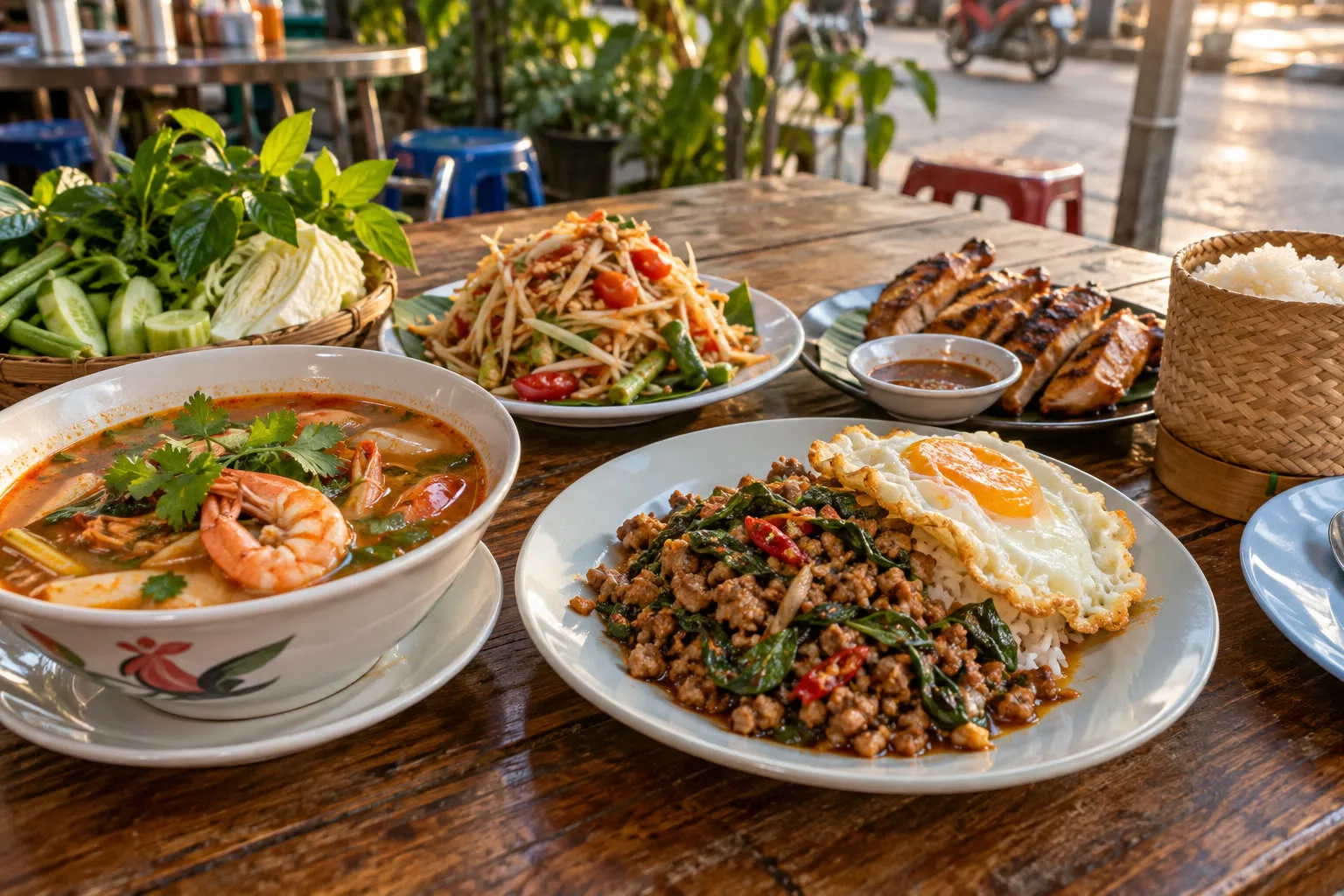
Thai cuisine is memorable because flavour, aroma, texture and temperature work together. A dish may be hot, sour, sweet, salty or gently bitter, but it does not need to express every taste with equal force. The cook adjusts the balance to suit the ingredients and the style of the dish.
This guide introduces the ingredients, techniques and well-known dishes you are likely to encounter in Thailand. Preparation varies between regions, households and individual cooks, so use these descriptions as a practical starting point rather than a single definition of what Thai food must be.
Menus can also differ from one market stall or restaurant to the next. If you have allergies, dietary requirements or a low tolerance for chilli, confirm the ingredients and preparation directly with the vendor. Fish sauce, shrimp paste, stock and prepared curry paste may be present even when they are not obvious from the English menu.
What makes Thai cuisine distinctive

Thai food is not built around one dominant taste. Heat from chilli may be softened by sweetness, lime or tamarind may cut through a rich sauce, and fermented seasonings can add saltiness and umami. The result depends on proportion. One element can lead, but the remaining flavours should still support the dish.
Balancing flavours as the foundation
Balance does not mean that every dish tastes the same. Tom yum is meant to be distinctly sour and aromatic. Som tam can be sharply hot and tangy. Massaman curry is usually gentler, richer and influenced by dried spices. Each dish has its own centre of gravity.
Thai cooking is not about adding equal amounts of sweet, sour, salty and hot ingredients. It is about deciding which flavours should lead and which should support them.
Tasting during preparation helps the cook respond to the strength of the lime, the saltiness of the fish sauce, the sweetness of the palm sugar and the heat of the chillies. Recipes provide a framework, but ingredients are not identical from one batch to the next.
Regional traditions matter too. Northern dishes often use herbs, roasted spices and sticky rice. Southern cooking is widely associated with seafood, turmeric, coconut and assertive heat. Isaan food commonly uses toasted rice, fresh herbs, grilling and fermented seasonings. Bangkok brings cooks and influences from across the country together.
Fresh ingredients and cooking methods
Fresh aromatics are central to many Thai dishes. Lemongrass, galangal, makrut lime leaves, Thai basil, coriander roots, garlic, shallots and chillies can be sliced, bruised or pounded to release their aroma. They are not interchangeable with one another, even when they appear together in the same soup or curry paste.
Wok-frying, grilling, steaming, simmering and pounding ingredients in a mortar all create different textures. High heat is useful for a quick stir-fry, but it is not the right method for every dish. A curry may need time for the paste to cook and the sauce to develop, while a salad is assembled without cooking at all.
Fresh food is not automatically safer or better simply because it comes from a street stall. Look at cleanliness, ingredient storage, cooking temperature and customer turnover. Excellent food can be found at markets, neighbourhood restaurants, hotel dining rooms and formal restaurants.
Essential Thai ingredients and flavours

A relatively small group of ingredients appears repeatedly across Thai cooking, but the combination changes from dish to dish. Learning to recognise them makes menus easier to understand and helps you explain allergies or preferences when ordering.
Aromatics you will recognise
Lemongrass has a clean citrus aroma. The tough stalk is usually bruised or sliced so that it can flavour soups, curry pastes and marinades. Galangal looks similar to ginger but tastes more resinous and peppery. Substituting ginger changes the character of the dish.
Makrut lime leaves give soups and curries an intense citrus fragrance. Thai basil may add an anise-like note, while holy basil has a different aroma and is used in dishes such as pad kra pao. Coriander roots, garlic and shallots often provide the savoury base.
If a woody aromatic such as lemongrass or galangal is left in the bowl, it may be there to perfume the dish rather than to be eaten whole.
Sauces, fermented seasonings and curry pastes
Fish sauce, or nam pla, contributes saltiness and umami. It is common, but it does not replace salt in every Thai recipe. Shrimp paste can add depth to curry pastes and relishes. Soy sauces and oyster sauce are important in many Chinese-influenced stir-fries.
Red, green and yellow curry pastes are mixtures rather than fixed formulas. Green paste generally uses fresh green chillies and herbs. Red paste often relies on dried red chillies. Yellow versions commonly include turmeric and dried spices. Colour alone does not tell you how hot a curry will be. Heat depends on the chillies, recipe and quantity of paste.
Palm sugar adds sweetness with a light caramel character. Tamarind provides a deeper acidity than lime. Coconut milk creates richness and carries aromatic oils, but not every Thai curry contains it.
Thai dishes worth knowing
Thailand has far more dishes than any short guide can cover. The examples below are useful reference points because they show several different techniques and flavour structures. Names and spellings vary on English menus.
Soups and curries
Tom yum is an aromatic, sour soup usually flavoured with lemongrass, galangal and makrut lime leaves. Tom yum goong contains prawns. Clear versions focus on the broth and aromatics, while creamy versions may include chilli paste, evaporated milk or coconut milk, depending on the cook.
Tom kha gai combines chicken with coconut milk and galangal. It is often gentler than a fiery tom yum, but the spice level still varies. Gaeng khiao wan, commonly called green curry, combines curry paste and coconut milk with meat or vegetables. It can be mild or very hot.
Ask about the spice level before ordering. The same dish can be prepared very differently in two restaurants.
Massaman curry usually includes coconut milk, potatoes and dried spices. It is often milder than many green or southern curries. Khao soi, associated with northern Thailand, combines noodles with a curry broth and a crisp noodle topping.
Wok dishes, salads and a sweet finish
Pad Thai is stir-fried rice noodles with a tamarind-based seasoning, egg and ingredients such as tofu, prawns or dried shrimp. Peanuts, lime and chilli may be served separately so that diners can adjust the final flavour.
Pad kra pao is a quick stir-fry built around holy basil, chilli and a savoury sauce. It is commonly served with rice and may be topped with a fried egg. Pad see ew uses wide rice noodles and dark soy sauce and is often an easier first choice for someone who wants a less spicy dish.
Som tam is green papaya pounded in a mortar with chilli and seasonings. Some versions include peanuts and dried shrimp, while Isaan and Lao-style variations may use fermented fish or salted crab. State allergies and preferred heat level before it is prepared.
Mango sticky rice combines ripe mango with glutinous rice and coconut sauce. Mango quality and availability vary with the season, so the dessert may taste different at different times of year.
How to cook Thai food at home

You can cook useful introductions to Thai food at home without specialist restaurant equipment, but ingredient quality matters. A home stove will not reproduce the heat of a commercial burner, and imported herbs may differ from produce sold in Thailand. The goal should be a well-balanced dish, not a claim that one home recipe is the only authentic version.
Ingredients worth keeping on hand
A practical cupboard can include jasmine rice, rice noodles, coconut milk, fish sauce, light and dark soy sauce, tamarind, palm sugar and a curry paste whose ingredients you have checked. Fresh lemongrass, galangal, makrut lime leaves, chillies and Thai basil are useful when available.
Read labels carefully. Prepared curry pastes may contain shrimp paste, fish products or other allergens. Coconut milk, fish sauce and paste also vary in salt, sweetness and concentration, so quantities from one recipe may need adjustment.
How to get started
Begin with one dish and prepare every ingredient before heating the pan. For a curry, cook the paste carefully, add coconut milk in stages and taste before adding more fish sauce or sugar. For a stir-fry, work in small batches so the pan stays hot and the ingredients cook rather than steam.
Add seasoning gradually. It is easier to add more fish sauce, sugar, lime or chilli than to correct a dish after one flavour has taken over.
Pad see ew, fried rice or a simple curry can be good starting points. Pad Thai is more demanding than it appears because the noodles, sauce and heat need to be managed at the same time.
Where to eat Thai food in Thailand and Poland
There is no single test for finding good Thai food. Local popularity can be useful, but a queue does not prove that a dish suits your dietary needs. Clean preparation, sensible storage, freshly cooked food and clear communication are more useful checks than décor or whether the menu is in English.
Choosing places to eat in Thailand
Markets are useful for seeing ingredients and comparing several small dishes in one visit. In Bangkok, Or Tor Kor Market is known for fresh produce and prepared food. In Chiang Mai, walking streets and local markets offer northern dishes alongside food from other regions. Opening days and vendor line-ups can change, so confirm current information locally.
At a busy stall, watch whether raw and cooked ingredients are kept apart and whether food is cooked to order. With seafood, check storage and turnover. Bottled water is the simplest option if you are unsure about a water source.
For allergies or strict dietary requirements, use a translated allergy card and confirm each dish. A visible vegetable does not mean that the sauce, stock or curry paste is vegetarian.
Thai food in Poland
Thai restaurants outside Thailand vary in recipe, ingredients and regional influence. A cook’s nationality, a restaurant’s décor or a claim of authenticity does not by itself prove how a dish was prepared. Judge the food on its ingredients, balance, freshness and consistency.
Trying Thai dishes before travelling can help you learn menu names, but do not expect the same dish to taste identical in Thailand. Local produce, chilli varieties, sauces and the cook’s choices all affect the result.
Summary
Thai cuisine is not one fixed set of recipes. It is a collection of regional and household traditions shaped by ingredients, technique and the cook’s judgement. Understanding a few aromatics, sauces and dish names makes ordering easier and helps you describe what you can and cannot eat.
Start with dishes whose ingredients you understand, then explore different regions and styles. Ask about chilli, fish sauce, shrimp paste, stock and allergens before ordering. Treat market food and restaurant food with the same practical food-safety checks.
Food can form part of a private Thailand itinerary, but stops and inclusions must be confirmed for your group. AsiaTrip arranges tours for one private, closed group of 4 to 20 guests. Unrelated customers are not combined. The route and services are quoted individually in THB, and there is no public AsiaTrip tour price list on this page.
For more detail on regional styles, read Thai Cuisine: Flavours, Ingredients and Regional Styles. For a practical list of dishes, see What to Eat in Thailand.
No comments