

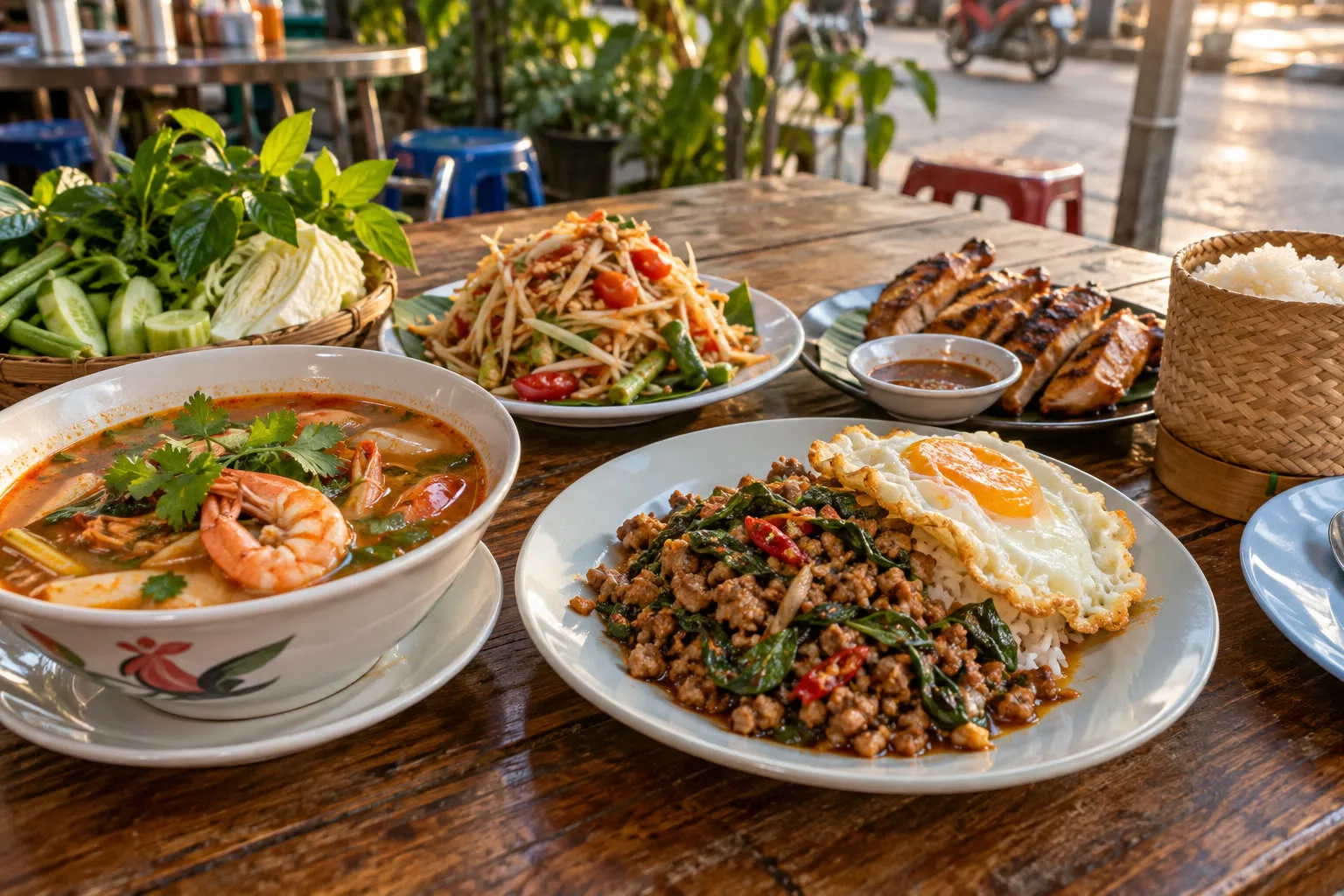
Thai cooking is often discussed through five recurring tastes: hot, sour, sweet, salty and bitter. They do not have to appear with equal strength in every dish. What matters is how the cook uses contrast, aroma, texture and temperature to give a dish its own balance.
Food is an important part of travelling in Thailand, whether you are ordering from a market stall, a neighbourhood restaurant or a hotel dining room. This guide explains the ingredients, flavour structure, techniques and regional traditions that help you understand a Thai menu. Dish names and recipes vary between cooks and provinces, so treat the descriptions as a practical orientation rather than a single official definition.
Why Thai cuisine is unique

Thai food makes an impression from the very first aroma. Bangkok street stalls serve pad thai in just a few minutes, while small restaurants in the north have been simmering khao soi since early morning. But speed and exoticism are not the whole story: the character of Thai cuisine is shaped by principles that take real knowledge and intuition to follow. The cook adjusts seasoning to the dish, the ingredients and the customer rather than following one universal formula.
The philosophy of flavour: balance above all
Thai cooks do not season by guesswork. They build every dish around the deliberate balancing of contrasts: heat from chilli tempered by the sweetness of palm sugar, lime acidity offset by the saltiness of fish sauce. If one element dominates too much, the whole plate loses its purpose. Thai food also reflects centuries of exchange within mainland Southeast Asia and with communities from China, India, the Malay world and elsewhere. Those influences were adapted locally rather than copied unchanged.
Thai cooking is not about making a dish taste “a little bit of everything”. It is about making every flavour exactly as strong as it should be.
In practice, this means the same recipe can taste completely different when prepared by two different people. An experienced cook can tell when a curry paste needs more lemongrass, or when the coconut milk needs to reduce for longer to achieve the right thickness and depth. That judgement develops through practice. Excellent food can be found in humble stalls and formal restaurants alike, so judge a place by freshness, preparation and care rather than price or décor alone.
Fresh ingredients as the foundation
Thai cuisine depends on daily access to fresh produce. At every market, even in a small town, you will find fresh makrut lime leaves, galangal, lemongrass, Thai basil and dozens of varieties of chilli. Vegetables and herbs are often bought in the morning for that same day. Freshness and local varieties help explain why a curry in Thailand may taste different from one made with imported substitutes elsewhere.
Fresh markets remain important to many households and food businesses. Herbs, vegetables, seafood and prepared curry pastes may arrive in small batches, although modern supermarkets and wholesale suppliers are also part of the food system. Cooks outside Thailand can make excellent Thai food, but ingredient varieties and freshness will influence the result.
Eating in Thailand lets you compare regional dishes, levels of seasoning and styles of service in their local context. It adds experience to what recipes and restaurant menus can teach you, without making one version the only authentic interpretation.
The five flavours and how to recognise them
When you are trying to understand Thai cuisine and its character, these five flavours are the best place to start. The point is not to include all five in every dish, but to ensure that none dominates without the cook making a deliberate choice. This goal is what makes Thai cooking so precise and so difficult to recreate outside Thailand.
Hot and sour: the two dominant poles
Heat comes mainly from fresh and dried chillies, of which dozens of varieties are used in Thailand. Small green bird’s eye chillies are among the hottest and most common; a single one can completely change the character of a dish. Heat in Thai food is not a background note; it is an active ingredient with a specific role. You feel it after a few seconds, rather than immediately.
Sourness is the other strong pole of Thai flavour. Its main sources are lime, both juice and zest, and tamarind, which adds a deeper, less sharp acidity than citrus. In northern dishes, you will also find fermented ingredients that bring a more complex kind of sourness. This flavour cuts through the richness of coconut milk and keeps curry from feeling heavy.
Heat catches your attention, but acidity gives Thai food its lightness and makes you want to eat more.
Sweet, salty and bitter: the notes that bring it all together
Sweetness comes mainly from palm sugar, which has a different profile from white sugar: it is less sharp, with a slight caramel note, and softens heat beautifully. Saltiness comes chiefly from fish sauce (nam pla), a foundation of most Thai dishes. It is not a substitute for salt, but a distinct ingredient with its own umami and depth, unlike anything you can get from a European product.
Bitter flavours are the least common and often surprise people who know Thai food only from restaurants abroad. You will find them in bitter melon (mara) and in some herbs and leafy vegetables, especially in northern cuisine. Bitterness is not accidental or a mistake; it acts as a counterpoint and gives the whole dish greater complexity.
Key ingredients and seasonings
To understand Thai cuisine and its character, it is worth starting with the ingredients, which create its distinctive flavour profile. The point is not exotic products that are hard to identify, but specific plants, sauces and pastes found in nearly every Thai dish that form a recognisable foundation of flavour.

An aromatic base: herbs and roots
Thai cooking starts with aromas. Lemongrass is one of the most important ingredients; its fresh, citrusy scent comes through in soups, curries and marinades. The lower part of the stalk is usually sliced or bruised to release its essential oils. Galangal is just as important. It looks much like ginger, but tastes quite different: more resinous and slightly peppery, with a citrus note.
Replacing galangal with ginger is not a technical mistake, but it will give you a completely different dish.
Makrut lime leaves are another ingredient that is difficult to replace. Their distinctive double-lobed shape is easy to recognise, and their intense citrus aroma has no equivalent among European herbs. Thai basil is stronger and more anise-like than European basil, and stands up better to high-heat cooking, so it is often added straight to the pan.
Sauces and pastes: the liquid heart of Thai flavour
Fish sauce (nam pla) is the salty foundation of most Thai dishes. It is made from fermented fish and has a complex umami flavour that ordinary salt or soy sauce cannot replace. It is used both in cooking and as a table seasoning. Shrimp paste (kapi) is another fermented ingredient with a strong, pungent smell; used sparingly, it adds depth to curries and soups.
Red, green and yellow curry pastes are blends of fresh ingredients ground together: chilli, garlic, shallots, lemongrass, galangal and shrimp paste. Each has different ingredients and a different level of heat. Green curry paste is coloured mainly by fresh green chillies and herbs, red paste generally uses dried red chillies, and many yellow curry pastes include turmeric. Heat varies by recipe, chilli and cook, so colour alone is not a reliable scale of spiciness. A good curry paste is the foundation on which the whole dish depends.

Cooking techniques and textures
The character of Thai cuisine is shaped not only by flavours and ingredients, but also by specific cooking methods that determine the final result on the plate. High heat and speed are two features of most Thai cooking techniques. Change either one and the dish becomes something else entirely.
The wok and quick, high-heat cooking
The wok is at the heart of Thai street cooking. It is used over very high heat, allowing ingredients to cook in a matter of seconds while retaining their texture and fresh flavour. The Cantonese term “wok hei” is often used in English-language food writing for the distinctive roasted aroma produced by skilled high-heat wok cooking. Thai cooks have their own vocabulary and techniques, so the borrowed term should not be treated as the Thai name for every stir-fry. It is hard to achieve in home kitchens because ordinary gas stoves do not generate enough heat.
Heat control, timing and the amount of food in the wok all affect aroma and texture.
Besides wok-frying, Thai cuisine also makes extensive use of steaming, especially for sticky rice (khao niao), fish and Chinese-inspired dim sum. Steaming retains the moisture and delicate texture of ingredients without adding fat, which is clear in dishes from central Thailand.
Texture as part of flavour
In Thai cooking, contrasts in texture matter as much as contrasts in flavour. A plate often combines something crunchy with something soft: roasted peanuts in pad thai, fried shallots on soup, or fresh bean sprouts added at the last moment. This is not decoration. It is a deliberate culinary choice.
Thai cooks also make sure sauces have the right consistency. Curry should be neither too thin nor too thick: coconut milk is reduced to the right consistency, rather than simply poured into a pot and heated. The difference between a well-made curry and an average one often comes down to this, rather than the choice of spices. If you want to understand the character of Thai cuisine from a technical perspective, start by watching how long the cook works the layer of oil and paste before adding the other ingredients.
Thailand’s regions and their culinary differences
Thailand is not one culinary country, but several. If you know Thai cuisine mainly from restaurants abroad or resort menus, you have seen only part of its regional range. Every region has its own ingredients, techniques and history, which help explain why the same word, “curry”, can mean something entirely different depending on where you are in the country.
The north and centre: two different approaches to the plate
Northern cuisine, centred on Chiang Mai and the mountain provinces, uses less coconut milk than the rest of the country. Sticky rice (khao niao) is more common here than fluffy steamed rice, and curry pastes are thicker and more herb-forward. The region’s signature dish is khao soi, a curry noodle soup with two textures: boiled and fried egg noodles. Burmese and Yunnanese influences from southern China are clear and distinctive.
Bangkok and the central plains, meanwhile, are what most of the world considers representative of “Thai cuisine”. Bangkok has absorbed cooks and culinary influences from across the country, so its menus offer a broad cross-section of central dishes and regional specialities. The centre is more cosmopolitan, with the greatest variety of available dishes of any region.
If you want to understand Thai cuisine, Bangkok is a good place to start, but it is not the end of the journey.
The south and Isaan: two bold regional traditions
Southern cuisine, including the areas around Phuket, Krabi and Hat Yai, is often associated with assertive heat, seafood and aromatic spice. Its proximity to Malaysia and strong Muslim influences mean more dishes with turmeric, less pork and far more seafood. Southern curries are thinner and spicier, with less coconut milk and more paste and fresh chillies than anywhere else.
Isaan in north-eastern Thailand shares culinary connections with Laos and uses toasted rice, fresh herbs, fermented seasonings, chilli and grilling to build distinctive flavours. Som tam, larb and grilled meat are local staples, and the intensity of flavour rivals the best dishes from the centre, despite being achieved with simpler means and without elaborate curry pastes. Isaan dishes are now widely available in Bangkok and other cities, while travelling in the north-east provides a broader view of their local variations.
Classic dishes and what to try
Now that you know the flavours, ingredients and regions, it is easier to understand why certain dishes have become symbols of Thai cuisine and its character. The aim is not to memorise a list of names, but to know what to look for on your plate and how to tell whether a dish has been prepared well or merely adapted for tourists.
Pad thai, tom yum and green curry: where to start
Pad thai is stir-fried rice noodles with egg, bean sprouts, spring onions and roasted peanuts. It sounds simple, but its quality depends on the wok temperature and the balance of the sauce. Good pad thai has a distinct smoky note, clear sweetness and acidity from the lime served on the side. The prawn version is the most popular, but the tofu version is just as good.
Tom yum is a broth-based soup with lemongrass, galangal, makrut lime leaves, chilli and fish sauce. Tom yum goong is made with prawns. Clear versions rely on the broth and aromatics, while creamy versions may use evaporated milk, coconut milk or chilli paste depending on the recipe and cook. Notice whether the soup has a clear acidity and whether the aromas are fresh rather than cooked for too long.
If you cannot smell lemongrass as soon as tom yum is served, something has gone wrong in the kitchen.
Green curry (gaeng khiao wan) shows how curry paste and coconut milk create a layered sauce when the paste is cooked carefully and the ingredients are added in the right order. It should be creamy, spicy and slightly sweet at the same time. It is served with jasmine rice, not bread.
What to try beyond the tourist menu
Beyond the classics, try dishes that rarely appear on restaurant menus outside Thailand. Larb, a salad of minced meat, toasted rice, fresh herbs and lime, is an Isaan dish that combines several textures and flavours on one plate. Khao soi from Chiang Mai, mentioned earlier, is a must-try in northern Thailand.
Som tam is green papaya pounded in a mortar with chilli and seasonings. Recipes vary: some include peanuts and dried shrimp, while others use fermented fish or salted crab. Order it at a heat level you can enjoy and mention allergies or dietary restrictions before preparation.
What to remember before your first bite
The character of Thai cuisine cannot be reduced to a single rule. Ingredients, technique, region, household tradition and the cook’s judgement all shape the final dish. Before you try your first dish in Thailand, you already know that chilli brings heat, fish sauce brings saltiness, lime and tamarind bring acidity, and palm sugar brings sweetness. That helps you read the plate instead of simply eating.
Start with a few dishes you recognise, then explore regional menus and ask what a restaurant prepares particularly well. If you have allergies, vegetarian requirements or limits on chilli, explain them clearly before ordering because fish sauce, shrimp paste, stock and pre-made curry paste may be present even when they are not obvious. Food can be part of a private Thailand itinerary, but the exact stops and inclusions must be confirmed for your group. AsiaTrip arranges tours for one existing closed private group of 4 to 20 guests. Unrelated customers are not combined. An individual quote is prepared in THB after the route and confirmed services are known. There is no public package price on this page.
For more, read the article Pad Thai: History and Ingredients.
No comments