

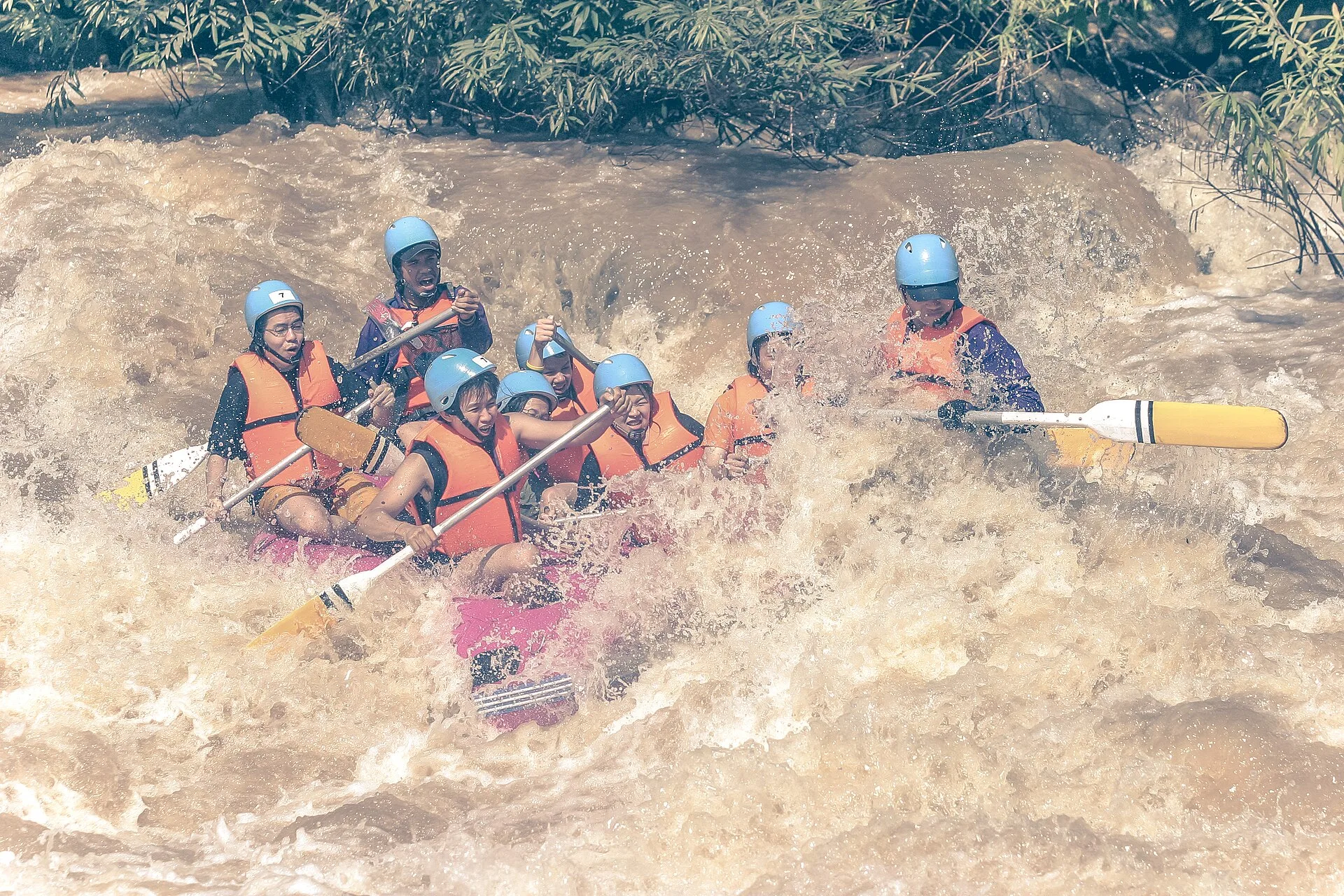
Rafting in Thailand can mean very different things. One operator may offer an easy paddle on a broad river, while another runs technical white water through a forested valley. Some listings use the word rafting for bamboo rafts or calm scenic floats. Before you book, identify the river, the section, the current conditions and the actual time on the water.
This guide explains the main rafting regions, how rainfall changes a trip, what to ask an operator and how to prepare. It does not assign a permanent difficulty grade to a river. Water level, weather, route choice and operating decisions can change the character of the same section from one day to the next.
A good rafting choice starts with the conditions on your date, not with the most dramatic photograph in the listing.
Is rafting in Thailand right for you?
A commercial rafting trip normally involves an inflatable raft, a guide, paddles, helmets and buoyancy aids. Guests work as a team and follow short commands from the guide. You do not need to be an athlete for every route, but you must be able to listen, move safely in the raft and tell the operator about anything that may affect your participation.
First-time rafters can enjoy a carefully selected route in suitable conditions. A stronger or more remote river demands more confidence, physical effort and planning. Age limits, swimming requirements, weight restrictions and health exclusions are set by the operator for the specific river and water level. Do not rely on a general promise that a trip is suitable for everyone.
White-water rafting, bamboo rafting and scenic floats
These activities are not interchangeable. White-water rafting uses an inflatable raft on moving water and may include rapids. Bamboo rafting is usually a slower local experience on a simple platform. A scenic river float may use a raft, kayak or tube on calmer water. Check photographs, equipment and the written route so that you know what is actually being sold.
Where to go rafting in Thailand
Thailand has rafting areas in the North, Central region and South. The best choice is usually the one that fits your wider itinerary and has appropriate conditions during your stay. Travelling across the country for a single activity rarely makes sense if a suitable alternative is closer.
| Region | Planning character | What to confirm |
|---|---|---|
| Mae Taeng, Chiang Mai | Popular northern base with forested river sections | Current section, water level, transfer time and actual rafting duration |
| Nakhon Nayok | Accessible option for travellers based in or near Bangkok | Seasonal operation, release and river conditions, route length and exit point |
| Khek River, Phitsanulok | Seasonal white-water destination with changing conditions | Local operating status, weather warning, section and participant requirements |
| Phang Nga | Convenient base for some visitors staying around Phuket or Khao Lak | How much of the programme is rafting and which other activities are included |
| Nam Wa, Nan | Remote routes that may require more time and logistical preparation | Trip length, remoteness, guide team, rescue plan and overnight arrangements |

Mae Taeng near Chiang Mai
Mae Taeng is one of the best-known rafting bases in northern Thailand. It works naturally with a Chiang Mai itinerary, and many programmes include road transport from the city. The attraction is the combination of river activity, wooded scenery and access from a major visitor hub.
Listings vary widely. One may focus on the river, while another bundles rafting with several unrelated activities. Ask which section will operate on your date, how long the raft is actually on the water and whether the itinerary changes when the level rises or falls. Do not treat a grade printed months earlier as a guarantee of current conditions.
Nakhon Nayok from the Bangkok region
Nakhon Nayok can be practical when you want an outdoor day without adding a domestic flight. The Tourism Authority of Thailand describes rafting routes on the Nakhon Nayok River and notes that operation is seasonal. Its visitor information refers to routes of different lengths and several road-access exit points.
Accessibility does not remove the need for checks. Confirm whether the river is operating, where the route starts and ends, and how the current level affects the trip. A day advertised as rafting may also devote substantial time to transfers, a waterfall or another stop.
Khek River in Phitsanulok
The Khek River is associated with seasonal white water in Phitsanulok Province. Official tourism information links rafting activity to the wetter part of the year, but the exact opening period and usable sections still depend on local conditions. Heavy rain can create powerful flow and can also make a trip unsafe.
This is not a route to choose from a generic national season chart. Ask for the local assessment on your date and check whether weather advisories affect Phitsanulok or the upstream catchment. A responsible cancellation or route change is a safety decision, not a service failure.
Phang Nga from Phuket or Khao Lak
Phang Nga appears in many southern adventure programmes and may be convenient from Phuket or Khao Lak. The important question is what proportion of the day is spent rafting. Some packages combine a short river section with transfers, a waterfall, an all-terrain vehicle, a zipline or other activities.
Read the complete itinerary and assess every included activity separately. A long list does not necessarily create a better day. If rafting is your priority, ask for the river name, route length, approximate time on the water and the plan if rain changes the conditions.
Nam Wa and remote routes in Nan
Nam Wa routes in Nan are better treated as remote adventure travel than as a casual add-on. Programmes can involve longer transport, limited access and, in some cases, multi-day logistics. That makes the guide team, communications and emergency arrangements especially important.
Do not assume that a remote trip is appropriate because you have completed an easy half-day excursion elsewhere. Ask what experience is expected, how equipment and food are carried, where the group can leave the river and how the operator responds if water or weather changes.
When is the rafting season in Thailand?
There is no single national rafting season. Thailand spans several weather regions, and each river responds differently to rainfall, releases and catchment conditions. More water can make a section runnable, but too much water can increase hazards, hide obstacles and remove safe margins.
The Tourism Authority of Thailand describes Nakhon Nayok rafting as a June to October activity and also associates the Khek River with the wetter months. Treat those descriptions as planning context, not a promise for a future date. The operator must still confirm the actual river level and whether the selected section is open.
Check the Thai Meteorological Department forecast and warnings shortly before travel. Pay attention to upstream rain, flash-flood warnings and local instructions, even when the weather at your hotel looks calm.
Why a wet-season label is not enough
A monthly average cannot show a sudden storm, an unusually dry period or a local closure. It also cannot tell you which section an operator will use. Ask for a fresh assessment, not a copied seasonal description. If the answer is vague, do not book solely because the photographs look exciting.
How to choose a rafting operator
Compare operators by the clarity of their answers. A well-run company should explain the route, participant requirements, equipment, briefing, guide team and cancellation policy. It should be willing to change or cancel a departure when conditions fall outside its operating limits.
- Identify the exact river and section. The province name alone is not enough.
- Ask for the current operating assessment. Confirm the water level, weather and any route change for your date.
- Check participant rules. Give accurate ages and disclose relevant medical, mobility or swimming concerns.
- Confirm the equipment. Every participant should receive a correctly fitted buoyancy aid and helmet suited to the trip.
- Ask about guides and rescue cover. Clarify who leads the raft, how the team communicates and what the emergency plan covers.
- Check the real rafting time. Separate time on the water from transfers, meals and optional activities.
- Read the cancellation terms. Safety-related changes should be explained before payment.
The International Rafting Federation maintains a Guide Training and Education system intended to support common safety standards. Its guide training overview is useful context, but a website badge alone does not prove the competence of the person assigned to your trip. Ask the operator directly about the guide team for your departure.
Questions worth sending before you book
- Which river section will you use on my date?
- What conditions would make you change or cancel the trip?
- What are the age, health, swimming and experience requirements?
- How many guests and guides are in each raft?
- Are helmets and buoyancy aids provided in suitable sizes?
- How long is the group actually on the water?
- What transport, meal, insurance and photographs are included?
- Are any other activities included, and can they be declined?
Safety before and during the trip
Arrive sober, rested and ready to listen. Do not hide an injury or health concern to avoid missing the trip. The operator needs accurate information to decide whether the route and conditions are suitable. If you do not understand the briefing, ask for it to be repeated in a language you can follow.
Put on the helmet and buoyancy aid as instructed and ask for a refit if either feels loose. Keep footwear secured to your feet. Follow the guide’s commands and the rescue procedure explained at the river. General advice found online cannot replace the briefing for that section and water level.
Children need a route, equipment and operating rule appropriate to them. A general family label is not evidence that every child can participate. Obtain the minimum age or size rule in writing and describe the child’s swimming confidence honestly.
When to step back
Do not continue if the operator skips the safety briefing, provides damaged or badly fitting equipment, appears unwilling to discuss the weather, or pressures you to ignore a medical or age restriction. The same applies if the route advertised and the route described on site do not match.
What to wear and bring
- Quick-drying clothing: choose clothing that allows movement and remains comfortable when wet.
- Secure footwear: use water shoes or sports footwear that cannot float away. Avoid loose flip-flops.
- Dry change of clothes: keep it in the operator’s designated dry storage or vehicle.
- Sun protection: use suitable sunscreen and follow local guidance for the river environment.
- Necessary medication: tell the guide where it is stored and how it should be used in an emergency.
- Minimal valuables: leave passports, jewellery and unnecessary electronics in secure storage.
A phone case is not a guarantee against loss. Ask whether personal devices are allowed in the raft and whether the operator provides photographs. Never attach equipment to your body in a way that could create an entanglement hazard.
How to compare the total itinerary
Compare the complete day, not just the headline. Note the pickup area, road time, river time, meal, changing facilities and return time. If a programme contains several activities, decide which ones matter to you and whether each has its own safety briefing and insurance terms.
Do not assume that the cheapest or longest listing gives the best value. A shorter trip with a clear route, appropriate equipment and an experienced team may be a better choice than an overloaded day with little time on the water. Prices and inclusions change, so request a current written quotation rather than relying on an old screenshot.
Frequently asked questions
Can a beginner go rafting in Thailand?
Yes, on a section and in conditions selected for beginners. Tell the operator that it is your first trip and ask how the route will be adapted if the water changes. Do not choose solely by a standard grade copied into a listing.
Do I need to be able to swim?
Requirements vary. A buoyancy aid is essential, but it does not remove the need to disclose limited swimming ability or fear of moving water. The operator must decide whether the route and rescue arrangements are suitable.
Is rafting safe during the rainy season?
Some rivers operate mainly during wetter months, but heavy rain can also cause unsafe flow, flash floods or closures. Check current forecasts, local warnings and the operator’s same-day decision.
Can children join?
Only when the operator accepts the child’s age and size for the specific route and conditions, and suitable equipment is available. Ask before booking and do not assume that a general family description applies to every departure.
Is rafting included in every AsiaTrip itinerary?
No. Availability, route, operator and conditions must be confirmed for the requested date. It should not be added automatically to a plan if the group, weather or location makes it unsuitable.
Plan a private trip with AsiaTrip
AsiaTrip arranges private itineraries for one closed group of 4 to 20 guests, without combining unrelated customers. Each route and quote is prepared individually in THB after the scope is confirmed. There is no public EN price list.
Tell us your dates, base, group size, ages and rafting experience. We can then check whether rafting fits the wider route and request current information for the relevant region. Start with the trip planner, browse private tours in Thailand, or contact AsiaTrip.
For current destination and safety context, consult the Tourism Authority of Thailand page for Nakhon Nayok rafting, its information on the Khek River area, the Thai Meteorological Department and the International Rafting Federation. Recheck conditions for your date.
No comments