

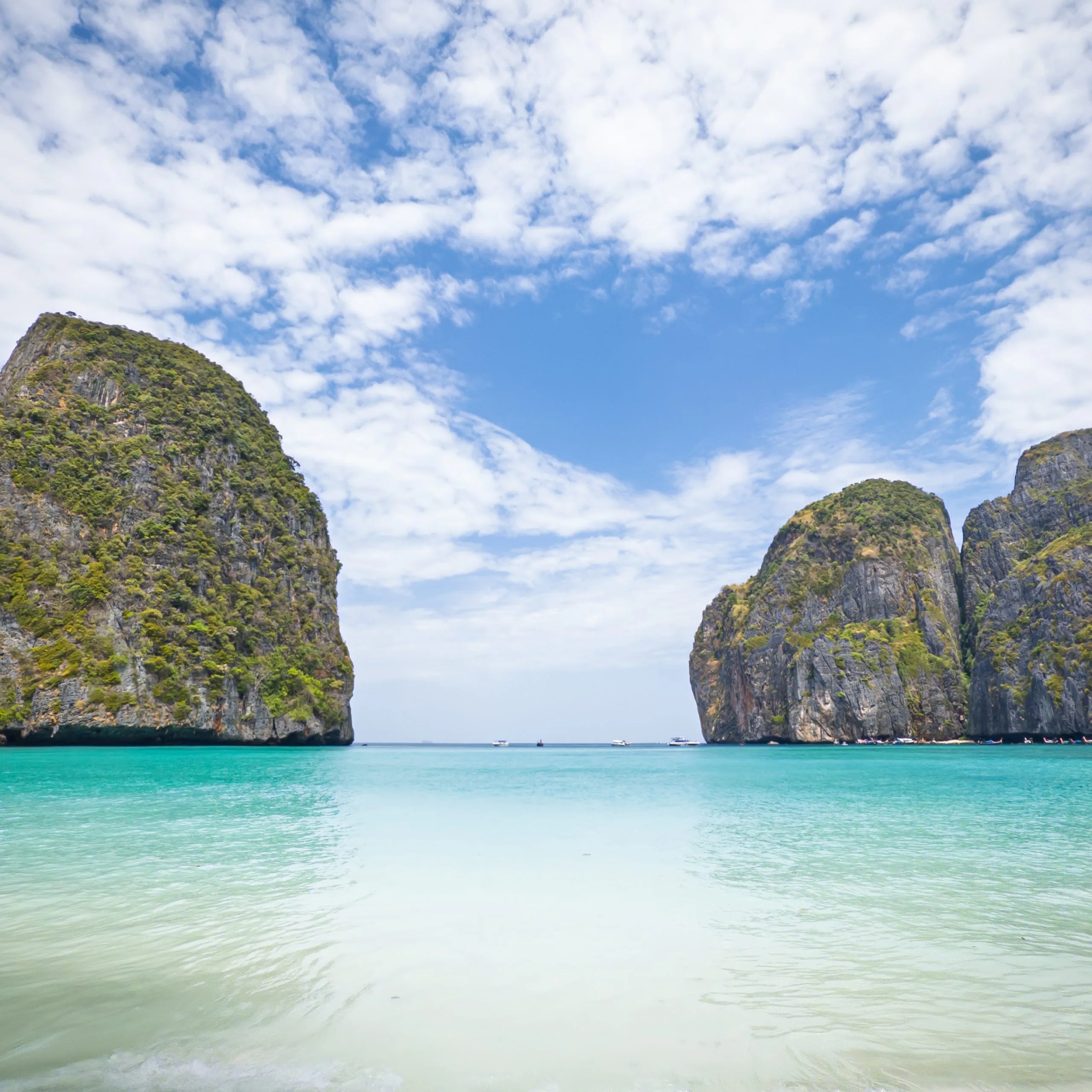
Maya Bay is one of Thailand’s most recognisable coastal landscapes, but visiting it is not the same as planning an ordinary beach day. The bay lies on Phi Phi Leh inside Hat Noppharat Thara-Mu Ko Phi Phi National Park, and access is managed to protect the beach, shallow water and marine life.
A good visit begins with realistic expectations. You arrive by boat, normally use the landing at Loh Samah Bay, follow the park route to the beach and spend a limited time inside the managed area. Swimming in the main bay is restricted, boats do not pull up on the famous beach, and seasonal or weather-related closures can change the plan.
This guide explains the current access model, the best starting points, how to compare boat trips, what to pack and how to combine Maya Bay with other stops around Phi Phi Leh. Always check the latest park notice shortly before travelling because conditions and operating rules can change.
What Maya Bay is and why access is controlled
Maya Bay sits on the uninhabited island of Phi Phi Leh, south of Phi Phi Don. High limestone cliffs enclose a curved beach and shallow turquoise water. The setting became internationally famous through the film The Beach, although the bay’s ecological importance is more relevant to the way it is managed today.
The Tourism Authority of Thailand overview of Ko Phi Phi places Phi Phi Leh and Maya Bay within the national park and identifies the wider archipelago as an important marine destination. This means the bay is a protected natural site, not a privately operated beach attraction.
Visitor controls were introduced after heavy tourism pressure damaged the area. The present route keeps tour boats away from the beach frontage and channels visitors through a defined entrance. Staff may limit movement, close sections or change landing arrangements when conservation or safety requires it.
Why swimming is restricted
The shallow water close to the beach is part of a recovering ecosystem. Blacktip reef sharks use the bay, and young sharks are often visible near the shoreline. Visitors should remain behind the permitted boundary and follow instructions from park staff. Seeing a shark from the beach is not a reason to enter the water or disturb it for a photograph.
In September 2026, Thailand’s Department of National Parks reported more than 200 blacktip reef sharks during the seasonal closure, with a peak observation of 278 animals. The DNP report on Maya Bay’s recovery described the annual rest period as important for the ecosystem and visitor safety during the south-west monsoon.
Plan Maya Bay as a short visit to a protected landscape. The value is in seeing the bay responsibly, not in trying to turn it into an unrestricted swimming stop.
Is Maya Bay open now?
Access is seasonal and can also be affected by wind, waves, maintenance or conservation decisions. For the 2026 season, DNP stated that Maya Bay was closed from 1 August to 30 September. On 15 October 2026, DNP announced the opening of the Andaman marine tourism season and listed Maya Bay among the principal attractions of Hat Noppharat Thara-Mu Ko Phi Phi National Park.
These dates describe the official 2026 position, not a permanent guarantee for every future year. Before booking, check a current DNP or national park notice and ask the operator to confirm that landing at Loh Samah Bay is permitted on your chosen day. A sales page or old blog post is not sufficient evidence of current access.
Even when the park is open, a captain may alter or cancel a trip if sea conditions make the landing unsafe. That is a safety decision, not necessarily a service failure. A responsible operator should explain the alternative route and what happens to any park fee or optional stop.
How a visit to Maya Bay normally works
Boats generally approach Phi Phi Leh and use the floating landing at Loh Samah Bay on the opposite side of the island. From there, visitors walk along a short managed path to Maya Bay. The route may involve a moving pontoon, steps and queues, so it is not completely barrier-free.
- Confirm the park status. Check the current opening notice and weather before leaving your hotel.
- Travel to Phi Phi Leh. Journey time depends on the departure point, boat type and sea state.
- Disembark at Loh Samah Bay. Follow the crew’s instructions and keep your life jacket on until told otherwise.
- Walk to Maya Bay. Stay on the marked route and allow extra time if the landing is busy.
- Follow the beach rules. Respect barriers, swimming restrictions and the time stated by park staff.
- Return to the boat. Continue only to stops that are safe and confirmed for that day.
The beach portion is commonly a short part of a wider Phi Phi itinerary. Do not expect several hours of sunbathing. The exact time allowed inside the managed area can change, and a queue at the landing can reduce the time available on the sand.
Where to start: Phi Phi Don, Phuket, Krabi or Ao Nang
Your starting point shapes the length and pace of the day. Staying on Phi Phi Don gives the shortest transfer and the greatest flexibility over departure time. Phuket, Krabi and Ao Nang provide many day-trip choices, but the journey is longer and more exposed to changes in sea conditions.
| Starting point | Best suited to | Main advantage | Main limitation |
|---|---|---|---|
| Phi Phi Don | Travellers staying in the Phi Phi Islands | Shortest boat transfer and easier early departure | Requires an overnight stay or separate ferry transfer |
| Phuket | Visitors based on Phuket who want a full-day trip | Wide choice of operators and hotel-transfer options | Longer day, with more time in open water |
| Krabi or Ao Nang | Visitors staying on the Krabi mainland | Convenient access to the Andaman islands | Schedule remains dependent on weather and operator routing |
| Koh Lanta | Travellers already staying further south | Can fit into a wider island itinerary | Longer transfer and fewer suitable daily departures |
When Phi Phi Don is the most practical base
An overnight stay on Phi Phi Don can make an early start easier and reduce time spent travelling. It does not guarantee an empty beach. Other boats may have the same idea, park opening times still apply and the crew cannot bypass official controls.
A mainland departure may be more convenient if you do not want to change hotels. Compare the total day, not only the advertised time at Maya Bay. Hotel pickup, pier check-in, boat transfer and the return journey can turn a short beach visit into a long excursion.
Choosing the right boat and itinerary
Boat type affects comfort, speed and flexibility. A speedboat is useful for longer crossings from Phuket or Krabi, while a longtail boat is commonly used for shorter local routes from Phi Phi Don. Neither option is automatically better in every sea state.
Ask for the actual passenger capacity, planned departure time, life-jacket provision and cancellation policy. Also confirm whether the route is private for your group or shared with unrelated passengers. A small-looking boat does not by itself prove that the trip is private.
Questions to ask before booking
- Which pier and island does the trip depart from?
- Is the boat private for one closed group or shared?
- Which stops are planned, and which depend on sea conditions?
- Are national park admission charges included in the written quote?
- What happens if Maya Bay is closed or the Loh Samah landing is unsafe?
- Are suitable life jackets available for every adult and child?
- How is the return journey handled if weather deteriorates?
Do not choose only by the number of stops. A route that promises Maya Bay, Pileh Lagoon, Viking Cave, several snorkelling sites and distant islands in a short window may leave very little time at each place. A shorter, realistic plan is usually more comfortable.
What to combine with Maya Bay
Pileh Lagoon is a natural companion to Maya Bay because both are on Phi Phi Leh. Swimming may be possible in the lagoon when the captain and local rules allow it. Viking Cave is usually viewed from the boat. Entry is not part of a normal sightseeing itinerary.
Snorkelling locations should be chosen according to visibility, currents and boat traffic on the day. The crew should decide whether a site is suitable. Do not enter the water simply because it appeared on a printed itinerary.
Bamboo Island lies elsewhere in the national park and adds travel time. It may suit a full-day route, but it is not automatically a sensible addition to every Maya Bay visit. Monkey Beach also requires caution. Macaques are wild animals, and feeding or approaching them can lead to bites and other harm.
Best time of day and seasonal conditions
Morning departures often offer cooler temperatures and may reduce crowding, especially from Phi Phi Don. They do not guarantee calm water or an empty beach. Tide, wind and the number of permitted boats all affect the experience.
The Tourism Authority of Thailand identifies November to April as the generally more settled period for the Phi Phi Islands. This is also a popular travel season, so piers and managed attractions can be busy. The wetter months may bring lower visitor numbers but less predictable sea conditions.
Why the weather forecast is not enough
A dry forecast on land does not confirm a comfortable boat journey. Wind direction, wave height and conditions at the floating pier matter. Follow the captain’s safety decision and do not pressure the crew to attempt a landing after it has been judged unsuitable.
The best itinerary is the one that remains safe and realistic on the day. A fixed checklist of attractions should never override the sea state or park instructions.
Rules and responsible behaviour at Maya Bay
The exact signs and instructions at the entrance take priority over any online guide. The following principles are consistent with visiting a protected marine area and should be treated as minimum standards.
- Stay on marked paths and behind all beach or water boundaries.
- Do not swim, wade beyond the permitted line or chase marine animals.
- Do not feed fish, sharks, monkeys or other wildlife.
- Do not remove sand, shells, coral, plants or any natural material.
- Take all rubbish back with you and avoid single-use items where practical.
- Do not fly a drone without the permissions required by the park and aviation authorities.
- Follow staff instructions promptly, including any limit on time or access.
Reef-safe behaviour also matters at snorkelling stops outside the bay. Keep fins away from coral, use mooring buoys instead of anchoring on a reef and avoid standing on marine life. Sunscreen claims vary, so physical protection such as a UV shirt is a useful first choice.
What to pack for the boat trip
Pack lightly. Bring drinking water, a hat, sunglasses, a UV shirt, a quick-drying towel and a waterproof pouch for electronics. Use secure footwear for wet piers and the walking route. Loose flip-flops can be awkward on a moving pontoon.
Carry any personal medication you may need, including suitable motion-sickness treatment if advised for you. Take it according to professional instructions before the crossing, not after symptoms become severe. People who are pregnant or who have back, heart or mobility concerns should seek appropriate advice and discuss the boat conditions before booking.
Travelling with children
Confirm that the operator has a correctly sized life jacket for every child. An adult should supervise each child during boarding, throughout the crossing and at the floating pier. A shorter route from Phi Phi Don may be easier than a long mainland day trip, but suitability depends on the child’s age, experience and the sea state.
FAQ about visiting Maya Bay
Can you swim at Maya Bay?
Do not plan to swim in the main bay. Follow the boundary and the instructions displayed by park staff. Swimming or snorkelling may be possible at other confirmed stops if conditions are safe.
Is Maya Bay open throughout the year?
No date should be assumed permanently. DNP closed the bay from 1 August to 30 September in 2026, and weather or conservation needs can cause additional changes. Check the current notice before booking and again shortly before departure.
How long does the visit take?
The managed beach visit is normally one short part of the trip. The full excursion can take half a day or a full day depending on the starting point, boat and confirmed route. Use the operator’s written itinerary for the actual timing.
What is the easiest starting point?
Phi Phi Don usually provides the shortest boat transfer. Phuket, Krabi and Ao Nang may be more convenient if you prefer to keep one hotel base, but they create a longer day.
Is a private boat worthwhile?
A private arrangement can give one group more control over pacing and compatible stops, but it cannot override park hours, visitor controls or weather decisions. Confirm exactly what is private and what is included in writing.
Are park fees included?
Inclusions vary. Ask whether national park admission, pier charges, transfers, equipment and meals are included. Fees can change, so rely on the written proposal rather than an old online price.
Is the route accessible for limited mobility?
The boat, moving pontoon and walking route may present significant barriers. Ask the operator and park about current arrangements before travelling. Do not assume that assistance or step-free access will be available.
Planning Maya Bay with AsiaTrip
AsiaTrip prepares English-language itineraries only for one private closed group of 4 to 20 guests. Unrelated customers are not combined. Every proposal is quoted individually in THB, and there is no public EN price list.
The written proposal must state the departure point, transport, planned stops, park-fee treatment and any other included service. Maya Bay access, sea conditions and availability are not confirmed until they are verified for the requested date.
To discuss an itinerary, compare the private day-tour options and private multi-day tours, or use the English contact page. The page’s WhatsApp button prepares an English message with the current article title and address.
No comments