

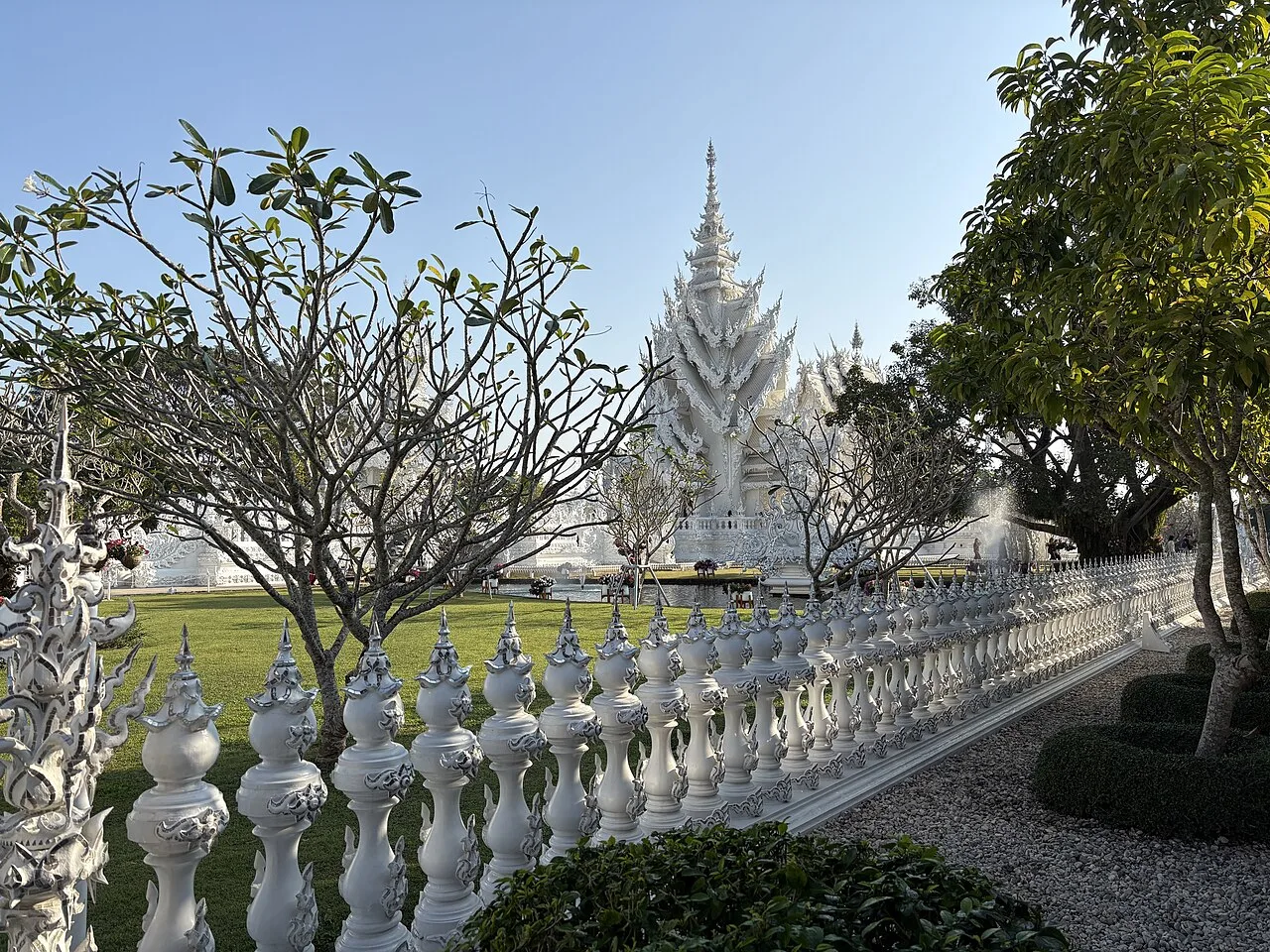
Chiang Rai White Temple is the name most visitors use for Wat Rong Khun, a contemporary Buddhist art complex in northern Thailand. Its brilliant white surfaces, mirrored details and unusual sculptures make it instantly recognisable, but the site is more than an elaborate background for photographs.
Wat Rong Khun stands in Pa O Don Chai, about 13 to 14 kilometres south of central Chiang Rai. It was designed and developed by Thai artist Chalermchai Kositpipat. The Tourism Authority of Thailand highlights it as one of Chiang Rai’s major cultural attractions and describes the white architecture as the artist’s work.
This guide explains what to look for, how the main symbols fit together, how much time to allow and how to organise the journey from Chiang Rai or Chiang Mai. Opening hours, admission arrangements and access to individual buildings can change, so confirm the current details shortly before travelling.
Chiang Rai White Temple beyond the tourist shorthand
Wat Rong Khun is not an ancient monument preserved unchanged over many centuries. It is a modern religious and artistic project whose official opening dates to the late 1990s. Work on the wider complex has continued, which is one reason older photographs do not always match what visitors see today.
The central white ubosot, or ordination hall, brings together Buddhist imagery, Lanna-inspired forms and contemporary visual references. From a distance, the building seems delicate and almost weightless. Up close, the details become more challenging: hands, faces, demons, flames and mirrored fragments sit beside the immaculate white architecture.
This contrast is deliberate. The route towards the ubosot moves from images of desire and suffering towards a space associated with purification and wisdom. Visitors do not need specialist knowledge to appreciate the building, but understanding this basic sequence makes the experience much richer.
Why is Wat Rong Khun white?
White is commonly explained as a reference to the purity of the Buddha, while the small mirrored pieces suggest wisdom and reflected light. The choice also separates Wat Rong Khun visually from the gold that dominates many Thai temples. The result is not a rejection of tradition, but an individual artistic interpretation of Buddhist ideas.
Light changes the appearance of the complex throughout the day. Direct sun makes the mirrored ornament sparkle, while softer morning light reveals more texture in the plasterwork. Cloudy weather reduces the glitter but can make the carved forms easier to photograph.
Wat Rong Khun works as architecture, religious space and visual narrative. The beauty attracts attention, while the symbols encourage visitors to look beyond the surface.
What to see at the White Temple in Chiang Rai
Do not stop after one photograph at the entrance. The approach to the ubosot is the best-known scene, but the gardens, side buildings, sculptures and exhibition spaces help explain the scale of the project. Walk slowly, follow the visitor route and respect any one-way sections or barriers.
| Part of the complex | What to notice | Suggested time |
|---|---|---|
| Hands before the bridge | The outstretched forms are associated with desire, attachment and the turmoil that precedes the spiritual path. | 5 to 10 minutes |
| Bridge to the ubosot | The crossing creates a visual passage from suffering towards purification. Keep moving if staff ask visitors not to stop. | 10 to 15 minutes |
| Main white ubosot | Look at the roofline, mirrored ornament and the changing relationship between traditional forms and modern imagery. | 20 to 30 minutes |
| Golden building | Its colour and material emphasis provide a deliberate contrast with the white religious structure. | 5 to 10 minutes |
| Art and exhibition areas | These spaces give more context for Chalermchai Kositpipat’s artistic language. Access may depend on the day’s arrangements. | 15 to 25 minutes |
| Gardens and side sculptures | Smaller details extend the themes of temptation, mortality, popular culture and moral choice. | 15 to 20 minutes |

Most visitors need about one to two hours. A quick stop may be enough for the main exterior, but it leaves little time for the gallery, side details or careful reading of the site. A longer visit is more useful for anyone interested in art, symbolism or photography.
The main approach and the bridge
The best-known view looks across the bridge towards the white ubosot. Before the bridge, hundreds of hands reach upwards from a sculpted pit. They are generally interpreted as human desire and attachment. The bridge then leads away from that turmoil towards the religious building.
The route can be busy and may operate in one direction. Take wide photographs before joining the flow, then follow local instructions. Do not climb on the sculptures, lean over barriers or hold up other visitors to create a staged shot.
How to visit Wat Rong Khun step by step
The right plan depends on where the day begins. From central Chiang Rai, the temple is a straightforward half-day stop. From Chiang Mai, it becomes part of a long road trip and should be planned with realistic transfer time.
- Check current visitor information: confirm opening hours, admission and any temporary restrictions through an official listing or the site itself.
- Leave enough travel time: allow for traffic and do not schedule the arrival close to the final admission time.
- Take exterior photographs first: the entrance view often becomes busier as the day progresses.
- Follow the symbolic route: observe the hands, bridge and approach before entering the main part of the complex.
- Read signs and follow staff directions: photography and access rules can differ between outdoor and indoor spaces.
- Explore the side areas: gardens, sculptures and exhibition spaces provide essential context for the main building.
- Keep the rest of the day realistic: choose one or two compatible Chiang Rai attractions instead of racing between distant stops.
From Chiang Rai city, a taxi, app-based ride, arranged driver or local public transport may be possible. Agree the fare and return arrangement before setting off when using a private vehicle. The site is south of the city on the route towards Chiang Mai, not in the city centre.
Arriving near opening time often gives more comfortable temperatures and a better chance of seeing the main approach before large groups arrive. This is a useful preference, not a guarantee of an empty site. Wat Rong Khun is a major attraction and can be busy on weekdays as well as weekends.
A day trip from Chiang Mai
Chiang Mai and Chiang Rai are separate cities, and the road journey normally takes several hours in each direction. A same-day trip is possible, but much of the day will be spent travelling. Before choosing it, compare the value of a long excursion with spending an additional night in Chiang Rai.
If you make the day trip, combine Wat Rong Khun with a small number of stops that form a logical route, such as Wat Rong Suea Ten, commonly called the Blue Temple, and Baan Dam Museum. Adding the Golden Triangle creates a much longer programme and may leave too little time at each place.
Practical tips before visiting Wat Rong Khun
Wat Rong Khun has the character of a contemporary art attraction, but it remains a religious site. Dress and behaviour should reflect that. Shoulders and knees should be covered, beachwear is inappropriate, and quiet conduct is expected in worship areas.
- Opening and admission: use the current Thai government tourism listing for Wat Rong Khun as a starting point, then verify any same-day changes. Old articles may show different hours or fees.
- Photography: exterior photography is widely possible, but signs and staff instructions determine what is allowed inside each building.
- Clothing: cover shoulders and knees and avoid clothing intended for the beach.
- Weather: bring drinking water, sun protection and rain protection appropriate to the forecast.
- Footwear: choose shoes that are easy to remove if required and comfortable for walking on outdoor paths.
- Accessibility: routes, steps and crowding may affect visitors with limited mobility. Confirm current access arrangements before travelling.
- Respectful conduct: do not touch artwork, cross barriers or block the route for photographs.
- Timing: allow at least one hour, with closer to two hours for a relaxed visit including side areas.
Official sources do not always update at the same moment, so avoid presenting an old screenshot as a guaranteed timetable. A flexible plan is especially important during public holidays, maintenance, special events or severe weather.
How to take better photographs
Begin with the wide frontal view before the main approach becomes crowded. A slightly off-centre position can reveal the layered roof and mirrored ornament without losing the symmetry of the building. Use a normal or short telephoto focal length for details rather than stepping across barriers.
Soft morning light usually keeps the white surfaces from losing detail. In bright midday sun, reduce exposure slightly and check highlights. After rain, reflections and deeper colour can be attractive, but paths may be slippery and the weather can change quickly.
Symbolism at the White Temple
The route through Wat Rong Khun is often read as a movement from desire and suffering towards purification. The hands before the bridge represent worldly cravings and attachment. Crossing the bridge suggests leaving them behind, while the white ubosot points towards a different moral and spiritual state.
Inside and around the complex, traditional Buddhist imagery appears beside references to modern technology, conflict, disaster and popular culture. The combination can be surprising, but that reaction is part of the work. The contemporary world is presented as complicated and unstable, while Buddhist teaching offers a framework for reflection.
The golden building provides another deliberate contrast. Gold is commonly associated here with the body, wealth and material desire, while white suggests spiritual purity. Interpretations can vary, so on-site explanations and the artist’s own materials should take priority over simplified captions copied online.
The first impression is visual, but the experience becomes more meaningful when the hands, bridge, colours and modern images are read as parts of one story.
Why does the complex evoke strong reactions?
Wat Rong Khun brings beauty and unease into the same space. Fine white ornament sits beside skulls, hands and unsettling figures. The abrupt contrast prevents the site from becoming only decorative. Some visitors find it inspiring, while others respond more strongly to the darker details.
Allow room for both reactions. The site does not need to be reduced to either a fairytale building or a collection of frightening sculptures. Its power comes from the relationship between the two.
Other Chiang Rai attractions to combine with Wat Rong Khun
Wat Rong Suea Ten, the Blue Temple, makes a strong visual companion to Wat Rong Khun. Its blue and gold interior creates a different atmosphere and helps demonstrate how varied contemporary temple design can be in Chiang Rai.
Baan Dam Museum, often called the Black House, is an art complex rather than a conventional temple. Its darker materials and collections provide another contrast with the White Temple. Because the sites lie in different parts of the city area, plan the route before setting off.
The Golden Triangle is much farther north. It can form part of a separate day or a carefully planned extended route, but adding it automatically to a short White Temple visit creates a rushed itinerary. Tea plantations and mountain viewpoints also deserve enough time rather than being treated as brief photo stops.
Best combinations for one day
For a comfortable day from Chiang Rai, choose Wat Rong Khun, the Blue Temple and Baan Dam, with time for lunch and travel between them. If your pace is slower, select only two. Families, photographers and visitors who want to read the exhibitions will usually benefit from fewer stops.
A route from Chiang Mai should be even more disciplined. The return drive is substantial, so do not promise yourself a full Chiang Rai programme after arriving late. An overnight stay gives much greater flexibility.
Is the White Temple worth the journey from Chiang Mai?
The answer depends on your interests and the time available. People who enjoy contemporary architecture, Thai art, photography and Buddhist symbolism are likely to find Wat Rong Khun memorable. Travellers who dislike long road days may prefer to visit Chiang Rai as an overnight destination.
If you have only two or three days in Chiang Mai, compare the journey with nearby options such as Doi Suthep, museums, markets or countryside trips. Wat Rong Khun is distinctive, but the excursion should not be presented as effortless. A good decision is based on travel time as well as the attraction itself.
Who will enjoy the visit most?
The complex suits travellers interested in visual culture, architecture and symbolic spaces. Photographers will find abundant detail, although crowd levels and access rules shape what is possible. Families can visit too, but some sculptures may feel dark or unsettling to younger children.
Visitors who mainly want a quiet historic temple may prefer a different site. Wat Rong Khun is active, contemporary and highly visited. Understanding that before arrival prevents disappointment.
Frequently asked questions about Chiang Rai White Temple
Where exactly is Wat Rong Khun?
Wat Rong Khun is in Pa O Don Chai, south of central Chiang Rai on the main route towards Chiang Mai. It is roughly 13 to 14 kilometres from the city centre. Travel time varies with the starting point, traffic and transport used.
How much time should I allow?
Allow at least one hour for the main exterior, bridge and central building. Around one and a half to two hours is more comfortable if you want to study the details, visit available exhibition areas and take photographs without rushing.
What should I wear?
Dress as you would for a Thai religious site. Cover shoulders and knees, avoid beachwear and be ready to remove footwear where signs require it. The artistic presentation does not remove the need for respectful clothing.
Can I take photographs?
Photography is possible in many outdoor areas. Restrictions can apply inside buildings or temporary exhibitions. Read the signs and follow staff instructions rather than relying on an old blog post or another visitor’s experience.
Is Wat Rong Khun suitable for children?
Children can visit, but parents should expect heat, walking and some unsettling imagery, including hands, skulls and demon-like figures. A shorter morning visit, water, sun protection and a simple route usually work best.
Planning summary
- Wat Rong Khun is a contemporary Buddhist art complex created by Chalermchai Kositpipat.
- It stands south of central Chiang Rai, not in the city centre.
- The hands, bridge and white ubosot form a symbolic route from desire towards purification.
- Allow one to two hours, depending on your interest in art, exhibitions and photography.
- Confirm current opening hours, admission and photography rules before travel.
- Dress respectfully and follow the visitor route and on-site instructions.
- Combine the temple with a small number of compatible Chiang Rai attractions.
- Treat a same-day journey from Chiang Mai as a long road trip, not a quick local excursion.
For related planning, read our guide to Chiang Mai tours and day-trip choices and our practical guide to travelling in Thailand. If a closed group of 4 to 20 guests wants a private northern Thailand itinerary, AsiaTrip can prepare an individual plan and quotation in THB without combining the group with unrelated travellers. Details can be discussed through the private itinerary enquiry page.
No comments